Larivière-Gauthier Guillaume, Thibodeau Alexandre, Letellier Ann, Yergeau Étienne, Fravalo Philippe
NSERC Industrial Research Chair in Meat-Safety (CRSV), Faculty of Veterinary Medicine, University of Montreal, Saint-Hyacinthe, QC, Canada.
Centre INRS-Institut Armand-Frappier, Institut National de la Recherche Scientifique, Université du Québec, Laval, QC, Canada.
Front Microbiol. 2017 Nov 10;8:2219. doi: 10.3389/fmicb.2017.02219. eCollection 2017.
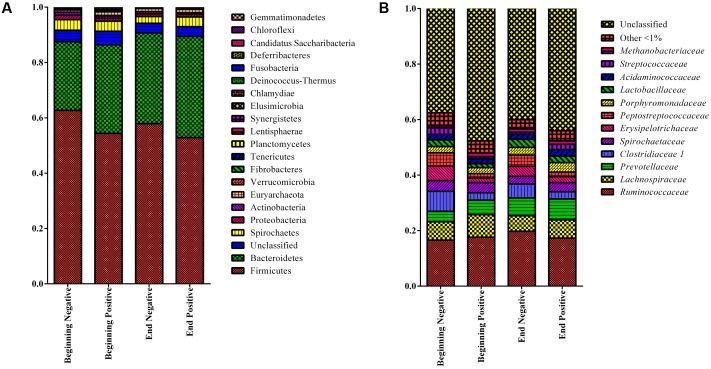
Pork meat is estimated to be responsible for 10-20% of human salmonellosis cases in Europe. Control strategies at the farm could reduce contamination at the slaughterhouse. One of the targeted sectors of production is maternity, where sows could be reservoirs. The aim of this study was to assess the dynamics of shedding of in terms of variation in both shedding prevalence and strains excreted during gestation in Quebec's maternity sector. The evolution of the fecal microbiota of these sows during gestation was also assessed to detect bacterial populations associated with these variations. A total of 73 sows both at the beginning and the end of the gestation were randomly selected and their fecal matter was analyzed. detection was conducted using a method that includes two selective enrichment media (MSRV and TBG). Nine isolates per positive samples were collected. Among the 73 sows tested, 27 were shedding . Sows in the first third of their gestation shed significantly more frequently (21/27) than those in the last third (6/46) (χ < 0.05). The shedding status of 19 of the sows that were previously sampled in the first third of their gestation was followed, this time in the last third of their gestation, which confirmed reduction of shedding. Using 16S rRNA gene sequencing and qPCR, significant differences between the fecal flora of sows at the beginning and the end of the gestation, shedding or not and with different parity number were detected. Using MaAsLin, multiple OTUs were found to be associated with the time of gestation, the status of excretion and parity number. Some of the identified taxa could be linked to the reduction of the shedding of at the end of gestation. In this study, we showed that the level of shedding was variable during gestation with significantly higher shedding at the beginning rather than at the end of gestation. We also observed for the first time a significant change in the microbiota during sow gestation and identified interesting taxa which could be linked to a reduced shedding.
据估计,在欧洲,猪肉导致了10%至20%的人类沙门氏菌病病例。养殖场的控制策略可以减少屠宰场的污染。生产的目标领域之一是产房,母猪可能是传染源。本研究的目的是根据魁北克省产房部门妊娠期间排菌率和排出菌株的变化,评估沙门氏菌的排菌动态。还评估了这些母猪妊娠期间粪便微生物群的演变,以检测与这些变化相关的细菌种群。在妊娠开始和结束时共随机选择了73头母猪,并对它们的粪便进行了分析。使用包括两种选择性富集培养基(MSRV和TBG)的方法进行沙门氏菌检测。每个阳性样本收集9个分离株。在测试的73头母猪中,27头正在排菌。妊娠前三分之一的母猪排菌频率(21/27)明显高于后三分之一的母猪(6/46)(χ<0.05)。对之前在妊娠前三分之一采样的19头母猪的排菌状况进行了跟踪,这次是在妊娠后三分之一,结果证实排菌减少。使用16S rRNA基因测序和qPCR,检测到妊娠开始和结束时、排菌与否以及不同胎次的母猪粪便菌群之间存在显著差异。使用MaAsLin,发现多个操作分类单元与妊娠时间、沙门氏菌排泄状况和胎次有关。一些已鉴定的分类群可能与妊娠末期沙门氏菌排菌减少有关。在本研究中,我们表明妊娠期间沙门氏菌的排菌水平是可变的,妊娠开始时的排菌量明显高于末期。我们还首次观察到母猪妊娠期间微生物群有显著变化,并鉴定出了可能与沙门氏菌排菌减少有关的有趣分类群。