Liu Cheng-Fei, Min Xiao-Yun, Wang Naiyin, Wang Jia-Xing, Ma Ning, Dong Xia, Zhang Bing, Wu Weiju, Li Zong-Fang, Zhou Wuding, Li Ke
Core Research Laboratory, The Second Affiliated Hospital, School of Medicine, Xi'an Jiaotong University, Xi'an, China.
Medical Research Council (MRC) Centre for Transplantation, King's College London, Guy's Hospital, London, United Kingdom.
Front Immunol. 2017 Nov 20;8:1602. doi: 10.3389/fimmu.2017.01602. eCollection 2017.
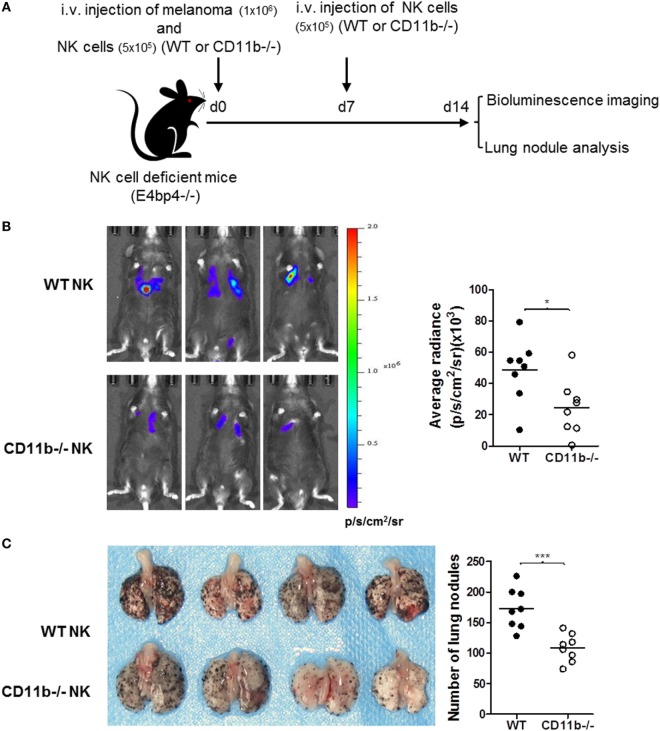
Complement receptor 3 (CR3) is expressed abundantly on natural killer (NK) cells; however, whether it plays roles in NK cell-dependent tumor surveillance is largely unknown. Here, we show that CR3 is an important negative regulator of NK cell function, which has negative impact on tumor surveillance. Mice deficient in CR3 (CD11b mice) exhibited a more activated NK phenotype and had enhanced NK-dependent tumor killing. In a B16-luc melanoma-induced lung tumor growth and metastasis model, mice deficient in CR3 had reduced tumor growth and metastases, compared with WT mice. In addition, adaptive transfer of NK cells lacking CR3 (into NK-deficient mice) mediated more efficient suppression of tumor growth and metastases, compared with the transfer of CR3 sufficient NK cells, suggesting that CR3 can impair tumor surveillance through suppression of NK cell function. analyses showed that engagement of CR3 with iC3b (classical CR3 ligand) on NK cells negatively regulated NK cell activity and effector functions (i.e. direct tumor cell killing, antibody-dependent NK-mediated tumor killing). Cell signaling analyses showed that iC3b stimulation caused activation of Src homology 2 domain-containing inositol-5-phosphatase-1 (SHIP-1) and JNK, and suppression of ERK in NK cells, supporting that iC3b mediates negative regulation of NK cell function through its effects on SHIP-1, JNK, and ERK signal transduction pathways. Thus, our findings demonstrate a previously unknown role for CR3 in dysregulation of NK-dependent tumor surveillance and suggest that the iC3b/CR3 signaling is a critical negative regulator of NK cell function and may represent a new target for preserving NK cell function in cancer patients and improving NK cell-based therapy.
补体受体3(CR3)在自然杀伤(NK)细胞上大量表达;然而,它是否在NK细胞依赖性肿瘤监视中发挥作用在很大程度上尚不清楚。在这里,我们表明CR3是NK细胞功能的重要负调节因子,对肿瘤监视有负面影响。CR3缺陷小鼠(CD11b小鼠)表现出更活化的NK表型,并且增强了NK依赖性肿瘤杀伤作用。在B16-荧光素酶黑色素瘤诱导的肺肿瘤生长和转移模型中,与野生型小鼠相比,CR3缺陷小鼠的肿瘤生长和转移减少。此外,与转导CR3充足的NK细胞相比,缺乏CR3的NK细胞(转导至NK缺陷小鼠体内)的适应性转移介导了对肿瘤生长和转移更有效的抑制,这表明CR3可通过抑制NK细胞功能来损害肿瘤监视。分析表明,NK细胞上的CR3与iC3b(经典CR3配体)结合会负调节NK细胞活性和效应功能(即直接肿瘤细胞杀伤、抗体依赖性NK介导的肿瘤杀伤)。细胞信号分析表明,iC3b刺激导致NK细胞中含Src同源2结构域的肌醇-5-磷酸酶-1(SHIP-1)和JNK激活,以及ERK抑制,支持iC3b通过其对SHIP-1、JNK和ERK信号转导途径的作用介导NK细胞功能的负调节。因此,我们的研究结果证明了CR3在NK依赖性肿瘤监视失调中以前未知的作用,并表明iC3b/CR3信号是NK细胞功能的关键负调节因子,可能代表了在癌症患者中保留NK细胞功能和改善基于NK细胞疗法的新靶点。