Chen Ying, Zhao Jing, Li Dengzhe, Hao Jinxia, He Pengcheng, Wang Huaiyu, Zhang Mei
Department of Hematology, The First Affiliated Hospital of Xi'an Jiao Tong University, Xi'an 710061, China.
Yonsei Med J. 2018 Jan;59(1):43-50. doi: 10.3349/ymj.2018.59.1.43.
Tripartite-motif-containing protein 56 (TRIM56) has been found to exhibit a broad antiviral activity, depending upon E3 ligase activity. Here, we attempted to evaluate the function of TRIM56 in multiple myeloma (MM) and its underlying molecular basis.
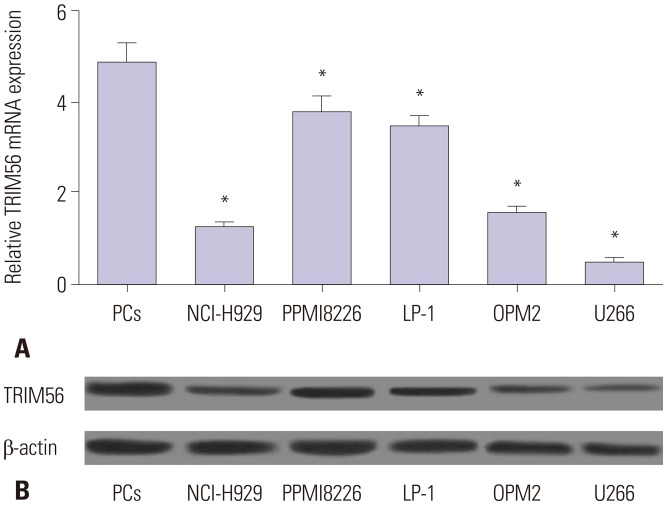
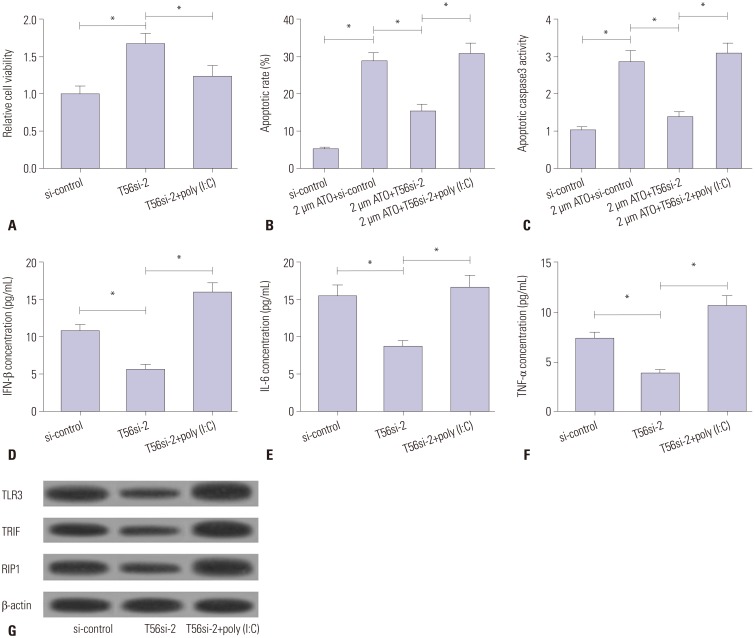
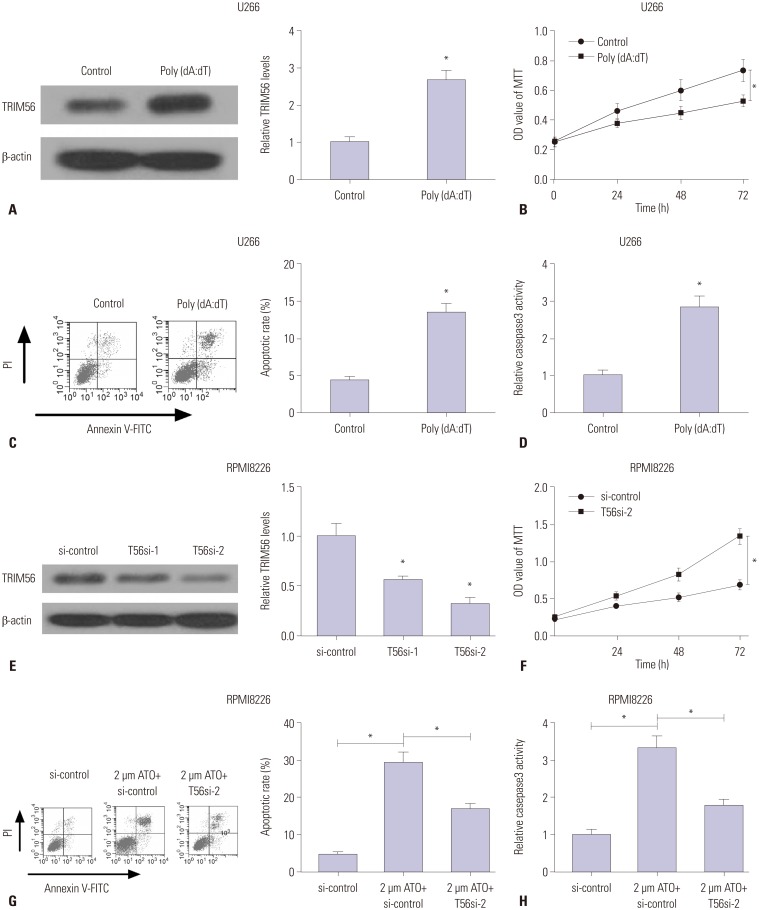
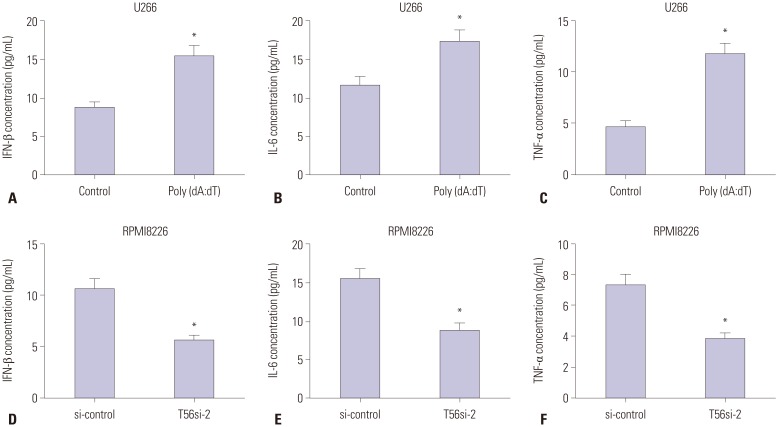
TRIM56 expression at the mRNA and protein level was measured by qRT PCR and western blot analysis. 3-(4,5-dimethylthiazol-2-yl)-2,5-diphenyltetrazolium bromide (MTT) and flow cytometry analysis was performed to investigate the effect of TRIM56 on MM cell proliferation and apoptosis. The concentrations of interferon (IFN)-β, interleukin (IL)-6, and tumor necrosis factor-α in MM cell culture supernatants were detected with respective commercial ELISA kits. Western blot was employed to determine the effect of TRIM56 on toll-like receptor 3 (TLR3)/toll-IL-1 receptor (TIR) domain-containing adaptor inducing IFN-β (TRIF) signaling pathway.
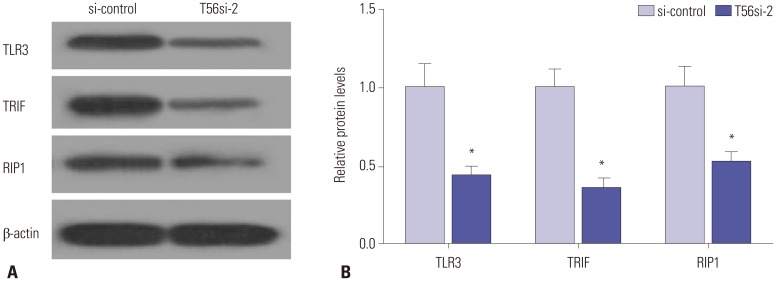
TRIM56 expression was prominently decreased in MM cells. Poly (dA:dT)-induced TRIM56 overexpression in U266 cells suppressed proliferation, induced apoptosis, and enhanced inflammatory cytokine production, while TRIM56 knockdown improved growth, diminished apoptosis, and inhibited inflammatory cytokine secretion in RPMI8226 cells. Moreover, TRIM56 knockdown blocked TLR3 signaling pathway. Furthermore, poly (I:C), a TLR3 agonist, markedly abolished TRIM56 depletion-induced increase of proliferation, decrease of apoptosis, and reduction of inflammatory factor in MM cells.
TRIM56 may act as a tumor suppressor in MM through activation of TLR3/TRIF signaling pathway, contributing to a better understanding of the molecular mechanism of TRIM56 involvement in MM pathogenesis and providing a promising therapy strategy for patients with MM.
已发现含三联基序蛋白56(TRIM56)具有广泛的抗病毒活性,这取决于E3连接酶活性。在此,我们试图评估TRIM56在多发性骨髓瘤(MM)中的功能及其潜在的分子基础。
通过qRT-PCR和蛋白质印迹分析检测TRIM56在mRNA和蛋白质水平的表达。进行3-(4,5-二甲基噻唑-2-基)-2,5-二苯基四氮唑溴盐(MTT)和流式细胞术分析,以研究TRIM56对MM细胞增殖和凋亡的影响。使用相应的商业ELISA试剂盒检测MM细胞培养上清液中干扰素(IFN)-β、白细胞介素(IL)-6和肿瘤坏死因子-α的浓度。采用蛋白质印迹法确定TRIM56对Toll样受体3(TLR3)/含Toll-IL-1受体(TIR)结构域的接头诱导IFN-β(TRIF)信号通路的影响。
MM细胞中TRIM56表达显著降低。聚(dA:dT)诱导U266细胞中TRIM56过表达可抑制增殖、诱导凋亡并增强炎性细胞因子产生,而TRIM56敲低则促进RPMI8226细胞生长、减少凋亡并抑制炎性细胞因子分泌。此外,TRIM56敲低阻断了TLR3信号通路。此外,TLR3激动剂聚(I:C)显著消除了TRIM56缺失诱导的MM细胞增殖增加、凋亡减少和炎性因子降低。
TRIM56可能通过激活TLR3/TRIF信号通路在MM中发挥肿瘤抑制作用,有助于更好地理解TRIM56参与MM发病机制的分子机制,并为MM患者提供有前景的治疗策略。