Department of Ecology and Ecosystem Modelling, Institute of Biochemistry and Biology, University of Potsdam, Maulbeerallee 2, 14469, Potsdam, Germany.
Sci Rep. 2017 Dec 7;7(1):17125. doi: 10.1038/s41598-017-17019-4.
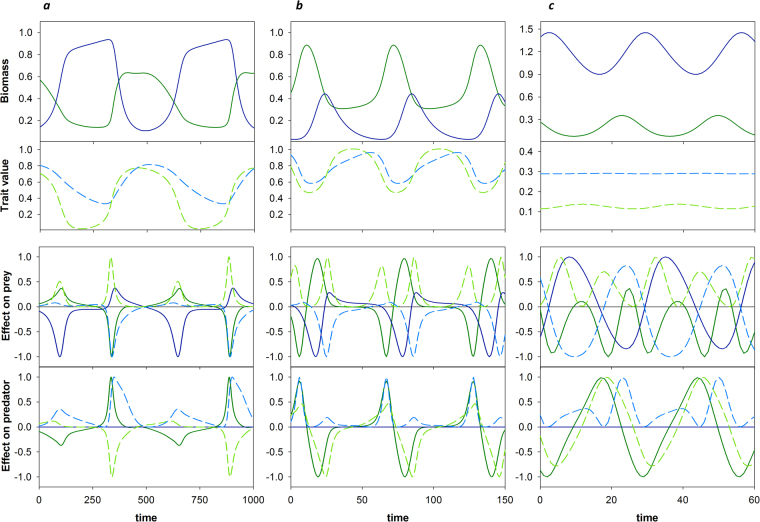
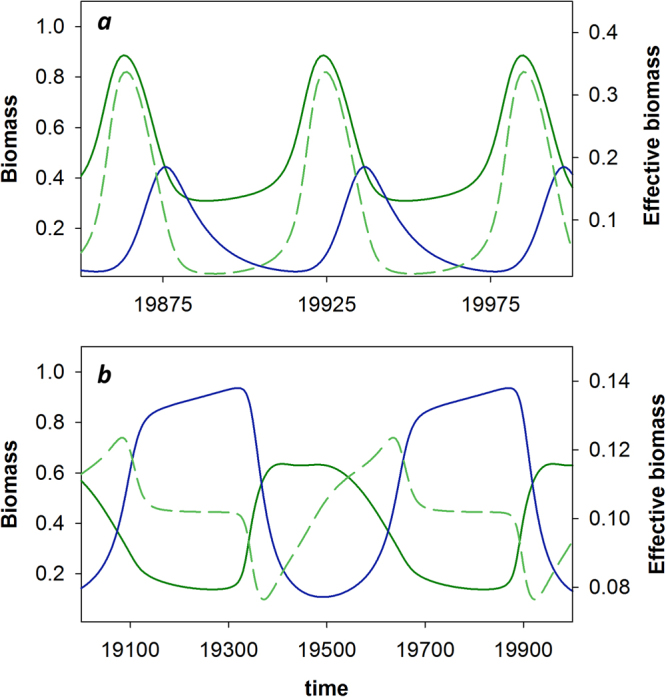
The impact of rapid predator-prey coevolution on predator-prey dynamics remains poorly understood, as previous modelling studies have given rise to contradictory conclusions and predictions. Interpreting and reconciling these contradictions has been challenging due to the inherent complexity of model dynamics, defying mathematical analysis and mechanistic understanding. We develop a new approach here, based on the Geber method for deconstructing eco-evolutionary dynamics, for gaining such understanding. We apply this approach to a co-evolutionary predator-prey model to disentangle the processes leading to either antiphase or ¼-lag cycles. Our analysis reveals how the predator-prey phase relationship is driven by the temporal synchronization between prey biomass and defense dynamics. We further show when and how prey biomass and trait dynamics become synchronized, resulting in antiphase cycles, allowing us to explain and reconcile previous modelling and empirical predictions. The successful application of our proposed approach provides an important step towards a comprehensive theory on eco-evolutionary feedbacks in predator-prey systems.
快速的捕食者-猎物共同进化对捕食者-猎物动态的影响仍未被充分理解,因为之前的模型研究得出了相互矛盾的结论和预测。由于模型动态的固有复杂性,解释和协调这些矛盾具有挑战性,这使得数学分析和机制理解变得困难。我们在这里开发了一种新方法,基于 Geber 方法来分解生态进化动态,以获得这种理解。我们将这种方法应用于一个共同进化的捕食者-猎物模型中,以分解导致反相或 1/4 滞后循环的过程。我们的分析揭示了捕食者-猎物的相位关系是如何由猎物生物量和防御动态之间的时间同步驱动的。我们进一步展示了何时以及如何使猎物生物量和特征动态同步,导致反相循环,使我们能够解释和协调以前的模型和经验预测。我们提出的方法的成功应用为捕食者-猎物系统中生态进化反馈的综合理论提供了重要的一步。