Department of Plant Biology, Michigan State University, 612 Wilson Road, Room 166, East Lansing, MI, 48824-1312, USA.
BMC Biol. 2017 Dec 7;15(1):118. doi: 10.1186/s12915-017-0458-3.
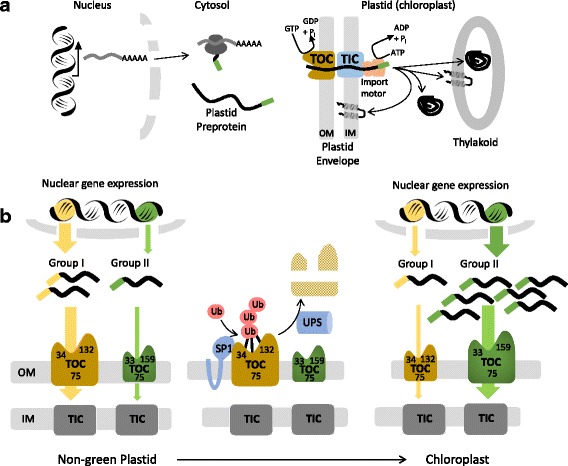
The plastids, including chloroplasts, are a group of interrelated organelles that confer photoautotrophic growth and the unique metabolic capabilities that are characteristic of plant systems. Plastid biogenesis relies on the expression, import, and assembly of thousands of nuclear encoded preproteins. Plastid proteomes undergo rapid remodeling in response to developmental and environmental signals to generate functionally distinct plastid types in specific cells and tissues. In this review, we will highlight the central role of the plastid protein import system in regulating and coordinating the import of functionally related sets of preproteins that are required for plastid-type transitions and maintenance.
质体,包括叶绿体,是一组相互关联的细胞器,赋予了植物系统特有的光合作用和独特的代谢能力。质体生物发生依赖于数千种核编码前体蛋白的表达、导入和组装。质体蛋白质组会响应发育和环境信号进行快速重塑,以在特定的细胞和组织中产生功能不同的质体类型。在这篇综述中,我们将强调质体蛋白导入系统在调节和协调功能相关的前体蛋白组导入中的核心作用,这些前体蛋白组是质体类型转变和维持所必需的。