Agroscope, Research Division Agroecology and Environment, Climate and Air Pollution Group, Zurich, Switzerland.
Department of Crop Sciences, Research Institute of Organic Agriculture (FiBL), Frick, Switzerland.
Int J Biometeorol. 2018 Apr;62(4):621-630. doi: 10.1007/s00484-017-1471-5. Epub 2017 Dec 7.
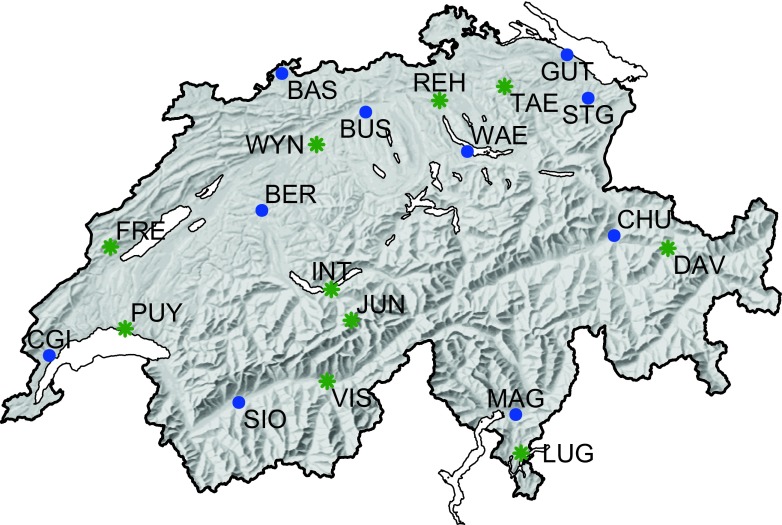
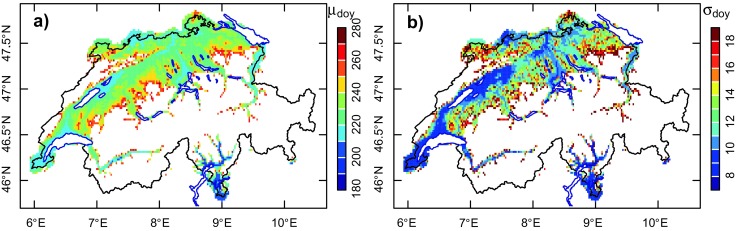
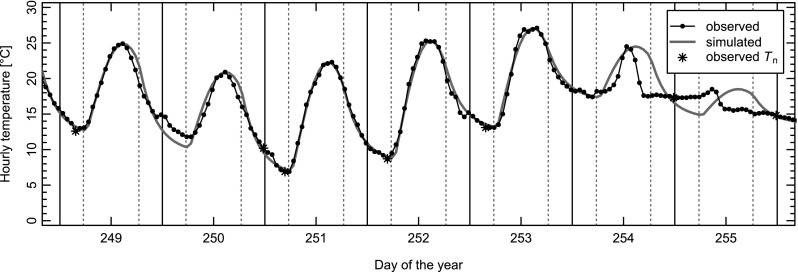
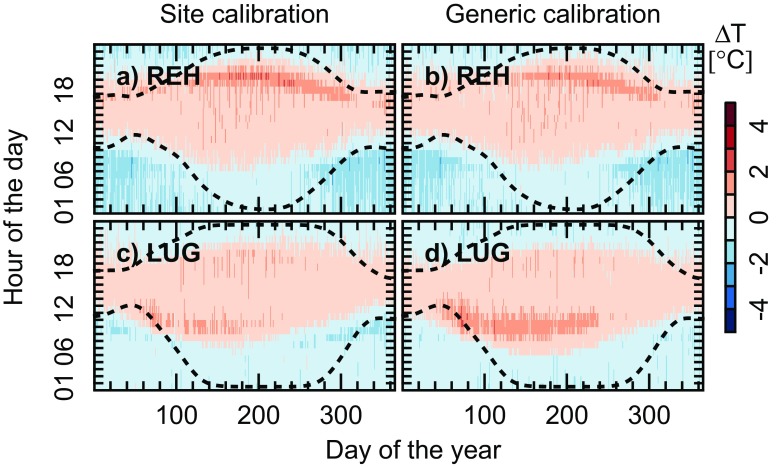
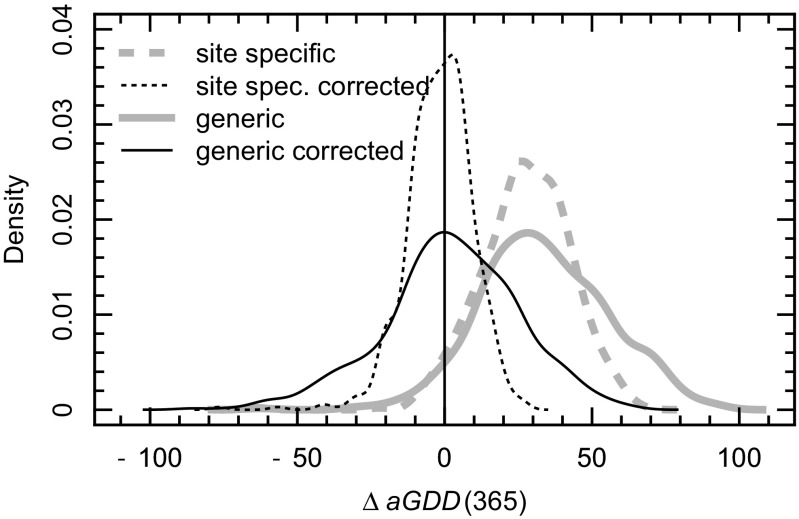
Accumulated growing degree-days (aGDD) are widely used to predict phenological stages of plants and insects. It has been shown in the past that the best predictive performance is obtained when aGDD are computed from hourly temperature data. As the latter are not always available, models of diurnal temperature changes are often employed to retrieve the required information from data of daily minimum and maximum temperatures. In this study, we examine the performance of a well-known model of hourly temperature variations in the context of a spatial assessment of aGDD. Specifically, we examine whether a generic calibration of such a temperature model is sufficient to infer in a reliable way spatial patterns of key phenological stages across the complex territory of Switzerland. Temperature data of a relatively small number of meteorological stations is used to obtain a generic model parameterization, which is first compared with site-specific calibrations. We show that, at the local scale, the predictive skill of the generic model does not significantly differ from that of the site-specific models. We then show that for aGDD up to 800 °C d (on a base temperature of 10 °C), phenological dates predicted with aGDD obtained from estimated hourly temperature data are within ± 3 days of dates estimated on the basis of observed hourly temperatures. This suggests the generic calibration of hourly temperature models is indeed a valid approach for pre-processing temperature data in regional studies of insect and plant phenology.
积温(aGDD)广泛用于预测植物和昆虫的物候阶段。过去的研究表明,使用小时温度数据计算 aGDD 可以获得最佳的预测性能。由于并非总是可以获得后者,因此通常采用日温度变化模型从每日最低和最高温度数据中检索所需信息。在这项研究中,我们在空间评估 aGDD 的背景下检查了一种著名的小时温度变化模型的性能。具体来说,我们检查了这种温度模型的通用校准是否足以可靠地推断瑞士复杂领土上关键物候阶段的空间模式。使用相对较少的气象站的温度数据来获得通用模型参数化,首先将其与特定地点的校准进行比较。我们表明,在局部尺度上,通用模型的预测技巧与特定地点的模型没有显著差异。然后我们表明,对于 800°Cd(以 10°C 为基础温度)的 aGDD,使用估计的小时温度数据获得的 aGDD 预测的物候日期与基于观测小时温度估计的日期相差±3 天以内。这表明,通用的小时温度模型校准确实是在昆虫和植物物候学的区域研究中预处理温度数据的有效方法。