McRackan Theodore R, Bauschard Michael, Hatch Jonathan L, Franko-Tobin Emily, Droghini Harris Richard, Velozo Craig A, Nguyen Shaun A, Dubno Judy R
Department of Otolaryngology-Head and Neck Surgery.
Division of Occupational Therapy, Medical University of South Carolina, Charleston, South Carolina.
Otol Neurotol. 2018 Jan;39(1):29-36. doi: 10.1097/MAO.0000000000001620.
Determine the change in general health-related quality of life (HRQOL) after cochlear implantation and association with speech recognition.
Meta-analysis.
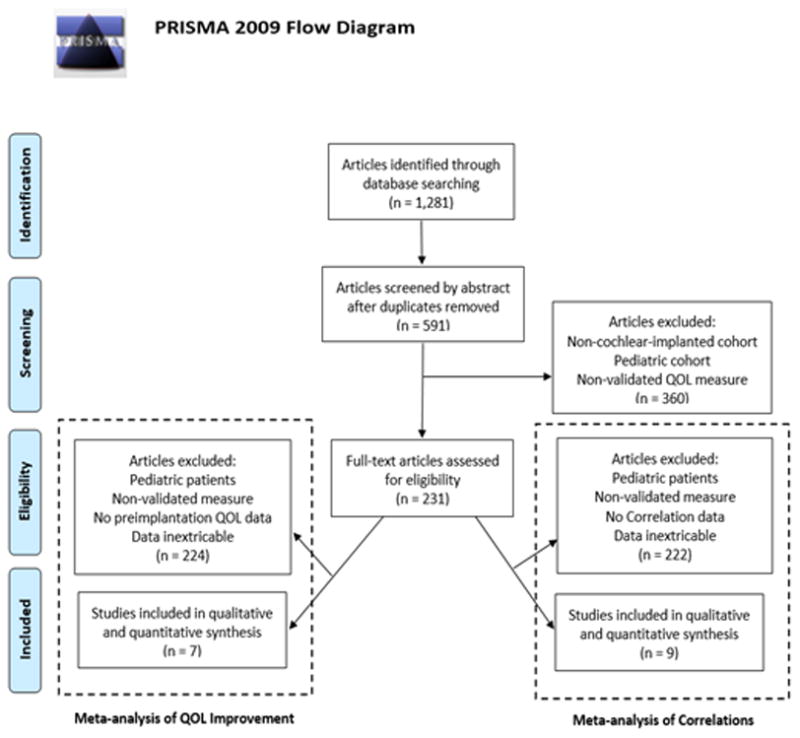
Search was performed following the PRISMA statement using PubMed, Medline, Scopus, and CINAHL. Studies on adult cochlear implant (CI) patients measuring HRQOL before and after cochlear implantation were included. Standardized mean difference (SMD) for each measure and pooled effects were determined. A meta-analysis of correlations was also performed between all non-disease-specific patient-reported outcome measures (PROMs) and speech recognition after cochlear implantation.
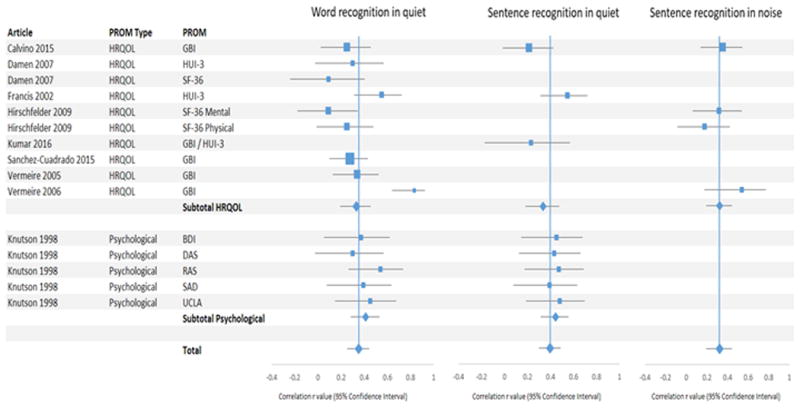
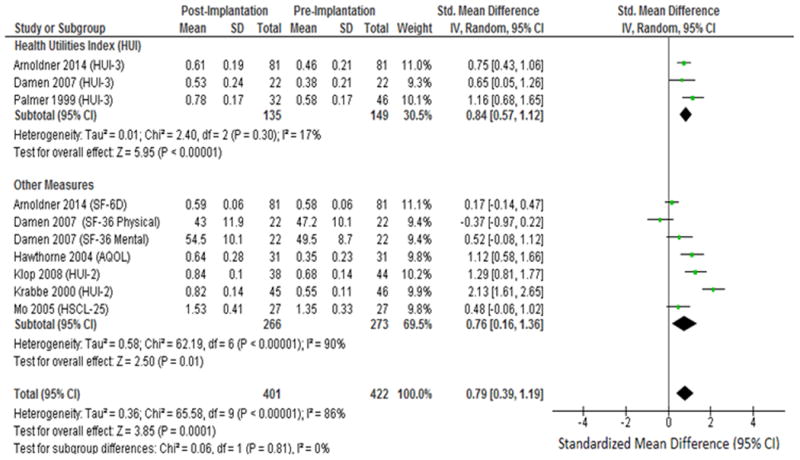
Twenty-two articles met criteria for meta-analysis of HRQOL improvement, but 15 (65%) were excluded due to incomplete statistical reporting. From the seven articles with 274 CI patients that met inclusion criteria, pooled analyses showed a medium positive effect of cochlear implantation on HRQOL (SMD = 0.79). Subset analysis of the HUI-3 measure showed a large effect (SMD = 0.84). Nine articles with 550 CI patients met inclusion criteria for meta-analysis of correlations between non-disease specific PROMs and speech recognition after cochlear implantation. Pooled analysis showed a low correlation between non-disease-specific PROMs and word recognition in quiet (r = 0.35), sentence recognition in quiet (r = 0.40), and sentence recognition in noise (r = 0.32).
Although regularly used, HRQOL measures are not intended to measure nor do they accurately reflect the complex difficulties facing CI patients. Only a medium positive effect of cochlear implantation on HRQOL was observed along with a low correlation between non-disease-specific PROMs and speech recognition. The use of such instruments in this population may underestimate the benefit of cochlear implantation.
确定人工耳蜗植入术后总体健康相关生活质量(HRQOL)的变化及其与言语识别的相关性。
荟萃分析。
按照PRISMA声明,使用PubMed、Medline、Scopus和CINAHL进行检索。纳入对成年人工耳蜗(CI)患者人工耳蜗植入前后HRQOL进行测量的研究。确定每项测量的标准化平均差(SMD)和合并效应。还对人工耳蜗植入后所有非疾病特异性患者报告结局指标(PROMs)与言语识别之间的相关性进行了荟萃分析。
22篇文章符合HRQOL改善荟萃分析的标准,但15篇(65%)因统计报告不完整而被排除。在符合纳入标准的7篇文章中的274例CI患者中,汇总分析显示人工耳蜗植入对HRQOL有中等程度的积极影响(SMD = 0.79)。HUI-3测量的亚组分析显示有较大影响(SMD = 0.84)。9篇文章中的550例CI患者符合人工耳蜗植入后非疾病特异性PROMs与言语识别相关性荟萃分析的纳入标准。汇总分析显示,非疾病特异性PROMs与安静环境下的单词识别(r = 0.35)、安静环境下的句子识别(r = 0.40)和噪声环境下的句子识别(r = 0.32)之间的相关性较低。
尽管HRQOL测量方法经常被使用,但它们并非旨在测量也不能准确反映CI患者面临的复杂困难。仅观察到人工耳蜗植入对HRQOL有中等程度的积极影响,且非疾病特异性PROMs与言语识别之间的相关性较低。在这一人群中使用此类工具可能会低估人工耳蜗植入的益处。