Martinez-Huedo Maria Angeles, Jiménez-García Rodrigo, Mora-Zamorano Eduardo, Hernández-Barrera Valentín, Villanueva-Martinez Manuel, Lopez-de-Andres Ana
Preventive Medicine and Public Health, Unidad de Docencia, Hospital Universitario La Paz, Comunidad de Madrid, Madrid, Spain.
Preventive Medicine and Public Health Teaching and Research Unit, Health Sciences Faculty, Rey Juan Carlos University, Avda. de Atenas s/n, 28922 Alcorcón, Madrid, Spain.
BMC Musculoskelet Disord. 2017 Dec 11;18(1):522. doi: 10.1186/s12891-017-1892-7.
Several studies have reported that diabetic persons have an increased risk for fractures than non-diabetes patients. The association between proximal humerus fractures and type 2 diabetes (T2DM) is unclear and some studies point to insulin treatment, hypoglycaemic episodes consequently to inadequate control of diabetes or, more recently, to an alteration of trabecular bone. We examined trends in the incidence of proximal humerus fractures, surgical procedures and outcomes among hospitalized patients aged ≥65 years, with and without T2DM in Spain, 2001-2013.
This retrospective, observational study was conducted using the Spanish National Hospital Discharge Database to select all hospital admissions with proximal humerus fracture. We calculated incidences overall and stratified by diabetes status, year and sex. We analyzed surgical procedures, comorbidities, length of stay, in-hospital complications and in-hospital mortality.
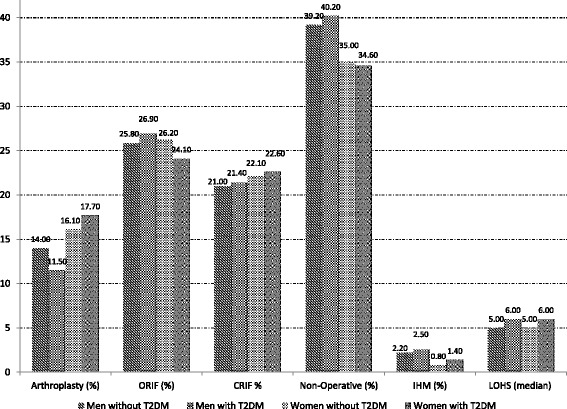
We identified 43,872 patients with proximal humerus fracture (18.3% had a T2DM diagnosis). Age-adjusted incidence rates elevated steadily over the study period for men and women with and without T2DM, independently of diabetes status, although we found a stable trend in the later years. Patients with T2DM had lower relative risk of proximal humeral fracture incidence: 0.87 (95%IC 0.82-0.93) for men and 0.97 (95%IC 0.95-1.00) for women. In-hospital complications were 4.0% of diabetic men vs. 2.6% in non-diabetic (p < 0.001) and 2.9% among T2DM women vs. 1.7% in those without (p < 0.05). The use of open reduction of fracture with internal fixation and arthroplasty is increasing overtime and closed reduction with internal fixation is decreasing. Presence of T2DM in women was associated with higher in-hospital mortality (OR 1.67; 95%CI 1.29-2.15). Comorbidities, in-hospital complications and older age were predictors of higher in-hospital mortality in both sexes.
The incidence of proximal humerus fractures seems to be increasing in Spain. The incidence is lower among men with than without T2DM. T2DM is associated to higher in-hospital complications in both sexes. The use of open reduction of fracture with internal fixation and arthroplasty is increasing overtime beside diabetes status. Women with T2DM have higher in-hospital mortality than those without the disease.
多项研究报告称,糖尿病患者比非糖尿病患者发生骨折的风险更高。肱骨近端骨折与2型糖尿病(T2DM)之间的关联尚不清楚,一些研究指出与胰岛素治疗、糖尿病控制不佳导致的低血糖发作有关,或者最近与小梁骨改变有关。我们研究了2001 - 2013年西班牙≥65岁住院患者中,有无T2DM的肱骨近端骨折发病率、手术治疗情况及预后趋势。
本回顾性观察性研究使用西班牙国家医院出院数据库,选取所有肱骨近端骨折的住院病例。我们计算了总体发病率,并按糖尿病状态、年份和性别进行分层。我们分析了手术方式、合并症、住院时间、院内并发症和院内死亡率。
我们确定了43872例肱骨近端骨折患者(18.3%有T2DM诊断)。在研究期间,无论糖尿病状态如何,有和没有T2DM的男性和女性的年龄调整发病率均稳步上升,不过在后期我们发现了稳定趋势。患有T2DM的男性肱骨近端骨折发病率的相对风险较低:男性为0.87(95%置信区间0.82 - 0.93),女性为0.97(95%置信区间0.95 - 1.00)。糖尿病男性的院内并发症发生率为4.0%,非糖尿病男性为2.6%(p < 0.001);T2DM女性为2.9%,非T2DM女性为1.7%(p < 0.05)。切开复位内固定术和关节置换术随时间的使用在增加,而闭合复位内固定术在减少。女性患有T2DM与较高的院内死亡率相关(比值比1.67;95%置信区间1.29 - 2.15)。合并症、院内并发症和高龄是两性院内死亡率较高的预测因素。
在西班牙,肱骨近端骨折的发病率似乎在上升。患有T2DM的男性发病率低于未患T2DM的男性。T2DM与两性较高的院内并发症相关。无论糖尿病状态如何,切开复位内固定术和关节置换术的使用随时间在增加。患有T2DM的女性院内死亡率高于未患该病的女性。