School of Biological Sciences, University of Tasmania, Sandy Bay, TAS, 7005, Australia.
Department of Biology, Lund University, SE-223 62, Lund, Sweden.
Nat Commun. 2017 Dec 11;8(1):2030. doi: 10.1038/s41467-017-02220-w.
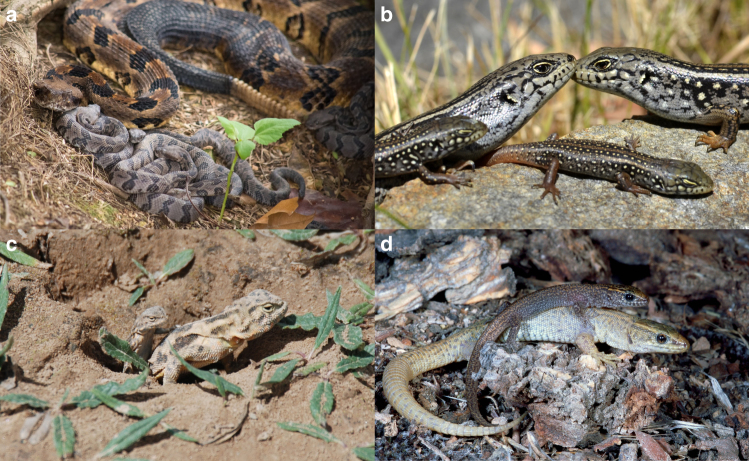
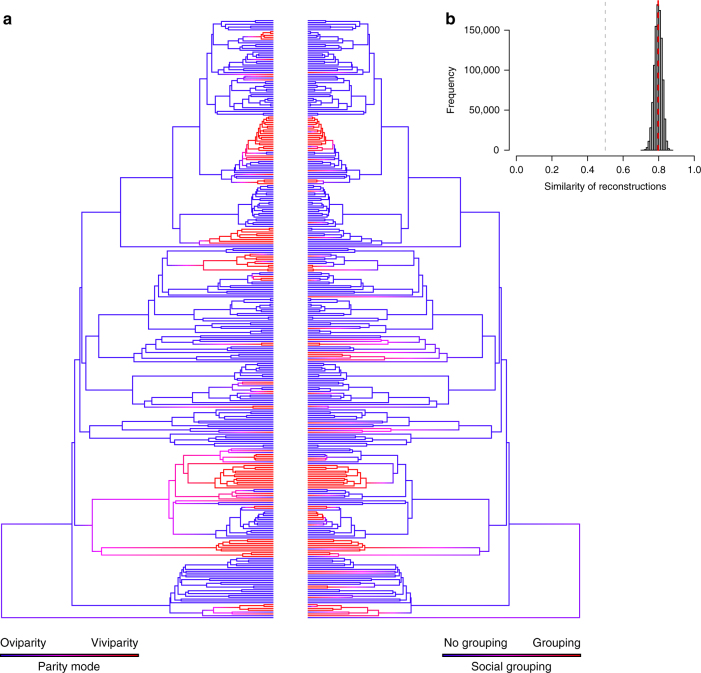
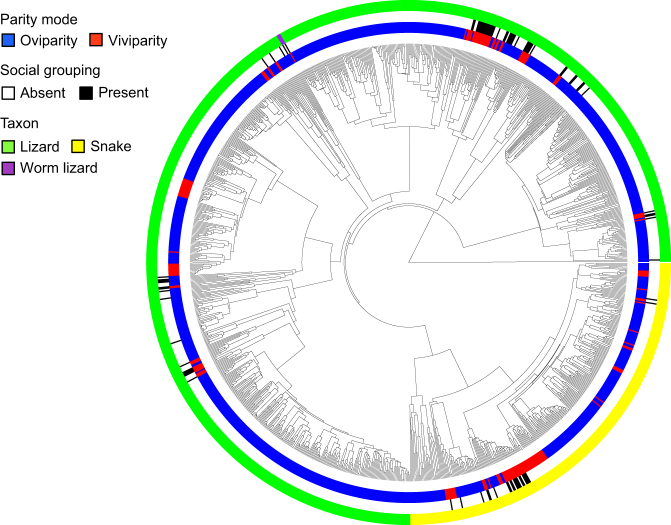
Identifying factors responsible for the emergence and evolution of social complexity is an outstanding challenge in evolutionary biology. Here we report results from a phylogenetic comparative analysis of over 1000 species of squamate reptile, nearly 100 of which exhibit facultative forms of group living, including prolonged parent-offspring associations. We show that the evolution of social groupings among adults and juveniles is overwhelmingly preceded by the evolution of live birth across multiple independent origins of both traits. Furthermore, the results suggest that live bearing has facilitated the emergence of social groups that remain stable across years, similar to forms of sociality observed in other vertebrates. These results suggest that live bearing has been a fundamentally important precursor in the evolutionary origins of group living in the squamates.
确定导致社会复杂性出现和演变的因素是进化生物学中的一个突出挑战。在这里,我们报告了对超过 1000 种蜥蜴目爬行动物的系统发育比较分析的结果,其中近 100 种表现出兼性群体生活形式,包括延长的亲代-后代关联。我们表明,成年和幼体之间社会群体的进化是由多个独立起源的活体分娩和这两个特征的进化所主导的。此外,结果表明,活体分娩促进了稳定存在多年的社会群体的出现,类似于在其他脊椎动物中观察到的社会形式。这些结果表明,活体分娩一直是蜥蜴目动物群体生活进化起源的一个基本重要前提。