Pharmacy Department, Erlangen University Hospital, Erlangen, Germany.
Department of Medical Informatics, Biometry and Epidemiology, Friedrich-Alexander University Erlangen-Nuremberg, Erlangen, Germany.
BMC Med Educ. 2017 Dec 12;17(1):251. doi: 10.1186/s12909-017-1092-z.
The pharmacy profession has shifted towards patient-centred care. To meet the new challenges it is necessary to provide students with clinical competencies. A quasi-experimental single-blinded teaching and learning study was carried out using a parallel-group design to evaluate systematically the benefits of clinical teaching in pharmacy education in Germany.
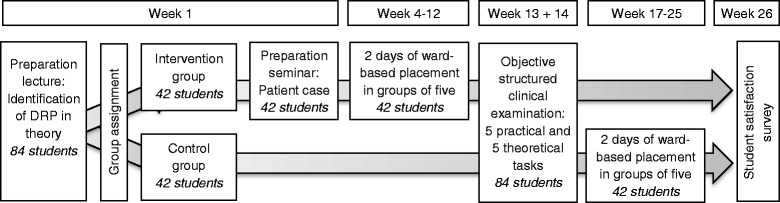
A clinical pharmacy course on a psychiatric ward was developed and implemented for small student groups. The learning aims included: the improvement of patient and interdisciplinary communication skills and the identification and management of pharmaceutical care issues. The control group participated only in the preparation lecture, while the intervention group took part in the complete course. The effects were assessed by an objective structured clinical examination (OSCE) and a student satisfaction survey.
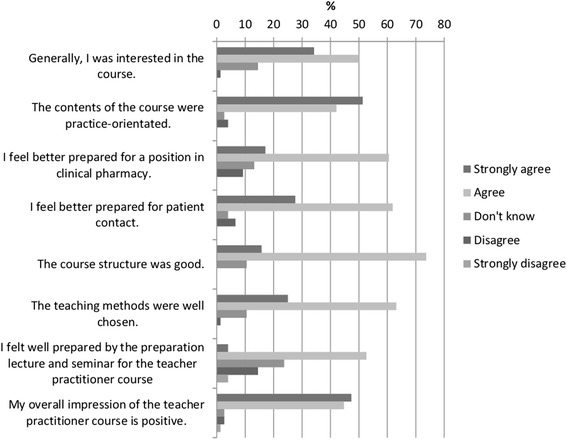
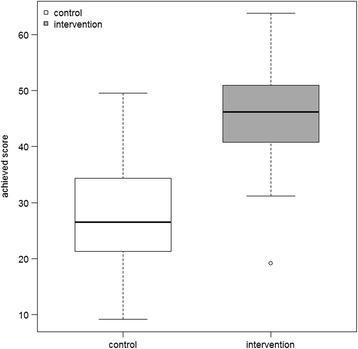
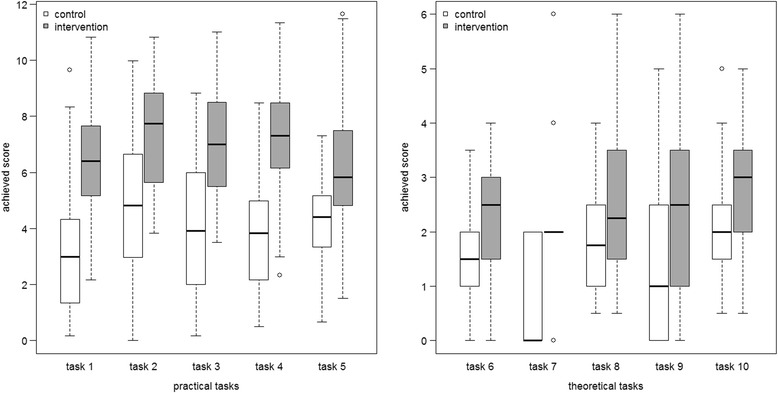
The intervention group achieved significantly better overall results on the OSCE assessment (46.20 ± 10.01 vs. 26.58 ± 12.91 of a maximum of 90 points; p < 0.0001).The practical tasks had the greatest effect, as reflected in the outcomes of tasks 1-5 (34.94 ± 9.60 vs. 18.63 ± 10.24 of a maximum of 60 points; p < 0.0001). Students' performance on the theoretical tasks (tasks 6-10) was improved but unsatisfying in both groups considering the maximum score (11.50 ± 4.75 vs. 7.50 ± 4.00 of a maximum of 30 points; p < 0.0001). Of the students, 93% rated the course as practice-orientated, and 90% felt better prepared for patient contact. Many students suggested a permanent implementation and an extension of the course.
The results suggest that the developed ward-based course provided learning benefits for clinical skills. Students' perception of the course was positive. Implementation into the regular clinical pharmacy curriculum is therefore advisable.
药学专业已向以患者为中心的护理方向转变。为了应对新的挑战,有必要为学生提供临床能力。采用完全随机设计的准实验性单盲教学研究,系统评估德国药学教育中临床教学的益处。
为小团体学生开发并实施了一门精神科病房临床药学课程。学习目标包括:提高患者和跨学科沟通技巧以及识别和处理药物治疗问题的能力。对照组仅参加准备讲座,而干预组则参加完整课程。通过客观结构化临床考试(OSCE)和学生满意度调查评估效果。
干预组在 OSCE 评估中取得了显著更好的总体成绩(46.20±10.01 与 90 分满分的 26.58±12.91 分;p<0.0001)。实践任务的效果最大,体现在任务 1-5 的结果中(34.94±9.60 与 60 分满分的 18.63±10.24 分;p<0.0001)。考虑到满分(30 分满分的 11.50±4.75 与 7.50±4.00 分),两组学生的理论任务(任务 6-10)表现均有所提高,但仍不理想。93%的学生认为该课程具有实践导向性,90%的学生认为自己更能胜任与患者的接触。许多学生建议永久实施并扩展该课程。
研究结果表明,开发的基于病房的课程为临床技能提供了学习收益。学生对该课程的看法是积极的。因此,将其纳入常规临床药学课程是可取的。