Warren Ashley, Cordon Roberto, Told Michaela, de Savigny Don, Kickbusch Ilona, Tanner Marcel
Department of Epidemiology and Public Health, Swiss Tropical and Public Health Institute, Socinstrasse 57, 4002, Basel, Switzerland.
University of Basel, Petersplatz 1, 4003, Basel, Switzerland.
Global Health. 2017 Dec 12;13(1):89. doi: 10.1186/s12992-017-0308-7.
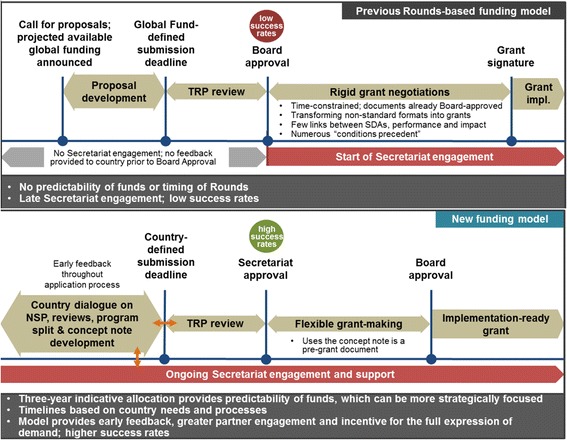
The Global Fund is one of the largest actors in global health. In 2015 the Global Fund was credited with disbursing close to 10 % of all development assistance for health. In 2011 it began a reform process in response to internal reviews following allegations of recipients' misuse of funds. Reforms have focused on grant application processes thus far while the core structures and paradigm have remained intact. We report results of discussions with key stakeholders on the Global Fund, its paradigm of oversight, monitoring, and results in Mozambique.
We conducted 38 semi-structured in-depth interviews in Maputo, Mozambique and members of the Global Fund Board and Secretariat in Switzerland. In-country stakeholders were representatives from Global Fund country structures (eg. Principle Recipient), the Ministry of Health, health or development attachés bilateral and multilateral agencies, consultants, and the NGO coordinating body. Thematic coding revealed concerns about the combination of weak country oversight with stringent and cumbersome requirements for monitoring and evaluation linked to performance-based financing.
Analysis revealed that despite the changes associated with the New Funding Model, respondents in both Maputo and Geneva firmly believe challenges remain in Global Fund's structure and paradigm. The lack of a country office has many negative downstream effects including reliance on in-country partners and ineffective coordination. Due to weak managerial and absorptive capacity, more oversight is required than is afforded by country team visits. In-country partners provide much needed support for Global Fund recipients, but roles, responsibilities, and accountability must be clearly defined for a successful long-term partnership. Furthermore, decision-makers in Geneva recognize in-country coordination as vital to successful implementation, and partners welcome increased Global Fund engagement.
To date, there are no institutional requirements for formalized coordination, and the Global Fund has no consistent representation in Mozambique's in-country coordination groups. The Global Fund should adapt grant implementation and monitoring procedures to the specific local realities that would be illuminated by more formalized coordination.
全球基金是全球卫生领域最大的行动者之一。2015年,全球基金发放的资金占所有卫生领域发展援助的近10%。2011年,在收到关于受援方滥用资金的指控后,全球基金开展了内部审查,并启动了改革进程。迄今为止,改革主要集中在赠款申请流程上,而核心结构和模式仍保持不变。我们报告了与莫桑比克关键利益相关者就全球基金、其监督、监测模式及成果进行讨论的结果。
我们在莫桑比克马普托以及瑞士的全球基金董事会和秘书处成员中进行了38次半结构化深入访谈。国内利益相关者包括全球基金国家机构(如主要受援方)、卫生部、双边和多边机构的卫生或发展专员、顾问以及非政府组织协调机构的代表。主题编码显示,人们担心国家监督薄弱,同时与基于绩效的融资相关的监测和评估要求严格且繁琐。
分析表明,尽管新融资模式带来了一些变化,但马普托和日内瓦的受访者都坚信,全球基金在结构和模式方面仍存在挑战。缺乏国家办事处产生了许多负面的下游影响,包括依赖国内合作伙伴以及协调不力。由于管理和吸收能力薄弱,国家团队的访问所提供的监督力度不够。国内合作伙伴为全球基金受援方提供了急需的支持,但为了建立成功的长期伙伴关系,必须明确各自的角色、责任和问责制。此外,日内瓦的决策者认识到国内协调对于成功实施至关重要,合作伙伴也欢迎全球基金更多地参与。
迄今为止,尚无关于正式协调的制度要求,全球基金在莫桑比克的国内协调小组中也没有统一的代表。全球基金应根据更正式的协调所揭示的具体当地实际情况,调整赠款实施和监测程序。