Cluster of Excellence Hearing4all, University of Oldenburg, Oldenburg, Germany.
Department of Neuroscience, University of Oldenburg, Oldenburg, Germany.
Front Neural Circuits. 2017 Nov 29;11:95. doi: 10.3389/fncir.2017.00095. eCollection 2017.
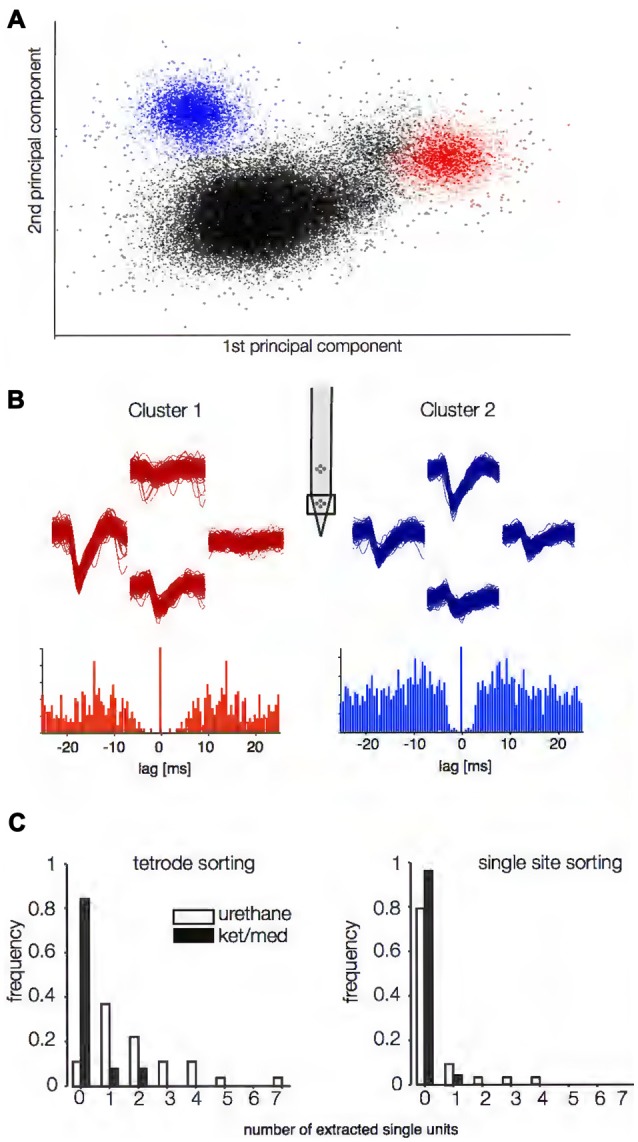
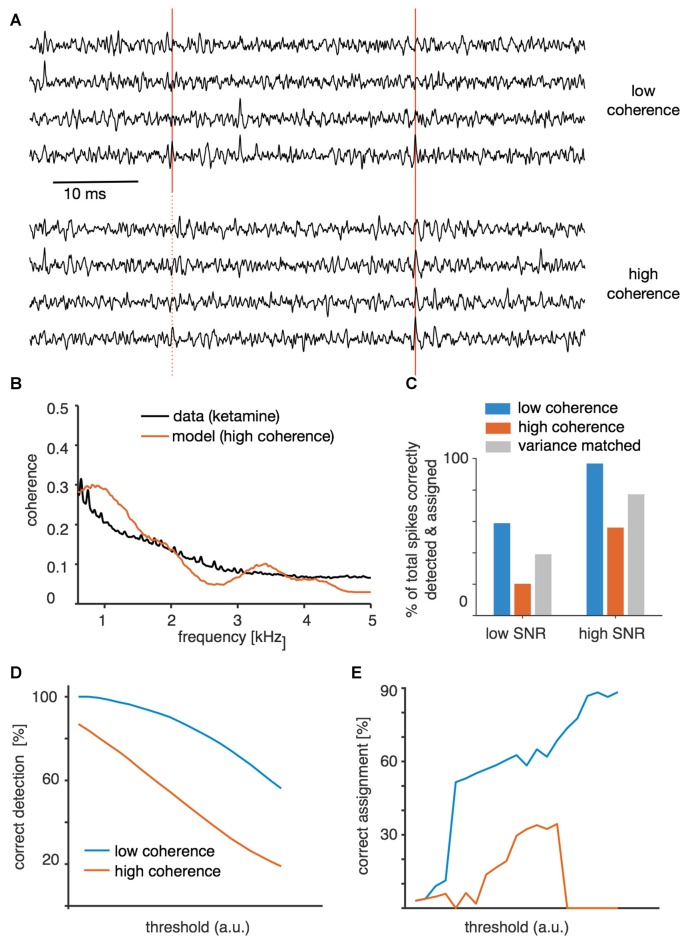
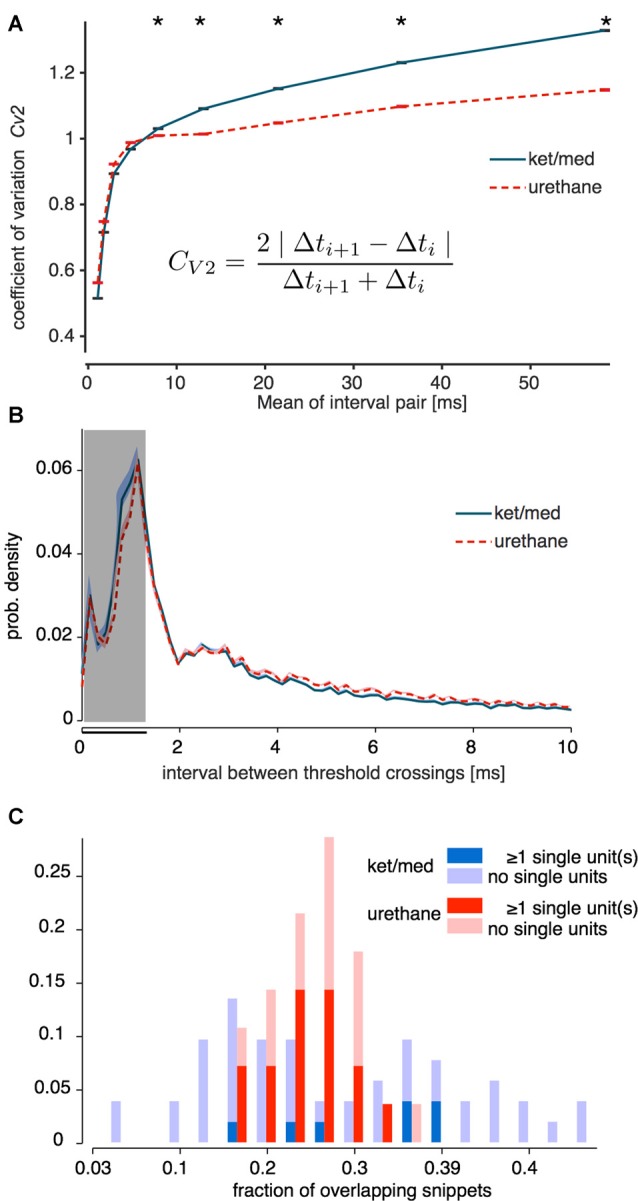
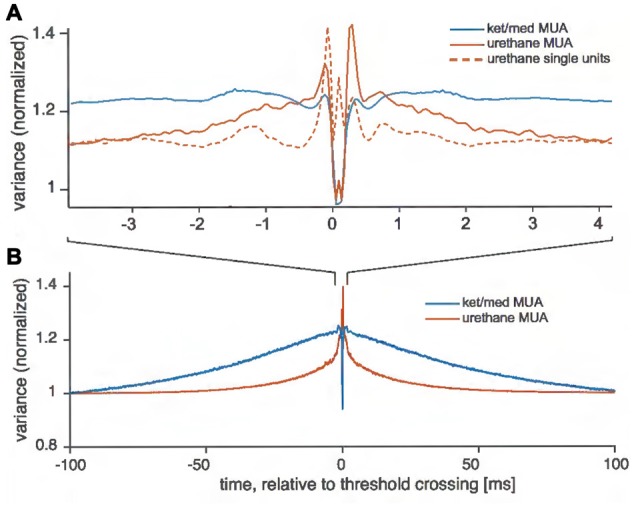
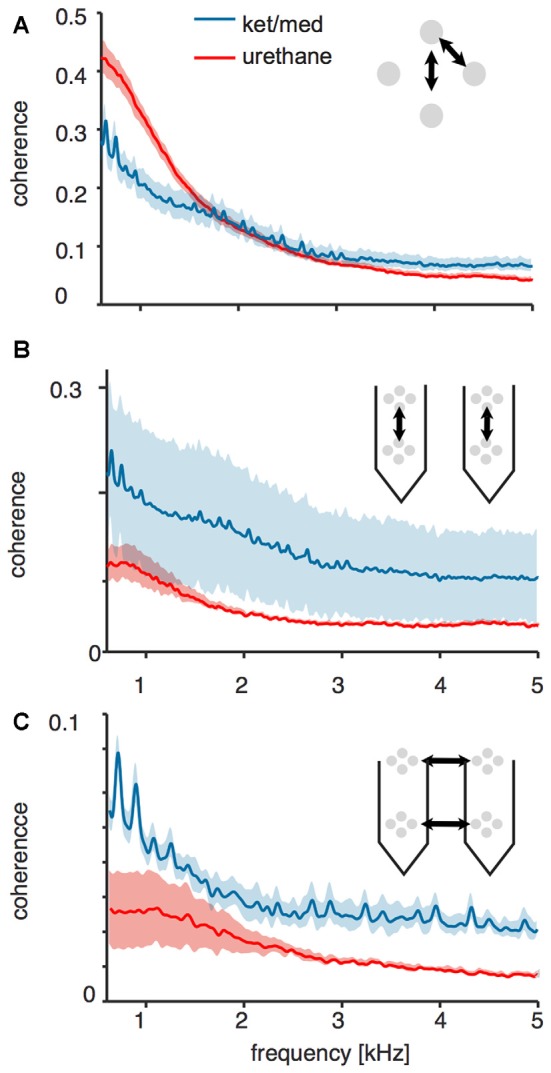
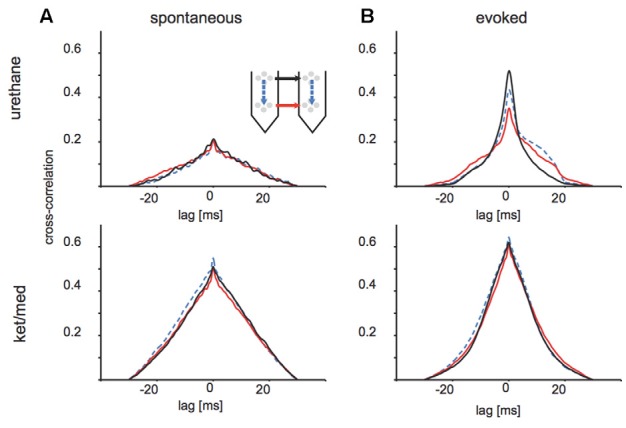
Spike sorting is an essential first step in most analyses of extracellular electrophysiological recordings. Here we show that spike-sorting success depends critically on characteristics of coordinated population activity that can differ between anesthetic states. In tetrode recordings from mouse auditory cortex, spike sorting was significantly less successful under ketamine/medetomidine (ket/med) than urethane anesthesia. Surprisingly, this difficulty with sorting under ket/med anesthesia did not appear to result from either greater millisecond-scale burstiness of neural activity or increased coordination of activity among neighboring neurons. Rather, the key factor affecting sorting success appeared to be the amount of coordinated population activity at long time intervals and across large cortical distances. We propose that spike-sorting success is directly dependent on overall coordination of activity, and is most disrupted by large-scale fluctuations in cortical population activity. Reliability of single-unit recording may therefore differ not only between urethane-anesthetized and ket/med-anesthetized states as demonstrated here, but also between synchronized and desynchronized states, asleep and awake states, or inattentive and attentive states in unanesthetized animals.
尖峰分选是大多数细胞外电生理记录分析的基本第一步。在这里,我们表明尖峰分选的成功与否取决于协调的群体活动的特征,这些特征在麻醉状态之间可能存在差异。在来自小鼠听觉皮层的四极管记录中,在氯胺酮/美托咪定(ket/med)麻醉下,尖峰分选的成功率明显低于尿烷麻醉。令人惊讶的是,在 ket/med 麻醉下这种排序困难似乎不是由于神经活动的毫秒级爆发性更强或相邻神经元活动的协调性增加所致。相反,影响排序成功的关键因素似乎是长时间间隔和大皮质距离上协调的群体活动的数量。我们提出,尖峰分选的成功直接取决于活动的整体协调性,而大规模的皮质群体活动波动对其干扰最大。因此,单个单元记录的可靠性不仅可能与这里所示的尿烷麻醉和 ket/med 麻醉状态不同,而且可能与同步和去同步状态、睡眠和清醒状态或未麻醉动物的不注意和注意状态不同。