Bod Réka Barbara, Rokai János, Meszéna Domokos, Fiáth Richárd, Ulbert István, Márton Gergely
Laboratory of Experimental Neurophysiology, Department of Physiology, Faculty of Medicine, George Emil Palade University of Medicine, Pharmacy, Science and Technology of Târgu Mureş, Târgu Mureş, Romania.
Integrative Neuroscience Group, Institute of Cognitive Neuroscience and Psychology, Research Centre for Natural Sciences, Budapest, Hungary.
Front Neuroinform. 2022 Jun 13;16:851024. doi: 10.3389/fninf.2022.851024. eCollection 2022.
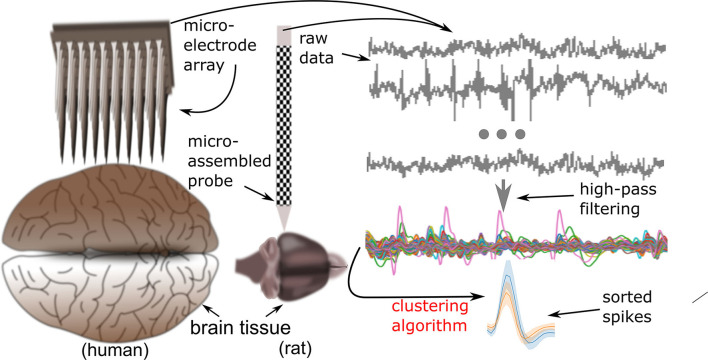
The meaning behind neural single unit activity has constantly been a challenge, so it will persist in the foreseeable future. As one of the most sourced strategies, detecting neural activity in high-resolution neural sensor recordings and then attributing them to their corresponding source neurons correctly, namely the process of spike sorting, has been prevailing so far. Support from ever-improving recording techniques and sophisticated algorithms for extracting worthwhile information and abundance in clustering procedures turned spike sorting into an indispensable tool in electrophysiological analysis. This review attempts to illustrate that in all stages of spike sorting algorithms, the past 5 years innovations' brought about concepts, results, and questions worth sharing with even the non-expert user community. By thoroughly inspecting latest innovations in the field of neural sensors, recording procedures, and various spike sorting strategies, a skeletonization of relevant knowledge lays here, with an initiative to get one step closer to the original objective: deciphering and building in the sense of neural transcript.
神经单单元活动背后的意义一直是个挑战,在可预见的未来仍将存在。作为最常用的策略之一,在高分辨率神经传感器记录中检测神经活动,然后将其正确归因于相应的源神经元,即尖峰分类过程,到目前为止一直很流行。不断改进的记录技术以及用于提取有价值信息的复杂算法,再加上聚类过程中的丰富性,使得尖峰分类成为电生理分析中不可或缺的工具。本综述试图说明,在尖峰分类算法的各个阶段,过去5年的创新带来了值得与非专业用户群体分享的概念、结果和问题。通过全面审视神经传感器领域、记录程序和各种尖峰分类策略的最新创新,相关知识的框架在此呈现,旨在朝着最初的目标更进一步:解读并构建神经转录的意义。