Campos-Cerqueira Marconi, Arendt Wayne J, Wunderle Joseph M, Aide T Mitchell
University of Puerto Rico-Río Piedras San Juan Puerto Rico.
International Institute of Tropical Forestry USDA Forest Service Sabana Field Research Station Luquillo Puerto Rico.
Ecol Evol. 2017 Oct 20;7(23):9914-9924. doi: 10.1002/ece3.3520. eCollection 2017 Dec.
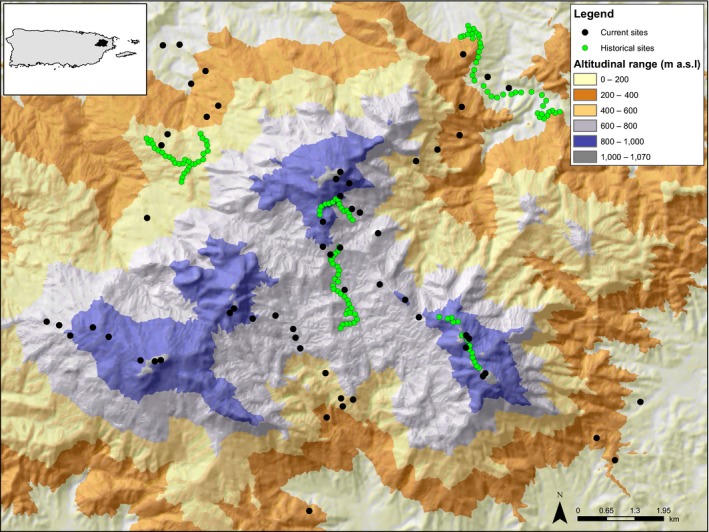
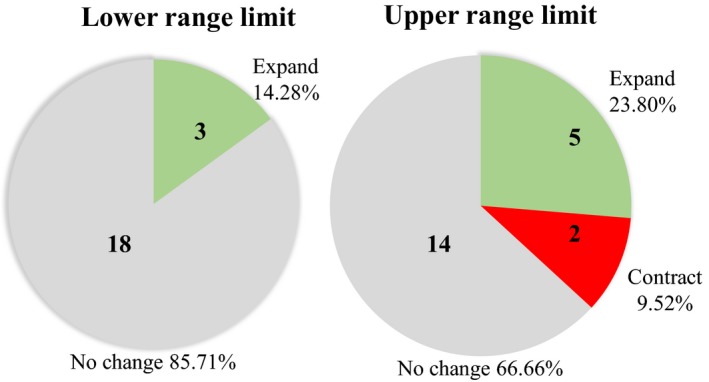
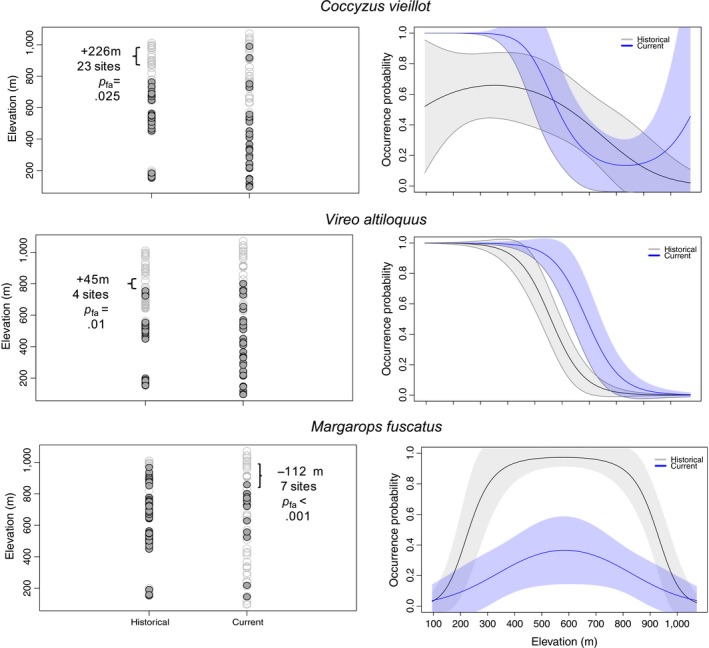
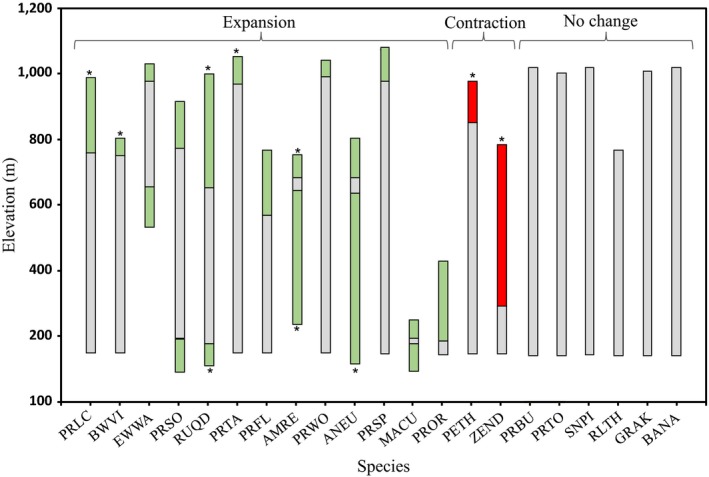
An upward shift in elevation is one of the most conspicuous species responses to climate change. Nevertheless, downward shifts and, apparently, the absences of response have also been recently reported. Given the growing evidence of multiple responses of species distributions due to climate change and the paucity of studies in the tropics, we evaluated the response of a montane bird community to climate change, without the confounding effects of land-use change. To test for elevational shifts, we compared the distribution of 21 avian species in 1998 and 2015 using occupancy models. The historical data set was based on point counts, whereas the contemporary data set was based on acoustic monitoring. We detected a similar number of species in historical (36) and contemporary data sets (33). We show an overall pattern of no significant change in range limits for most species, although there was a significant shift in the range limit of eight species (38%). Elevation limits shifted mostly upward, and this pattern was more common for upper than lower limits. Our results highlight the variability of species responses to climate change and illustrate how acoustic monitoring provides an easy and powerful way to monitor animal populations along elevational gradients.
海拔上升是物种对气候变化最显著的反应之一。然而,最近也有报道称存在下降趋势以及明显的无反应情况。鉴于越来越多的证据表明气候变化导致物种分布出现多种反应,且热带地区相关研究匮乏,我们评估了山地鸟类群落对气候变化的反应,排除了土地利用变化的混杂影响。为了测试海拔变化,我们使用占有率模型比较了1998年和2015年21种鸟类的分布情况。历史数据集基于定点计数,而当代数据集基于声学监测。我们在历史数据集(36种)和当代数据集(33种)中检测到的物种数量相似。我们发现,大多数物种的分布范围界限总体上没有显著变化,尽管有8种物种(38%)的分布范围界限发生了显著变化。海拔界限大多向上移动,这种模式在上限比下限更为常见。我们的研究结果突出了物种对气候变化反应的变异性,并说明了声学监测如何为沿海拔梯度监测动物种群提供了一种简单而有效的方法。