Department of Cardiovascular Surgery, The Second Xiangya Hospital of Central South University, Changsha, Hunan, 410011, China.
Clinical Center for Gene Diagnosis and Therapy, The Second Xiangya Hospital of Central South University, Changsha, Hunan, 410011, China.
Cancer Med. 2018 Jan;7(1):208-218. doi: 10.1002/cam4.1269. Epub 2017 Dec 13.
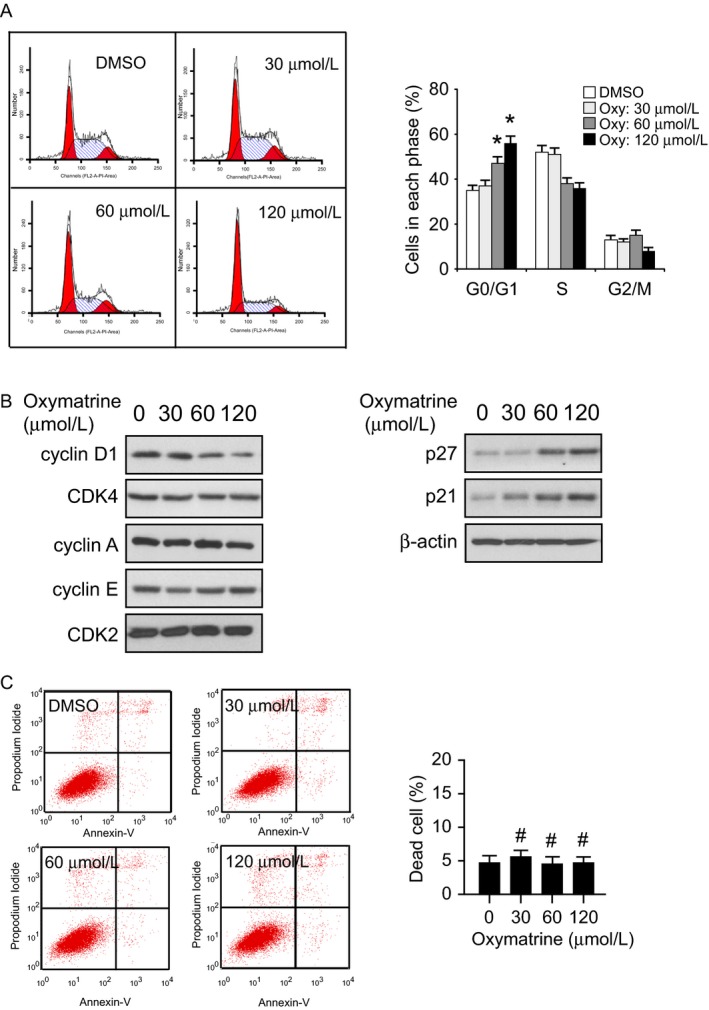
Epidermal growth factor receptor (EGFR) plays a crucial role in human non-small cell lung cancer (NSCLC) tumorigenesis. In this study, oxymatrine was identified as an EGFR signaling pathway inhibitor in NSCLC. Oxymatrine inhibited anchorage-dependent and independent growth of NSCLC cell lines but had no cytotoxicity in normal lung cells. We found that exposure to oxymatrine not only suppressed the activity of wild-type EGFR but also inhibited the activation of exon 19 deletion and L858R/T790M mutated EGFR. Flow cytometry analysis suggested that oxymatrine-induced cell cycle G0/G1 arrest was dependent on EGFR-Akt signaling. Exogenous overexpression of Myr-Akt rescued cyclin D1 expression in HCC827 cells. Moreover, oxymatrine prominently suppressed tumor growth in a xenograft mouse model. Thus, oxymatrine appears to be a novel therapeutic agent for NSCLC treatment.
表皮生长因子受体(EGFR)在人类非小细胞肺癌(NSCLC)的肿瘤发生中起着至关重要的作用。在这项研究中,氧化苦参碱被鉴定为 NSCLC 中的 EGFR 信号通路抑制剂。氧化苦参碱抑制 NSCLC 细胞系的锚定依赖性和非依赖性生长,但对正常肺细胞没有细胞毒性。我们发现,氧化苦参碱的暴露不仅抑制了野生型 EGFR 的活性,而且还抑制了外显子 19 缺失和 L858R/T790M 突变型 EGFR 的激活。流式细胞术分析表明,氧化苦参碱诱导的细胞周期 G0/G1 期阻滞依赖于 EGFR-Akt 信号。外源性过表达 Myr-Akt 可挽救 HCC827 细胞中环化蛋白 D1 的表达。此外,氧化苦参碱在异种移植小鼠模型中显著抑制肿瘤生长。因此,氧化苦参碱似乎是一种治疗 NSCLC 的新型治疗药物。