Institute for Biomedicine of Aging, Friedrich-Alexander-Universität Erlangen-Nürnberg, Kobergerstraße 60, 90408 Nürnberg, Germany.
Chair of Nutritional Medicine, Technical University of Munich, Gregor-Mendel-Str., 85354 Freising-Weihenstephan, Germany.
Nutrients. 2017 Dec 14;9(12):1358. doi: 10.3390/nu9121358.
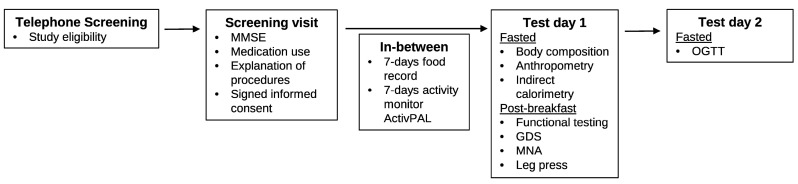
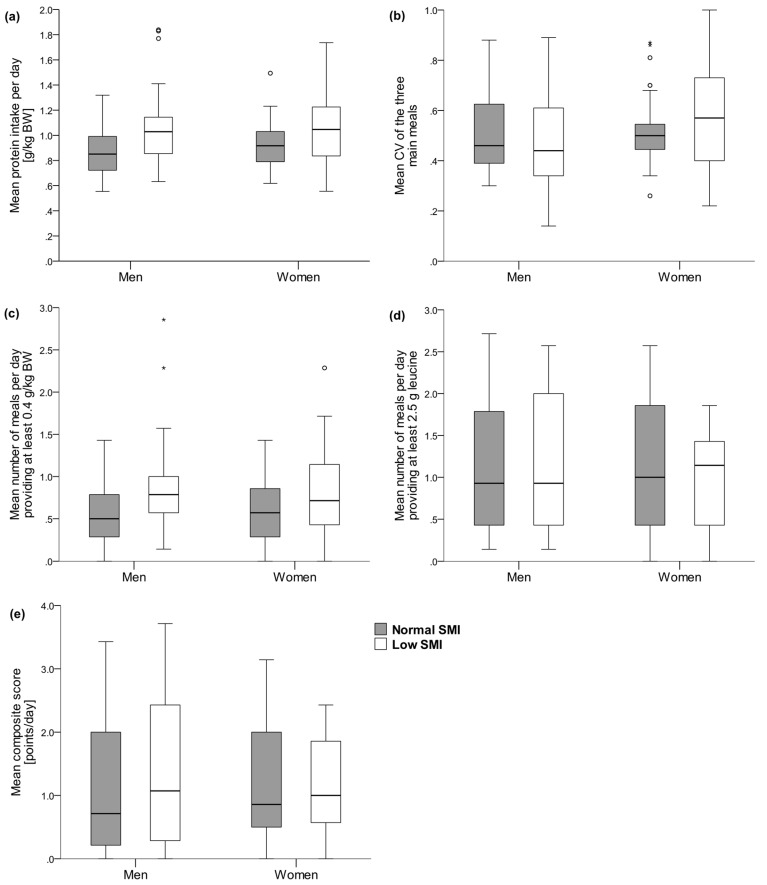
To maintain muscle mass in older age, several aspects regarding the amount and distribution of protein intake have been suggested. Our objective was to investigate single and combined associations of daily protein intake, evenness of protein distribution across the three main meals, number of meals providing ≥0.4 g protein/kg body weight (BW), and number of meals providing ≥2.5 g leucine, with muscle mass, strength, and power in successful agers. In this cross-sectional study in 97 healthy community-dwelling adults without functional limitations aged 75-85 years, protein intake was assessed using 7-day food records. Muscle mass, leg muscle strength, leg muscle power, and handgrip strength were measured according to standardized protocols. Mean daily protein intake was 0.97 ± 0.28 g/kg BW and the coefficient of variance between main meals was 0.53 ± 0.19. Per day, 0.72 ± 0.50 meals providing ≥0.4 g protein/kg BW and 1.11 ± 0.76 meals providing ≥2.5 g leucine were consumed. No correlations between single or combined aspects of protein intake and skeletal muscle index, leg muscle power, leg muscle strength, or handgrip strength were observed (Spearman's of -0.280 to 0.291). In this sample of healthy older adults without functional limitations, aspects of protein intake were not associated with muscle mass, strength, or power.
为了保持老年人的肌肉质量,人们提出了几个关于蛋白质摄入量的数量和分布的方面。我们的目的是调查每日蛋白质摄入量、蛋白质在三餐中分布的均匀性、每餐提供≥0.4 g 蛋白质/公斤体重(BW)的次数以及每餐提供≥2.5 g 亮氨酸的次数与肌肉质量、力量和功率在成功老年人中的关联。在这项针对 97 名无功能限制、年龄在 75-85 岁的健康社区居民的横断面研究中,使用 7 天食物记录来评估蛋白质摄入量。根据标准化方案测量肌肉质量、腿部肌肉力量、腿部肌肉力量和握力。平均每日蛋白质摄入量为 0.97 ± 0.28 g/kg BW,主餐之间的变异系数为 0.53 ± 0.19。每天有 0.72 ± 0.50 餐提供≥0.4 g 蛋白质/公斤 BW,1.11 ± 0.76 餐提供≥2.5 g 亮氨酸。在观察到的单一或综合蛋白质摄入方面与骨骼肌指数、腿部肌肉力量、腿部肌肉力量或握力之间没有相关性(Spearman's ρ 为-0.280 到 0.291)。在这个没有功能限制的健康老年人样本中,蛋白质摄入方面与肌肉质量、力量或力量无关。