Ponte-Sucre Alicia, Gamarro Francisco, Dujardin Jean-Claude, Barrett Michael P, López-Vélez Rogelio, García-Hernández Raquel, Pountain Andrew W, Mwenechanya Roy, Papadopoulou Barbara
Department of Physiological Sciences, Laboratory of Molecular Physiology, Institute of Experimental Medicine, Luis Razetti School of Medicine, Universidad Central de Venezuela, Caracas, Venezuela.
Department of Biochemistry and Molecular Pharmacology, Instituto de Parasitología y Biomedicina López-Neyra, Spanish National Research Council (IPBLN-CSIC), Granada, Spain.
PLoS Negl Trop Dis. 2017 Dec 14;11(12):e0006052. doi: 10.1371/journal.pntd.0006052. eCollection 2017 Dec.
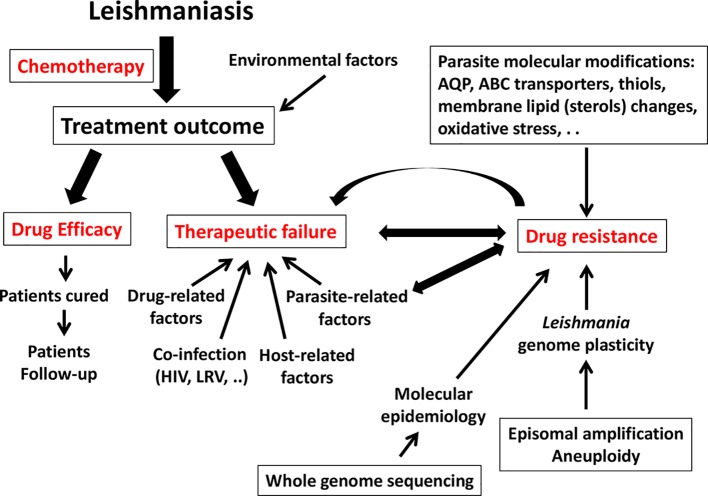
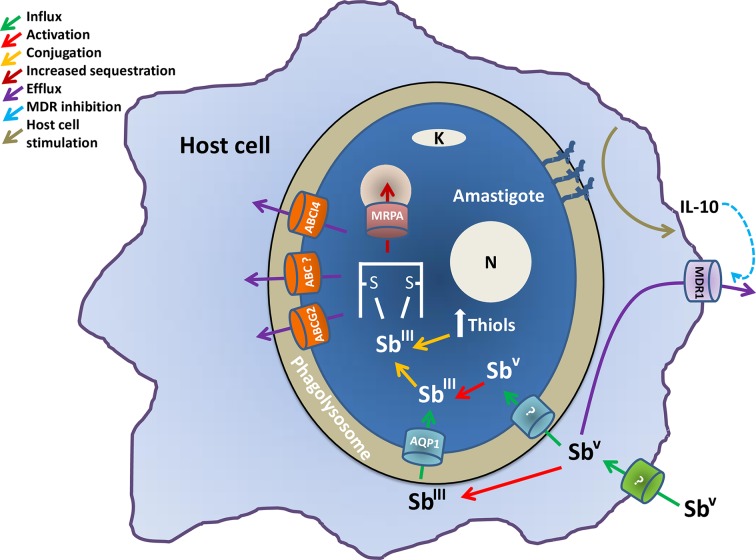
Reevaluation of treatment guidelines for Old and New World leishmaniasis is urgently needed on a global basis because treatment failure is an increasing problem. Drug resistance is a fundamental determinant of treatment failure, although other factors also contribute to this phenomenon, including the global HIV/AIDS epidemic with its accompanying impact on the immune system. Pentavalent antimonials have been used successfully worldwide for the treatment of leishmaniasis since the first half of the 20th century, but the last 10 to 20 years have witnessed an increase in clinical resistance, e.g., in North Bihar in India. In this review, we discuss the meaning of "resistance" related to leishmaniasis and discuss its molecular epidemiology, particularly for Leishmania donovani that causes visceral leishmaniasis. We also discuss how resistance can affect drug combination therapies. Molecular mechanisms known to contribute to resistance to antimonials, amphotericin B, and miltefosine are also outlined.
由于治疗失败问题日益严重,全球迫切需要重新评估新旧世界利什曼病的治疗指南。耐药性是治疗失败的一个基本决定因素,尽管其他因素也导致了这一现象,包括全球艾滋病毒/艾滋病流行及其对免疫系统的附带影响。自20世纪上半叶以来,五价锑剂已在全球成功用于治疗利什曼病,但在过去10至20年中,临床耐药性有所增加,例如在印度比哈尔邦北部。在这篇综述中,我们讨论了与利什曼病相关的“耐药性”的含义,并讨论了其分子流行病学,特别是针对引起内脏利什曼病的杜氏利什曼原虫。我们还讨论了耐药性如何影响联合药物治疗。文中还概述了已知导致对锑剂、两性霉素B和米替福新耐药的分子机制。