Department of Engineering Science, Institute of Biomedical Engineering, University of Oxford, Oxford, OX3 7DQ, UK.
Nuffield Department of Medicine, University of Oxford, Oxford, OX3 7BN, UK.
Bioinformatics. 2018 May 15;34(10):1666-1671. doi: 10.1093/bioinformatics/btx801.
Correct and rapid determination of Mycobacterium tuberculosis (MTB) resistance against available tuberculosis (TB) drugs is essential for the control and management of TB. Conventional molecular diagnostic test assumes that the presence of any well-studied single nucleotide polymorphisms is sufficient to cause resistance, which yields low sensitivity for resistance classification.
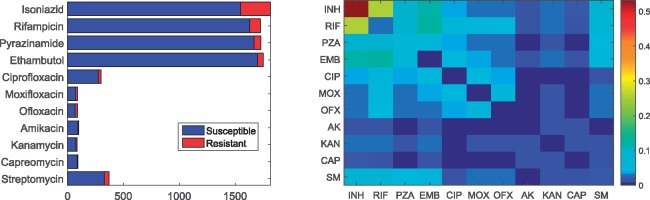
Given the availability of DNA sequencing data from MTB, we developed machine learning models for a cohort of 1839 UK bacterial isolates to classify MTB resistance against eight anti-TB drugs (isoniazid, rifampicin, ethambutol, pyrazinamide, ciprofloxacin, moxifloxacin, ofloxacin, streptomycin) and to classify multi-drug resistance.
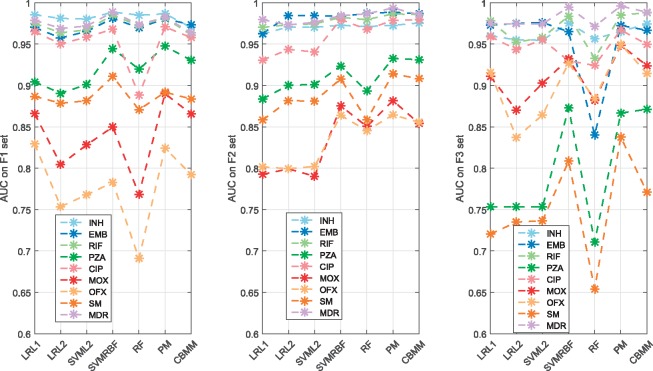
Compared to previous rules-based approach, the sensitivities from the best-performing models increased by 2-4% for isoniazid, rifampicin and ethambutol to 97% (P < 0.01), respectively; for ciprofloxacin and multi-drug resistant TB, they increased to 96%. For moxifloxacin and ofloxacin, sensitivities increased by 12 and 15% from 83 and 81% based on existing known resistance alleles to 95% and 96% (P < 0.01), respectively. Particularly, our models improved sensitivities compared to the previous rules-based approach by 15 and 24% to 84 and 87% for pyrazinamide and streptomycin (P < 0.01), respectively. The best-performing models increase the area-under-the-ROC curve by 10% for pyrazinamide and streptomycin (P < 0.01), and 4-8% for other drugs (P < 0.01).
The details of source code are provided at http://www.robots.ox.ac.uk/~davidc/code.php.
Supplementary data are available at Bioinformatics online.
正确、快速地确定结核分枝杆菌(MTB)对现有抗结核(TB)药物的耐药性,对于控制和管理结核病至关重要。传统的分子诊断测试假设存在任何经过充分研究的单核苷酸多态性就足以引起耐药性,这导致耐药性分类的灵敏度较低。
鉴于 MTB 的 DNA 测序数据的可用性,我们针对来自英国的 1839 个细菌分离株的队列开发了机器学习模型,以对八种抗 TB 药物(异烟肼、利福平、乙胺丁醇、吡嗪酰胺、环丙沙星、莫西沙星、氧氟沙星、链霉素)的 MTB 耐药性进行分类,并对多药耐药性进行分类。
与以前的基于规则的方法相比,性能最佳的模型对异烟肼、利福平和乙胺丁醇的灵敏度分别提高了 2-4%,达到 97%(P < 0.01);对于环丙沙星和多药耐药性结核病,提高到 96%。对于莫西沙星和氧氟沙星,基于现有已知耐药等位基因的灵敏度分别从 83%和 81%提高了 12%和 15%,达到 95%和 96%(P < 0.01)。特别是,我们的模型与以前的基于规则的方法相比,对吡嗪酰胺和链霉素的灵敏度分别提高了 15%和 24%,达到 84%和 87%(P < 0.01)。性能最佳的模型提高了 10%的 ROC 曲线下面积(P < 0.01),对吡嗪酰胺和链霉素分别提高了 4-8%(P < 0.01),对其他药物分别提高了 4-8%(P < 0.01)。
源代码的详细信息在 http://www.robots.ox.ac.uk/~davidc/code.php 提供。
补充数据可在《生物信息学》在线获取。