The Bethune Institute of Epigenetic Medicine, The First Hospital of Jilin University, Changchun, China.
College of Life Sciences, The University of Jilin, Changchun, China.
Sci Rep. 2017 Dec 14;7(1):17571. doi: 10.1038/s41598-017-17931-9.
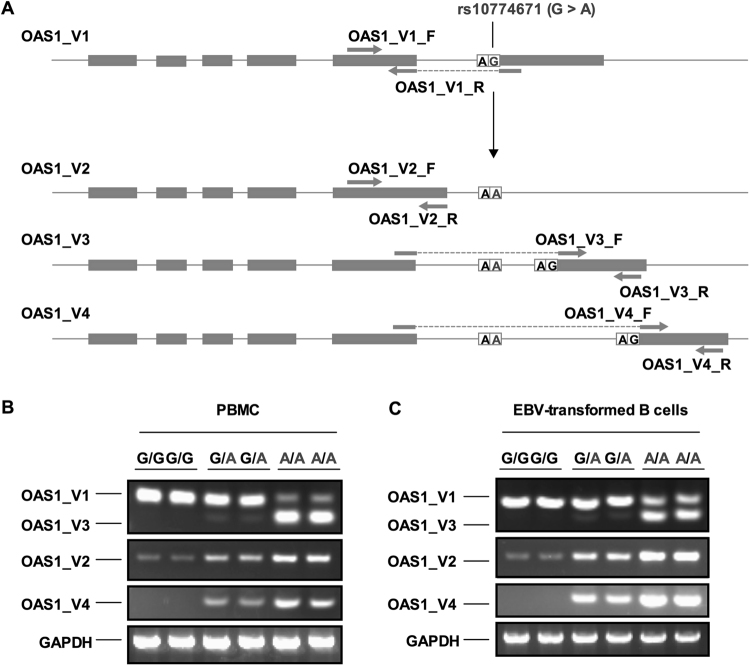
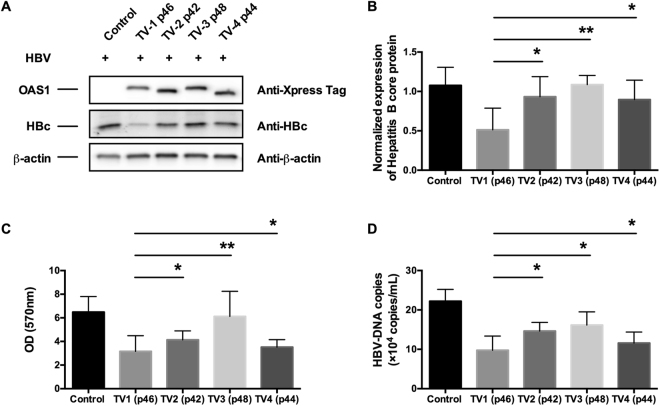
Hepatitis B virus (HBV) has been suspected to contribute to several autoimmune diseases, including Sjögren's syndrome (SS), although the exact mechanism is unknown. The 2'-5' oligoadenylate synthetase (OAS1) is one of the most important components of the immune system and has significant antiviral functions. We studied a polymorphism rs10774671 of OAS1 gene in Han Chinese descent. The minor allele G was significantly associated with a decreased risk for SS, anti-SSA-positive SS, and anti-SSA-positive SS complicated with HBV infection, which have not been seen in anti-SSA-negative SS and HBcAb-negative SS patients. Gene expression analysis showed that the risk-conferring A allele was correlated with lower expression of p46 and increased expression of p42, p48, and p44. A functional study of enzymatic activities revealed that the p42, p44, and p48 isoforms display a reduced capacity to inhibit HBV replication in HepG2 cells compared to the normal p46 isoform. Our data demonstrated that the functional variant, rs10774671, is associated with HBV infection and anti-SSA antibody-positive SS. The SAS variant switches the primary p46 isoform to three alternatives with decreased capacities to inhibit HBV replication. These data indicated that individuals harboring the risk allele might be susceptible to hepatitis B infection and SS development.
乙型肝炎病毒 (HBV) 已被怀疑与几种自身免疫性疾病有关,包括干燥综合征 (SS),尽管确切的机制尚不清楚。2'-5'寡聚腺苷酸合成酶 (OAS1) 是免疫系统最重要的组成部分之一,具有显著的抗病毒功能。我们研究了汉族人群中 OAS1 基因的 rs10774671 多态性。次要等位基因 G 与 SS、抗 SSA 阳性 SS 和抗 SSA 阳性 SS 合并 HBV 感染的风险降低显著相关,但在抗 SSA 阴性 SS 和 HBcAb 阴性 SS 患者中未观察到这种相关性。基因表达分析表明,风险相关的 A 等位基因与 p46 表达降低和 p42、p48 和 p44 表达增加相关。酶活性的功能研究表明,与正常 p46 同工型相比,p42、p44 和 p48 同工型抑制 HepG2 细胞中 HBV 复制的能力降低。我们的数据表明,功能性变体 rs10774671 与 HBV 感染和抗 SSA 抗体阳性 SS 相关。SAS 变体将主要的 p46 同工型切换为三种替代物,其抑制 HBV 复制的能力降低。这些数据表明,携带风险等位基因的个体可能容易感染乙型肝炎和 SS 的发展。