Department of Health Promotion and Human Behavior, Kyoto University Graduate School of Medicine/School of Public Health, Kyoto, Japan.
Department of Health care Epidemiology, Kyoto University Graduate School of Medicine/School of Public Health, Kyoto, Japan.
BMJ Open. 2017 Dec 14;7(12):e018355. doi: 10.1136/bmjopen-2017-018355.
To investigate whether overstatements in abstract conclusions influence primary care physicians' evaluations when they read reports of randomised controlled trials (RCTs) DESIGN: RCT setting: This study was a parallel-group randomised controlled survey, conducted online while masking the study hypothesis.
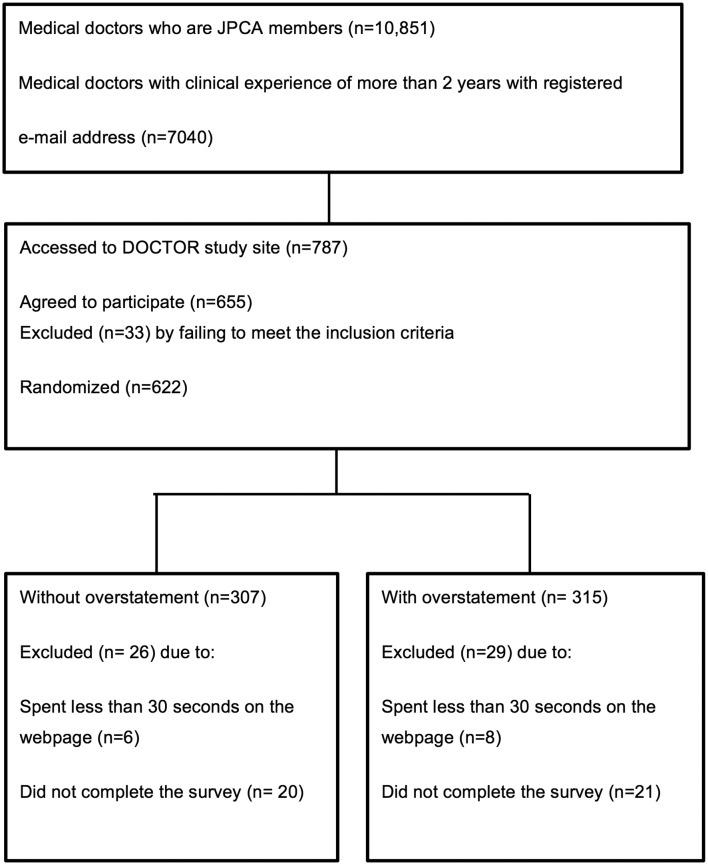
Volunteers were recruited from members of the Japan Primary Care Association in January 2017. We sent email invitations to 7040 primary care physicians. Among the 787 individuals who accessed the website, 622 were eligible and automatically randomised into 'without overstatement' (n=307) and 'with overstatement' (n=315) groups.
We selected five abstracts from published RCTs with at least one non-significant primary outcome and overstatement in the abstract conclusion. To construct a version without overstatement, we rewrote the conclusion sections. The methods and results sections were standardised to provide the necessary information of primary outcome information when it was missing in the original abstract. Participants were randomly assigned to read an abstract either with or without overstatements and asked to evaluate the benefit of the intervention.
The primary outcome was the participants' evaluation of the benefit of the intervention discussed in the abstract, on a scale from 0 to 10. A secondary outcome was the validity of the conclusion.
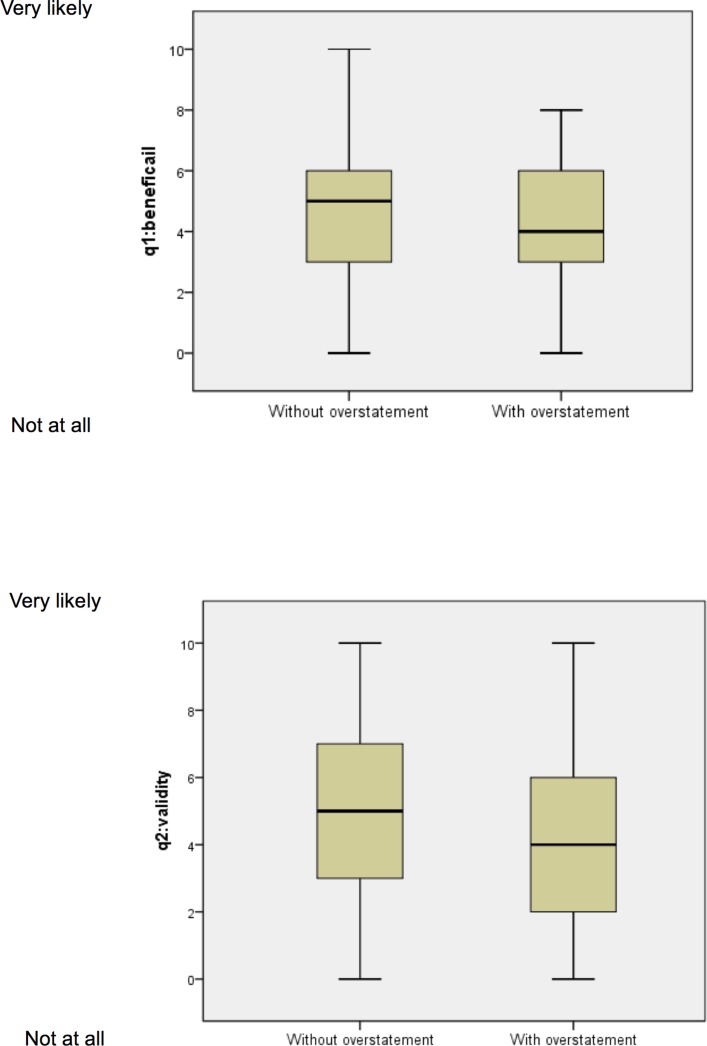
There was no significant difference between the groups with respect to their evaluation of the benefit of the intervention (mean difference: 0.07, 95% CI -0.28 to 0.42, p=0.69). Participants in the 'without' group considered the study conclusion to be more valid than those in the 'with' group (mean difference: 0.97, 95% CI 0.59 to 1.36, P<0.001).
The overstatements in abstract conclusions did not significantly influence the primary care physicians' evaluations of the intervention effect when necessary information about the primary outcomes was distinctly reported.
UMIN000025317; Pre-results.
研究当初级保健医生阅读随机对照试验(RCT)报告时,摘要结论中的夸大陈述是否会影响他们的评估。
RCT 研究设置:这是一项平行组随机对照调查,在网上进行,同时掩盖研究假设。
2017 年 1 月,从日本初级保健协会的成员中招募志愿者。我们向 7040 名初级保健医生发送了电子邮件邀请。在访问该网站的 787 人中,有 622 人符合条件,并自动随机分为“无夸大陈述”(n=307)和“有夸大陈述”(n=315)组。
我们从至少有一个非显著性主要结局和摘要结论中夸大陈述的已发表 RCT 中选择了五个摘要。为了构建一个没有夸大陈述的版本,我们重写了结论部分。方法和结果部分标准化,以在原始摘要中缺少主要结局信息时提供必要的信息。参与者被随机分配阅读有或没有夸大陈述的摘要,并被要求评估干预措施的益处。
在评估摘要中讨论的干预措施的益处方面,两组之间没有显著差异(平均差异:0.07,95%置信区间-0.28 至 0.42,p=0.69)。“无”组的参与者认为研究结论比“有”组更有效(平均差异:0.97,95%置信区间 0.59 至 1.36,P<0.001)。
当明显报告主要结局的相关信息时,摘要结论中的夸大陈述并未显著影响初级保健医生对干预效果的评估。
UMIN000025317;预结果。