Tsujimoto Yasushi, Aoki Takuya, Shinohara Kiyomi, So Ryuhei, Suganuma Aya M, Kimachi Miho, Yamamoto Yosuke, Furukawa Toshi A
Department of Healthcare Epidemiology, School of Public Health in the Graduate School of Medicine, Kyoto University, Kyoto, Japan.
Department of Nephrology and Dialysis, Kyoritsu Hospital, Kawanishi, Hyogo, Japan.
PLoS One. 2019 Jan 25;14(1):e0211206. doi: 10.1371/journal.pone.0211206. eCollection 2019.
Little is known about the physician characteristics associated with appraisal skills of research evidence, especially the assessment of the validity of study methodology. This study aims to explore physician characteristics associated with proper assessment of overstated conclusions in research abstracts.
A secondary analysis of a randomized controlled trial.
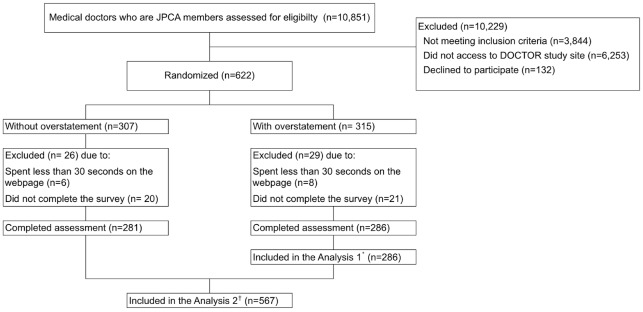
We recruited 567 volunteers from the Japan Primary Care Association.
Participants were randomly assigned to read the abstract of a research paper, with or without an overstatement, and to rate its validity. Our primary outcome was proper assessment of the validity of its conclusions. We investigated the association of physician characteristics and proper assessment using logistic regression models and evaluated the interaction between the associated characteristics and overstatement.
We found significant associations between proper assessment and post-graduate year (odds ratio [OR] = 0.67, 95% confidence interval [CI] 0.49 to 0.91, for every 10-year increase) and research experience as a primary investigator (PI; OR = 2.97, 95% CI 1.65 to 5.34). Post-graduate year and PI had significant interaction with overstatement (P = 0.015 and < 0.001, respectively). Among participants who read abstracts without an overstatement, post-graduate year was not associated with proper assessment (OR = 1.04, 95% CI 0.82 to 1.33), and PI experience was associated with lower scores of the validity (OR = 0.58, 95% CI 0.35 to 0.96).
Physicians who have been in practice longer should be trained in distinguishing overstatements in abstract conclusions. Physicians with research experience might be informed that they tend to rate the validity of research lower regardless of the presence or absence of overstatements.
UMIN000026269.
对于与研究证据评估技能相关的医生特征,尤其是对研究方法有效性的评估,我们了解甚少。本研究旨在探索与正确评估研究摘要中夸大结论相关的医生特征。
对一项随机对照试验进行二次分析。
我们从日本初级保健协会招募了567名志愿者。
参与者被随机分配阅读一篇有或没有夸大内容的研究论文摘要,并对其有效性进行评分。我们的主要结果是对结论有效性的正确评估。我们使用逻辑回归模型研究医生特征与正确评估之间的关联,并评估相关特征与夸大内容之间的相互作用。
我们发现正确评估与研究生年级(每增加10年,优势比[OR]=0.67,95%置信区间[CI]为0.49至0.91)以及作为主要研究者(PI)的研究经验(OR=2.97,95%CI为1.65至5.34)之间存在显著关联。研究生年级和PI与夸大内容有显著的相互作用(P分别为0.015和<0.001)。在阅读没有夸大内容摘要的参与者中,研究生年级与正确评估无关(OR=1.04,95%CI为0.82至1.33),而PI经验与有效性得分较低相关(OR=0.58,95%CI为0.35至0.96)。
执业时间较长的医生应接受培训,以辨别摘要结论中的夸大内容。有研究经验的医生可能需要被告知,无论是否存在夸大内容,他们往往会对研究的有效性给出较低评分。
UMIN000026269。