Instituto de Investigaciones Farmacológicas, Universidad de Buenos Aires - Consejo Nacional de Investigaciones Científicas y Técnicas, Ciudad Autónoma de Buenos Aires, Buenos Aires, Argentina.
Molecular Neuropsychiatry Research Branch, NIH/NIDA Intramural Research Program, Baltimore, MD, United States.
Prog Neuropsychopharmacol Biol Psychiatry. 2018 Mar 2;82:1-11. doi: 10.1016/j.pnpbp.2017.12.009. Epub 2017 Dec 13.
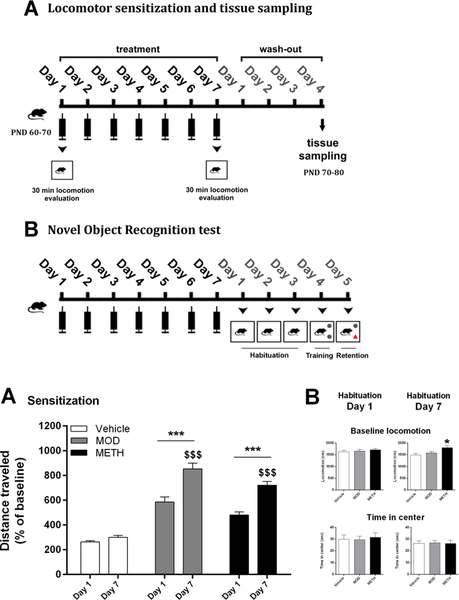
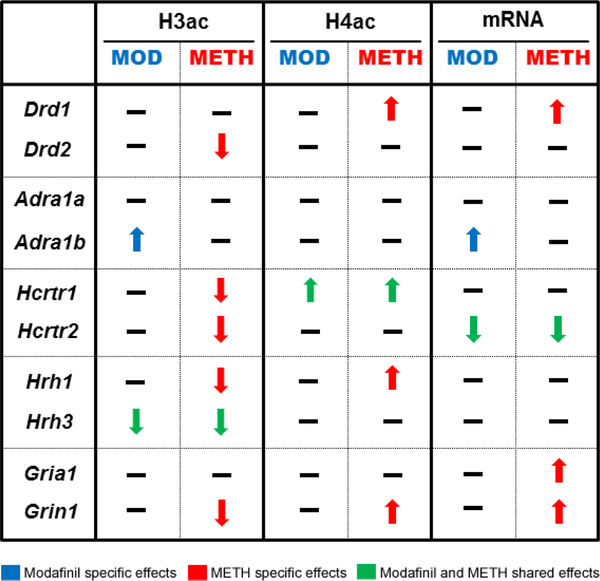
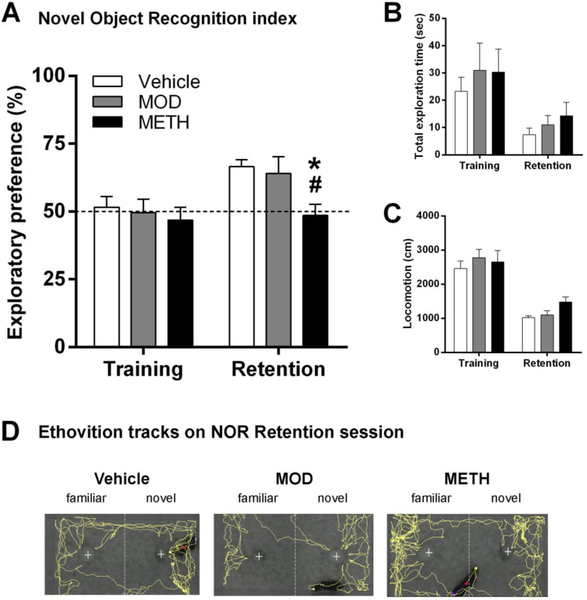
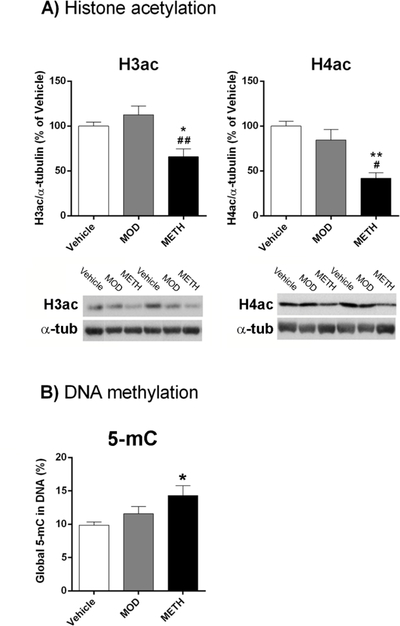
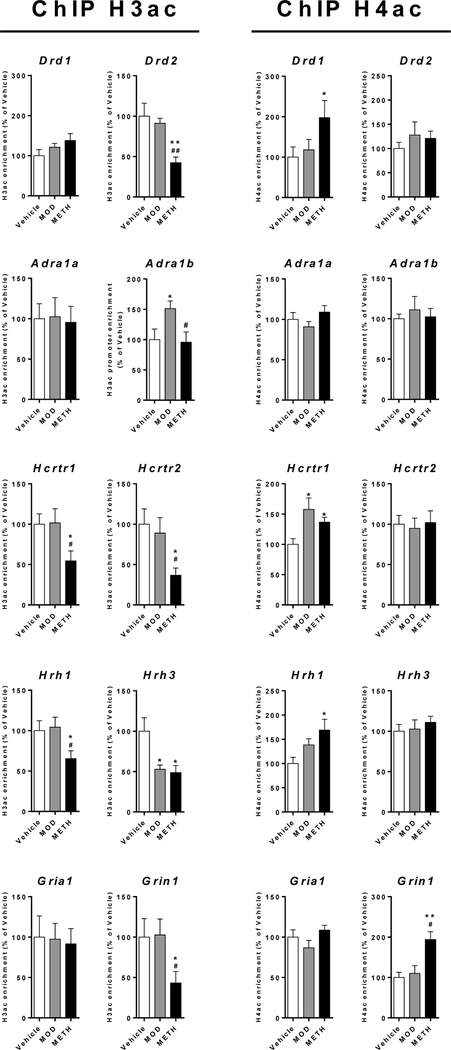
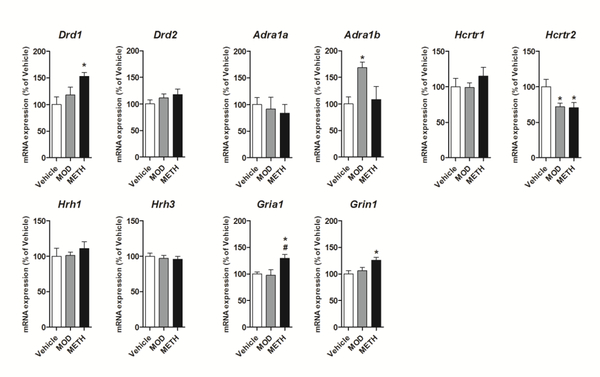
Methamphetamine (METH) and modafinil are psychostimulants with different long-term cognitive profiles: METH is addictive and leads to cognitive decline, whereas modafinil has little abuse liability and is a cognitive enhancer. Increasing evidence implicates epigenetic mechanisms of gene regulation behind the lasting changes that drugs of abuse and other psychotropic compounds induce in the brain, like the control of gene expression by histones 3 and 4 tails acetylation (H3ac and H4ac) and DNA cytosine methylation (5-mC). Mice were treated with a seven-day repeated METH, modafinil or vehicle protocol and evaluated in the novel object recognition (NOR) test or sacrificed 4days after last injection for molecular assays. We evaluated total H3ac, H4ac and 5-mC levels in the medial prefrontal cortex (mPFC), H3ac and H4ac promotor enrichment (ChIP) and mRNA expression (RT-PCR) of neurotransmitter systems involved in arousal, wakefulness and cognitive control, like dopaminergic (Drd1 and Drd2), α-adrenergic (Adra1a and Adra1b), orexinergic (Hcrtr1 and Hcrtr2), histaminergic (Hrh1 and Hrh3) and glutamatergic (AMPA Gria1 and NMDA Grin1) receptors. Repeated METH and modafinil treatment elicited different cognitive outcomes in the NOR test, where modafinil-treated mice performed as controls and METH-treated mice showed impaired recognition memory. METH-treated mice also showed i) decreased levels of total H3ac and H4ac, and increased levels of 5-mC, ii) decreased H3ac enrichment at promoters of Drd2, Hcrtr1/2, Hrh1 and Grin1, and increased H4ac enrichment at Drd1, Hrh1 and Grin1, iii) increased mRNA of Drd1a, Grin1 and Gria1. Modafinil-treated mice shared none of these effects and showed increased H3ac enrichment and mRNA expression at Adra1b. Modafinil and METH showed similar effects linked to decreased H3ac in Hrh3, increased H4ac in Hcrtr1, and decreased mRNA expression of Hcrtr2. The specific METH-induced epigenetic and transcriptional changes described here may be related to the long-term cognitive decline effects of the drug and its detrimental effects on mPFC function. The lack of similar epigenetic effects of chronic modafinil administration supports this notion.
冰毒(METH)和莫达非尼是具有不同长期认知特征的精神兴奋剂:METH 具有成瘾性,导致认知能力下降,而莫达非尼滥用的可能性很小,是一种认知增强剂。越来越多的证据表明,药物滥用和其他精神药物在大脑中引起的持久变化背后存在着表观遗传机制,这些机制控制着组蛋白 3 和 4 尾部乙酰化(H3ac 和 H4ac)和 DNA 胞嘧啶甲基化(5-mC)对基因表达的控制。用 7 天重复 METH、莫达非尼或载体方案处理小鼠,并在新物体识别(NOR)测试中进行评估,或在最后一次注射后 4 天处死进行分子分析。我们评估了内侧前额叶皮质(mPFC)中的总 H3ac、H4ac 和 5-mC 水平、H3ac 和 H4ac 启动子富集(ChIP)和涉及觉醒、清醒和认知控制的神经递质系统的 mRNA 表达(RT-PCR),如多巴胺能(Drd1 和 Drd2)、α-肾上腺素能(Adra1a 和 Adra1b)、食欲肽能(Hcrtr1 和 Hcrtr2)、组胺能(Hrh1 和 Hrh3)和谷氨酸能(AMPA Gria1 和 NMDA Grin1)受体。重复 METH 和莫达非尼治疗在 NOR 测试中引起了不同的认知结果,其中莫达非尼治疗的小鼠表现为对照组,而 METH 治疗的小鼠表现出识别记忆受损。METH 治疗的小鼠还显示:i)总 H3ac 和 H4ac 水平降低,5-mC 水平升高,ii)Drd2、Hcrtr1/2、Hrh1 和 Grin1 启动子处的 H3ac 富集减少,Drd1、Hrh1 和 Grin1 启动子处的 H4ac 富集增加,iii)Drd1a、Grin1 和 Gria1 的 mRNA 增加。莫达非尼治疗的小鼠没有表现出这些影响,并且在 Adra1b 处表现出 H3ac 富集和 mRNA 表达增加。莫达非尼和 METH 表现出类似的影响,与 Hrh3 中的 H3ac 减少、Hcrtr1 中的 H4ac 增加以及 Hcrtr2 的 mRNA 表达减少有关。这里描述的特定 METH 诱导的表观遗传和转录变化可能与药物的长期认知衰退效应及其对 mPFC 功能的不利影响有关。慢性莫达非尼给药缺乏类似的表观遗传效应支持了这一观点。