Gansen Alexander, Tóth Katalin, Schwarz Nathalie, Langowski Jörg
Nucleic Acids Res. 2015 Feb 18;43(3):1433-43. doi: 10.1093/nar/gku1354.
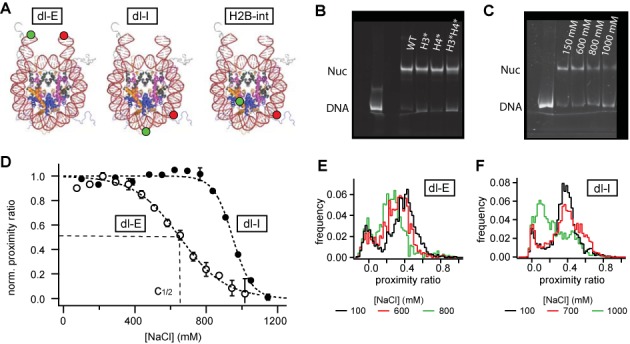
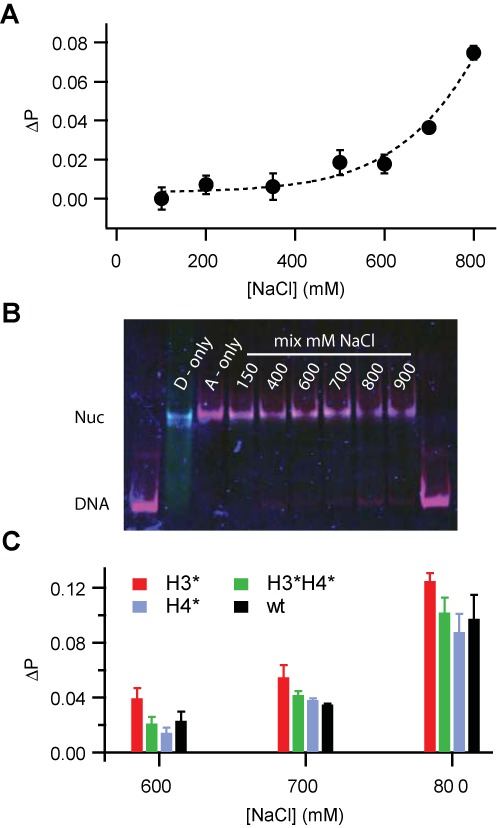
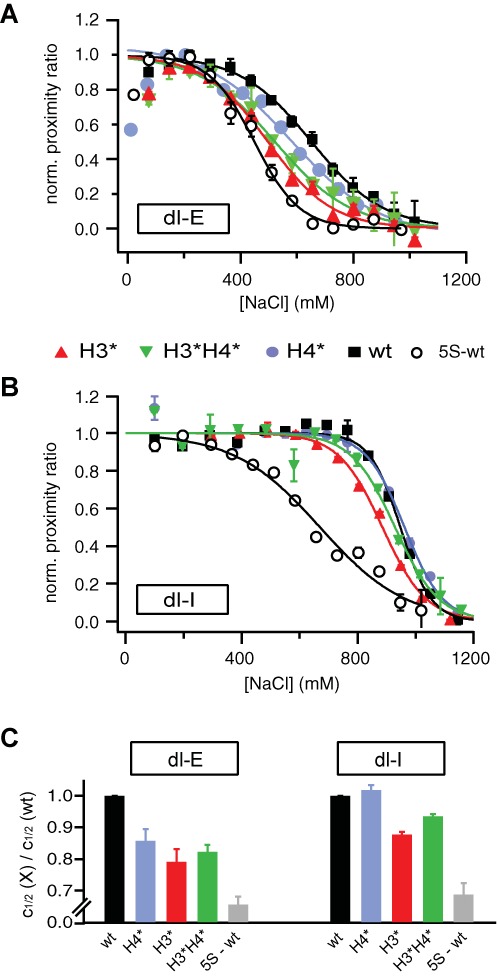
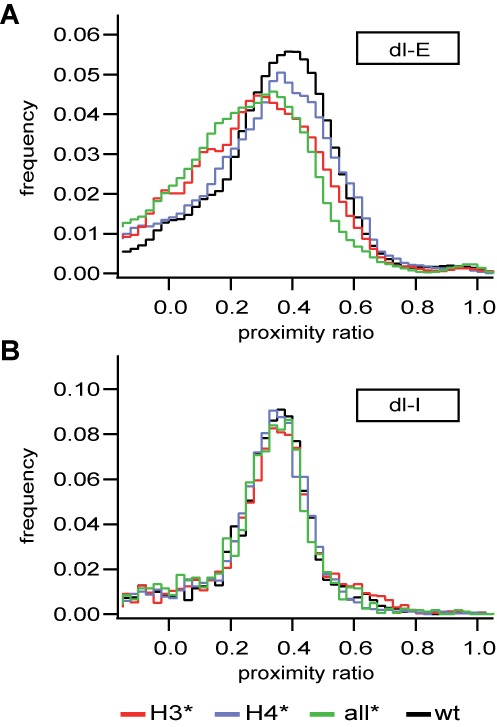
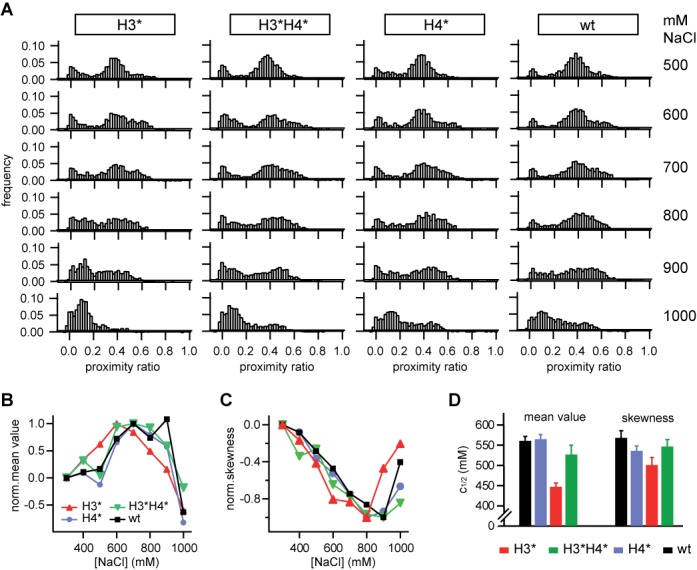
Using FRET in bulk and on single molecules, we assessed the structural role of histone acetylation in nucleosomes reconstituted on the 170 bp long Widom 601 sequence. We followed salt-induced nucleosome disassembly, using donor–acceptor pairs on the ends or in the internal part of the nucleosomal DNA, and on H2B histone for measuring H2A/H2B dimer exchange. This allowed us to distinguish the influence of acetylation on salt-induced DNA unwrapping at the entry–exit site from its effect on nucleosome core dissociation. The effect of lysine acetylation is not simply cumulative, but showed distinct histone-specificity. Both H3- and H4-acetylation enhance DNA unwrapping above physiological ionic strength; however, while H3-acetylation renders the nucleosome core more sensitive to salt-induced dissociation and to dimer exchange, H4-acetylation counteracts these effects. Thus, our data suggest, that H3- and H4-acetylation have partially opposing roles in regulating nucleosome architecture and that distinct aspects of nucleosome dynamics might be independently controlled by individual histones.
我们利用体相荧光共振能量转移(FRET)和单分子FRET技术,评估了组蛋白乙酰化在基于170 bp长的维登601序列重构的核小体中的结构作用。我们通过在核小体DNA末端或内部以及H2B组蛋白上使用供体-受体对来跟踪盐诱导的核小体解聚,并测量H2A/H2B二聚体交换。这使我们能够区分乙酰化对盐诱导的进出位点DNA解旋的影响与其对核小体核心解离的影响。赖氨酸乙酰化的作用并非简单的累积效应,而是表现出明显的组蛋白特异性。H3和H4乙酰化均能在生理离子强度以上增强DNA解旋;然而,H3乙酰化使核小体核心对盐诱导的解离和二聚体交换更敏感,而H4乙酰化则抵消了这些效应。因此,我们的数据表明,H3和H4乙酰化在调节核小体结构方面具有部分相反的作用,并且核小体动力学的不同方面可能由单个组蛋白独立控制。