Vendomèle Julie, Khebizi Quentin, Fisson Sylvain
INTEGRARE, Genethon, INSERM, Univ Evry, Université Paris-Saclay, Evry, France.
Front Immunol. 2017 Nov 30;8:1686. doi: 10.3389/fimmu.2017.01686. eCollection 2017.
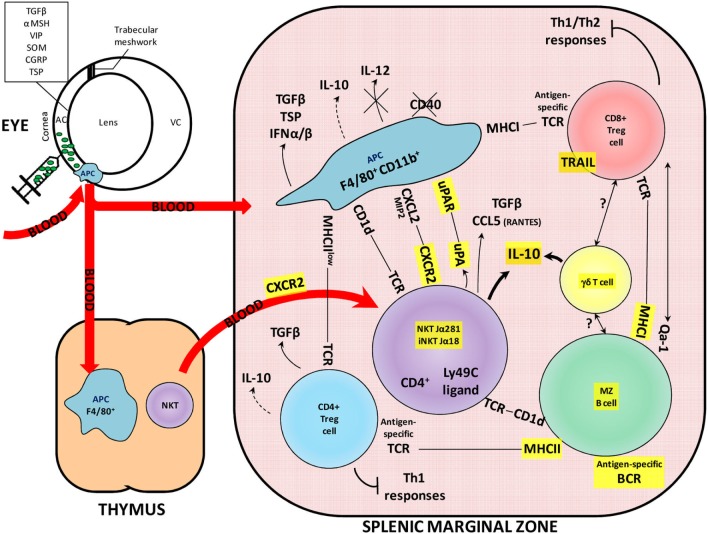
Anterior chamber-associated immune deviation (ACAID) is a well-known phenomenon that can occur after an antigen is introduced without any danger signal into the anterior chamber of a murine eye. It is reported to lead to an antigen-specific immune deviation throughout the body. Despite the relatively little evidence of this phenomenon in humans, it has been suggested as a potential prophylactic strategy in allograft rejections and in several autoimmune diseases. Cellular and molecular mechanisms of ACAID have been explored in different murine models mainly as proofs of concept, first by direct analyses of immune components in normal immunocompetent settings and by cell transfer experiments. Later, use of knockout (KO) mice has helped considerably to decipher ACAID mechanisms. However, several factors raise questions about the reliability and validity of studies using KO murine models. This mini-review summarizes results obtained with KO mice and discusses their advantages, their potential weaknesses, and their potential methods for further progress.
前房相关免疫偏离(ACAID)是一种众所周知的现象,当抗原在没有任何危险信号的情况下被引入小鼠眼前房后就会发生。据报道,它会导致全身出现抗原特异性免疫偏离。尽管在人类中这种现象的证据相对较少,但它已被提议作为同种异体移植排斥反应和几种自身免疫性疾病的一种潜在预防策略。主要在不同的小鼠模型中探索了ACAID的细胞和分子机制,主要作为概念验证,首先是在正常免疫活性环境中对免疫成分进行直接分析以及通过细胞转移实验。后来,基因敲除(KO)小鼠的使用在很大程度上有助于解读ACAID机制。然而,有几个因素对使用KO小鼠模型的研究的可靠性和有效性提出了疑问。这篇小型综述总结了使用KO小鼠获得的结果,并讨论了它们的优点、潜在弱点以及进一步取得进展的潜在方法。