Pang Xueqin, Li Rui, Shi Dongtao, Pan Xudong, Ma Chen, Zhang Guangbo, Mu Chuanyong, Chen Weichang
Department of Gastroenterology, The First Affiliated Hospital of Soochow University, Suzhou, Jiangsu 215006, P.R. China.
Department of Respiratory, The First Affiliated Hospital of Soochow University, Suzhou, Jiangsu 215006, P.R. China.
Oncol Lett. 2017 Dec;14(6):8028-8034. doi: 10.3892/ol.2017.7182. Epub 2017 Oct 13.
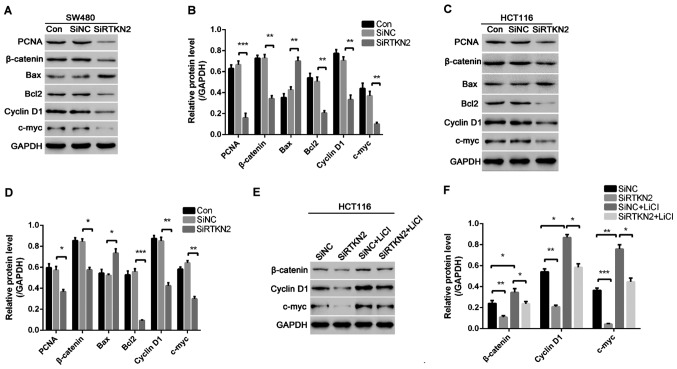
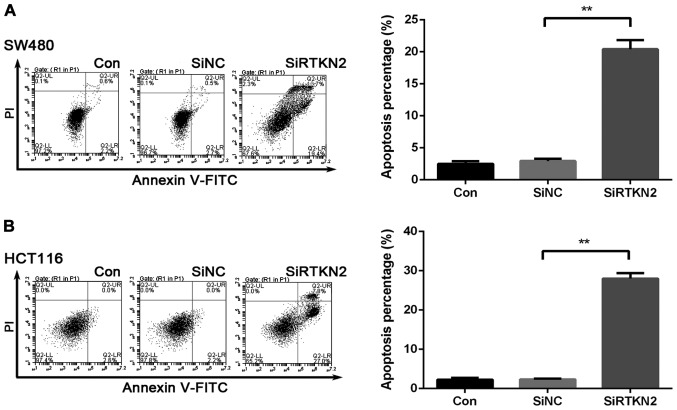
Colon cancer is one of the most common malignant tumors in the human body, ranking second as a gastrointestinal tumor. It has a high incidence in Europe, America and China and more than 1 million new cases of colon cancer are reported worldwide each year. The incidence of colon cancer in China has increased from 12/0.1 million in the early 1970s to 56/0.1 million at present with an annual growth rate of 4.2%, which far exceeds the international level (2%). Rhotekin (RTKN) 2, a Rho-guanosine triphosphatase (GTPase) effector, has been reported to be anti-apoptotic. However, the molecular mechanism underlying the biological function of RTKN2 in colon cancer remains unknown. The present study investigated whether the mRNA expression level of RTKN2 was markedly higher in 30 human colon cancer specimens compared with adjacent non-cancerous tissues. The results showed that the protein expression level of RTKN2 was significantly higher in SW480 and HCT116 cells, compared with HIEC cells. Knockdown of RTKN2 in the SW480 and HCT116 colon cancer cells, by lentivirus-mediated RNA interference led to the notable inhibition of cell proliferation and cell cycle progression, by reducing the expression levels of the PCDA, Cyclin D1 and c-myc cell cycle-associated proteins. The inhibitory effect of RTKN2 silencing on the proliferation of colon cancer cells may be partially realized by inhibiting the Wnt/β-catenin signaling pathway. Furthermore, the silencing of RTKN2 in the cells induced apoptosis by reducing the expression level of Bax and increasing the expression level of Bcl2. These results show that RTKN2 is involved in the carcinogenesis and progression of human colon cancer, indicating that RTKN2 may be a molecular target in colon cancer therapy.
结肠癌是人体最常见的恶性肿瘤之一,作为胃肠道肿瘤位居第二。它在欧美及中国的发病率都很高,全球每年报告的结肠癌新发病例超过100万。中国结肠癌的发病率已从20世纪70年代初的12/10万增至目前的56/10万,年增长率为4.2%,远远超过国际水平(2%)。Rhotekin(RTKN)2是一种Rho-鸟苷三磷酸酶(GTPase)效应器,据报道具有抗凋亡作用。然而,RTKN2在结肠癌中生物学功能的分子机制仍不清楚。本研究调查了30例人类结肠癌标本中RTKN2的mRNA表达水平是否明显高于相邻的非癌组织。结果显示,与HIEC细胞相比,RTKN2的蛋白表达水平在SW480和HCT116细胞中显著更高。通过慢病毒介导的RNA干扰敲低SW480和HCT116结肠癌细胞中的RTKN2,可通过降低PCDA、细胞周期蛋白D1和c-myc等细胞周期相关蛋白的表达水平,显著抑制细胞增殖和细胞周期进程。RTKN2沉默对结肠癌细胞增殖的抑制作用可能部分是通过抑制Wnt/β-连环蛋白信号通路实现的。此外,细胞中RTKN2的沉默通过降低Bax的表达水平和增加Bcl2的表达水平诱导细胞凋亡。这些结果表明,RTKN2参与了人类结肠癌的发生和发展,提示RTKN2可能是结肠癌治疗的一个分子靶点。