Pichler Renate, Heidegger Isabel
Department of Urology, Medical University Innsbruck, Anichstraße 35, 6020 Innsbruck, Austria.
Memo. 2017;10(4):206-212. doi: 10.1007/s12254-017-0344-2. Epub 2017 Aug 11.
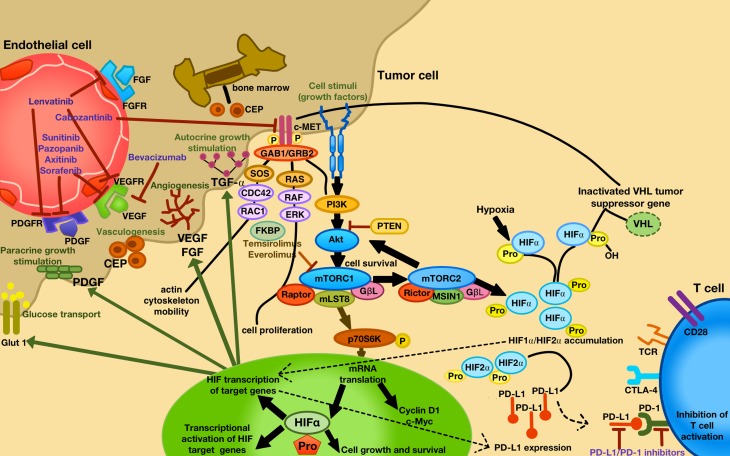
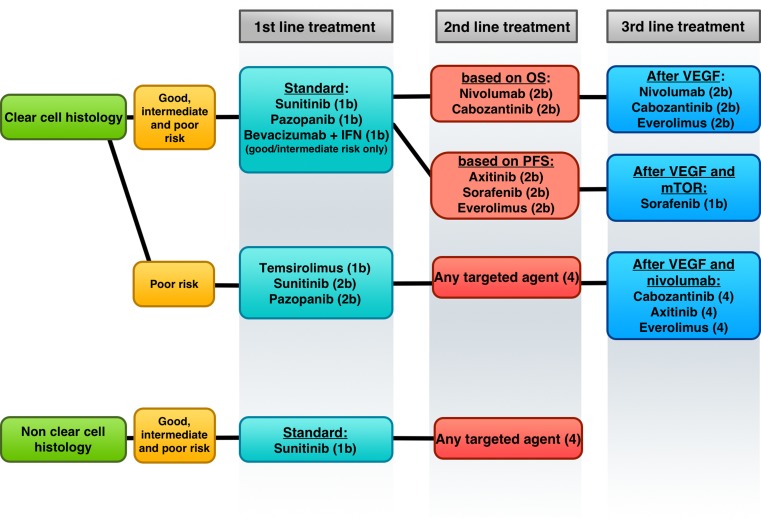
The era of antiangiogenic drugs targeting the vascular endothelial growth factor (VEGF) signaling pathway has become a mainstay in the treatment of metastatic renal cell carcinoma (mRCC), showing primary responses in 65-70% of patients. Nevertheless, most of those patients progress to angiogenesis inhibitors over time due to different modes of resistance (adaptive and intrinsic). Both in vitro and in vivo analyses provided evidence that PD-L1 upregulation in hypoxia conditions is dependent on hypoxia-inducible factor (HIF)-2alpha and is associated with an overexpression of VEGF. Thus, additional blockade of PD-L1 along with inhibition of angiogenesis pathways seems to represent a novel and innovative treatment concept in mRCC. In this short review, we provide an overview on ongoing phase III trials combining antiangiogenic therapies with checkpoint inhibitors in the first-line setting. Moreover, we critically analyze the impact of recently approved therapeutic antiangiogenic agents and checkpoint inhibitors after progression to first-generation tyrosine kinase inhibitors and their mode of action. In addition, response and resistance hypotheses and biomarkers to antiangiogenic therapy in clinical practice are critically discussed.
靶向血管内皮生长因子(VEGF)信号通路的抗血管生成药物时代已成为转移性肾细胞癌(mRCC)治疗的中流砥柱,65%-70%的患者出现初步反应。然而,随着时间的推移,这些患者中的大多数由于不同的耐药模式(适应性和固有性)而对血管生成抑制剂产生耐药。体外和体内分析均表明,缺氧条件下PD-L1的上调依赖于缺氧诱导因子(HIF)-2α,并与VEGF的过表达相关。因此,在抑制血管生成途径的同时额外阻断PD-L1似乎代表了mRCC一种全新的治疗理念。在这篇简短的综述中,我们概述了一线治疗中抗血管生成疗法与检查点抑制剂联合进行的III期临床试验。此外,我们批判性地分析了第一代酪氨酸激酶抑制剂进展后最近批准的治疗性抗血管生成药物和检查点抑制剂的影响及其作用方式。此外,还对临床实践中抗血管生成治疗的反应和耐药假说以及生物标志物进行了批判性讨论。