Kloos Anne D, Kegelmeyer Deb A, Fritz Nora E, Daley Allison M, Young Gregory S, Kostyk Sandra K
Division of Physical Therapy, College of Medicine, The Ohio State University, Columbus, OH, USA.
Department of Neurology, Program in Physical Therapy, College of Pharmacy and Health Sciences, College of Medicine, Wayne State University, Detroit, MI, USA.
J Huntingtons Dis. 2017;6(4):363-370. doi: 10.3233/JHD-170279.
Huntington's disease (HD) is a progressive neurodegenerative disorder that results in a gradual decline in mobility and balance. Increasing evidence has documented an important role of executive function in the safe ambulation of the elderly and people with a variety of neurological disorders. Little is known about the contribution of cognitive deficits to decline in mobility over time in HD.
This study examined the relationships of mobility, motor and cognitive function measures at baseline, and of mobility and cognitive measures over four years.
A retrospective chart review was performed on 70 patients with genetically confirmed HD (age 20-75 years old) across 121 HD clinic visits. Correlations between Unified Huntington's Disease Rating Scale - Total Motor, Tinetti Mobility Test (TMT), and cognitive measures (Letter Verbal Fluency, Symbol Digit Modalities Test (SDMT), and Stroop Test) were analyzed. Longitudinal relationships between TMT and cognitive measures were examined using mixed effect regression models.
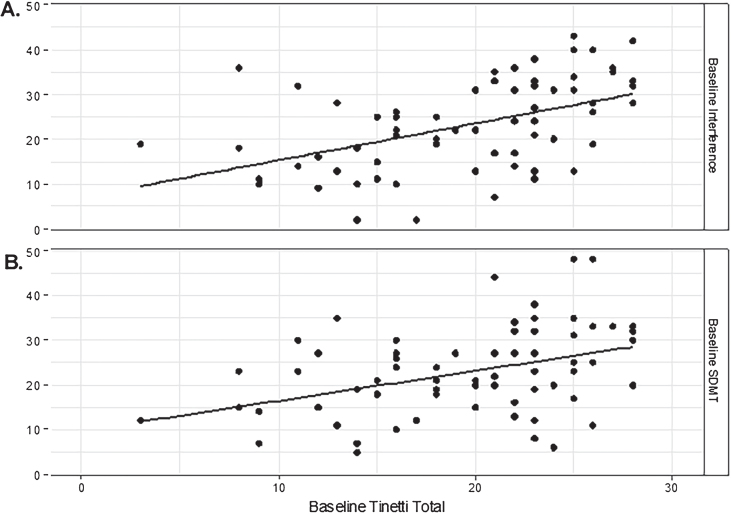
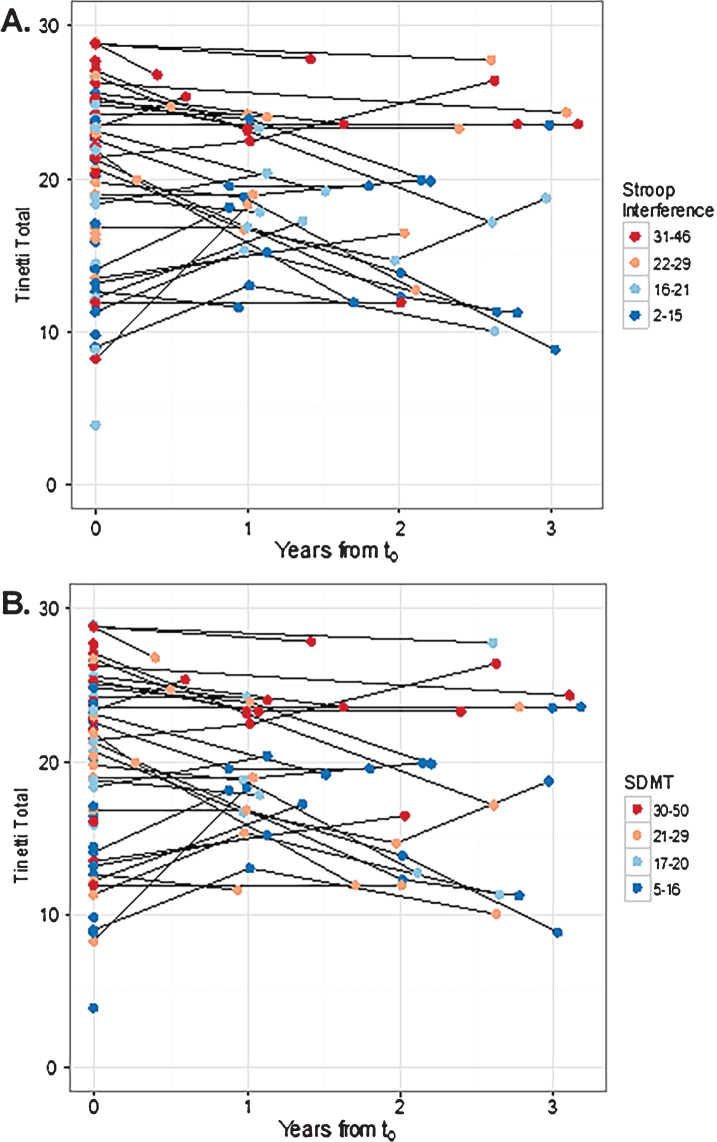
Gait and balance measures representing domains of mobility (TMT scores) were significantly correlated with each of the cognitive measures with the exception of the Verbal Fluency score. Mixed effects regression modeling showed that the Stroop Interference sub-test and SDMT were significant predictors (p-values <0.01) of TMT total scores.
Impairments in executive function measures correlate highly with measures of gait, balance and mobility in individuals with HD. Interventions designed to improve mobility and decrease fall risk should also address issues of cognitive impairments with particular consideration given to interventions that may focus on motor-cognitive dual task training.
亨廷顿舞蹈症(HD)是一种进行性神经退行性疾病,会导致行动能力和平衡能力逐渐下降。越来越多的证据表明,执行功能在老年人及患有各种神经系统疾病的人群安全行走方面起着重要作用。关于认知缺陷对HD患者随时间推移行动能力下降的影响,人们了解甚少。
本研究考察了基线时行动能力、运动和认知功能指标之间的关系,以及四年间行动能力和认知指标之间的关系。
对70例基因确诊为HD的患者(年龄20 - 75岁)的121次HD门诊就诊记录进行回顾性图表审查。分析统一亨廷顿舞蹈病评定量表 - 总运动评分、Tinetti行动能力测试(TMT)与认知指标(字母言语流畅性、符号数字模式测试(SDMT)和Stroop测试)之间的相关性。使用混合效应回归模型检验TMT与认知指标之间的纵向关系。
代表行动能力领域的步态和平衡指标(TMT评分)与除言语流畅性评分外的各项认知指标均显著相关。混合效应回归模型显示,Stroop干扰子测试和SDMT是TMT总分的显著预测因子(p值<0.01)。
HD患者的执行功能指标受损与步态、平衡和行动能力指标高度相关。旨在改善行动能力和降低跌倒风险的干预措施也应解决认知障碍问题,尤其要考虑可能侧重于运动 - 认知双重任务训练的干预措施。