Meng Ze-Wu, Pan Wei, Hong Hai-Jie, Chen Jiang-Zhi, Chen Yan-Ling
Department of Hepatobiliary Surgery, Fujian Medical University Union Hospital, Fuzhou, Fujian 350001, People's Republic of China.
Key Laboratory of Ministry of Education for Gastrointestinal Cancer, Fujian Medical University, Fuzhou, Fujian 350001, People's Republic of China.
Oncotarget. 2017 Sep 15;8(60):101165-101174. doi: 10.18632/oncotarget.20932. eCollection 2017 Nov 24.
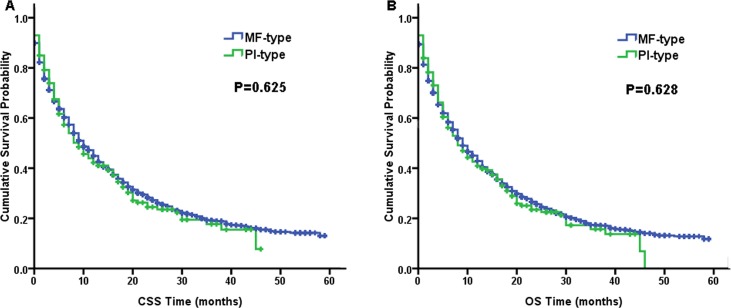
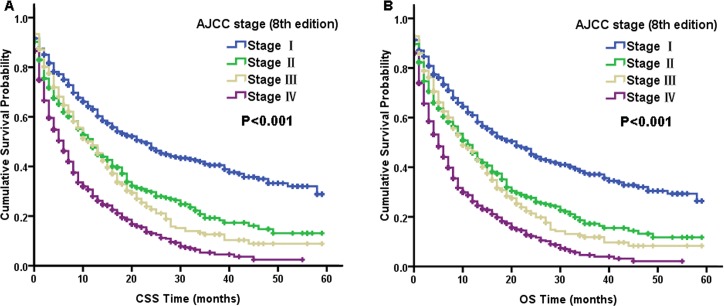
The prognosis of patients with intrahepatic cholangiocarcinoma (ICC) is undefined among the different macroscopic types. This study evaluated the viability of the American Joint Committee on Cancer (AJCC) 8th edition staging classification for different macroscopic types. Utilizing the Surveillance, Epidemiology, and End Results (SEER) database, we enrolled a total of 2,679 eligible patients with an estimated 199 periductal infiltrating type of ICC (ICC-PI) patients and 2,480 mass-forming type of ICC (ICC-MF) patients. After conducting a multivariate Cox analysis, we found that the AJCC 8th edition staging system was suitable for ICC-MF patients but not for ICC-PI patients according to cancer-specific survival (CSS) and overall survival (OS). The main reason was the similar hazard ratio (HR) between the ICC-PI patients with stage I and stage II disease according to CSS (HR:0.969, = 0.949) and OS (HR:0.832, = 0.703). Moreover, we found that ICC-PI patients in AJCC stage I had a similar HR as ICC-MF patients in AJCC stage II according to CSS (HR: 1.208, = 0.475) and OS (HR:1.206, = 0.456). Therefore, we suggested that ICC-PI patients may be defined as T2, which is classified as stage II disease. This suggestion for the AJCC 8th edition staging system would be more suitable for different macroscopic types of ICC but requires further verification in prospective clinical trials.
肝内胆管癌(ICC)患者在不同大体类型中的预后尚不明确。本研究评估了美国癌症联合委员会(AJCC)第8版分期分类对不同大体类型的适用性。利用监测、流行病学和最终结果(SEER)数据库,我们共纳入了2679例符合条件的患者,其中估计有199例为导管周围浸润型ICC(ICC-PI)患者和2480例肿块形成型ICC(ICC-MF)患者。在进行多因素Cox分析后,我们发现根据癌症特异性生存(CSS)和总生存(OS),AJCC第8版分期系统适用于ICC-MF患者,但不适用于ICC-PI患者。主要原因是根据CSS(风险比[HR]:0.969,P = 0.949)和OS(HR:0.832,P = 0.703),I期和II期ICC-PI患者的HR相似。此外,我们发现根据CSS(HR:1.208,P = 0.475)和OS(HR:1.206,P = 0.456),AJCC I期的ICC-PI患者与AJCC II期的ICC-MF患者的HR相似。因此,我们建议将ICC-PI患者定义为T2,归类为II期疾病。对AJCC第8版分期系统的这一建议可能更适用于不同大体类型的ICC,但需要在前瞻性临床试验中进一步验证。