Zhang Tao, Yang Xiaowen, Zhou Jianrui, Liu Pei, Wang Hui, Li Anrong, Zhou Yi
Department of Neurosurgery, Taihe Hospital, Hubei University of Medicine, Shiyan, Hubei, 442000, China.
Department of Clinical Laboratory, Taihe Hospital, Hubei University of Medicine, Shiyan, Hubei, 442000, China.
Oncotarget. 2017 Oct 19;8(60):102381-102391. doi: 10.18632/oncotarget.22057. eCollection 2017 Nov 24.
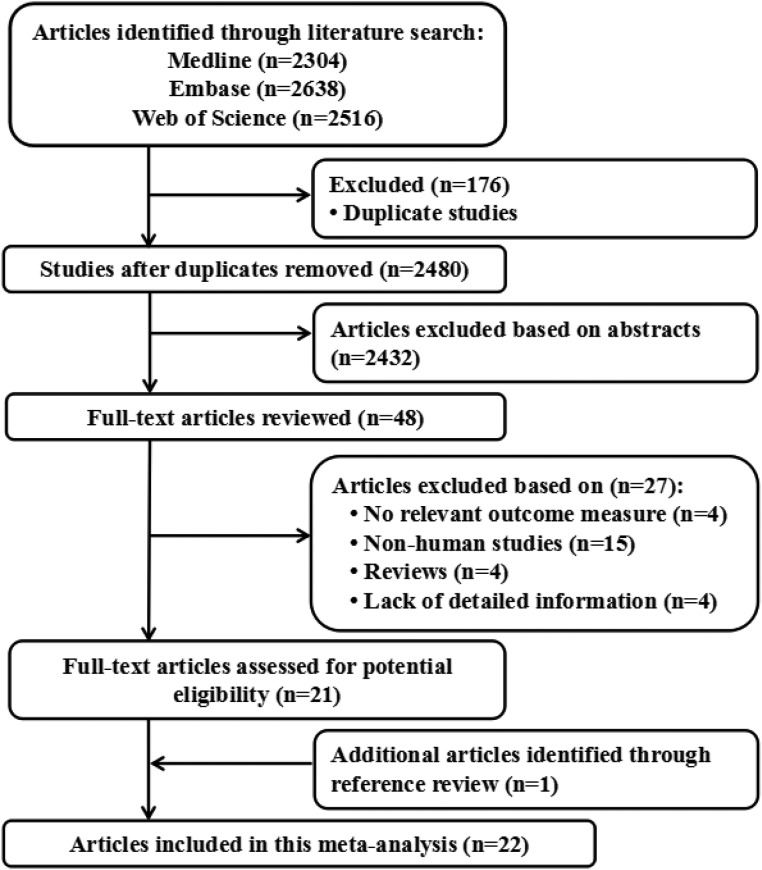
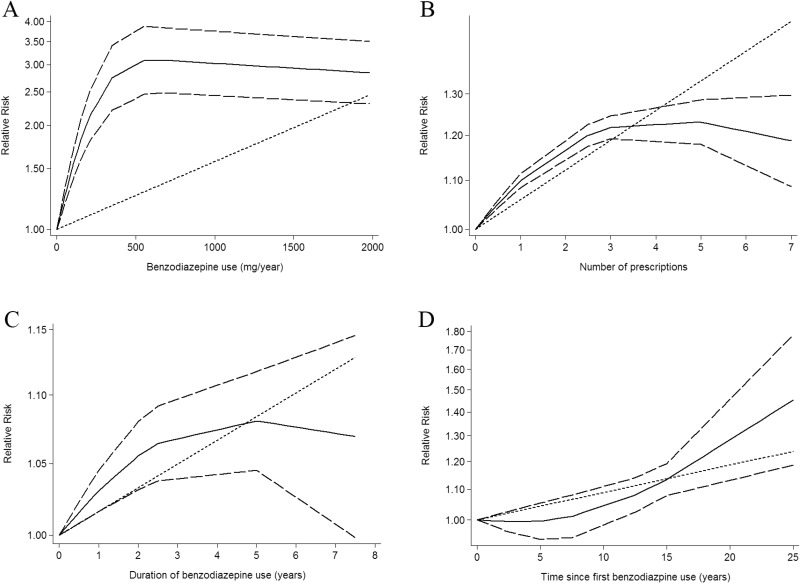
Conflicting results identifying the relationship between benzodiazepine drug use and cancer risk. Therefore, we conducted a dose-response meta-analysis of prospective cohort studies to clarify and quantitative assessed the relationship between benzodiazepine drug use and cancer risk. Up to July 2017, 22 original publications were included in current meta-analysis. Our results showed statistically significant association between benzodiazepine drug use and cancer risk (RR:1.25; 95% CI, 1.15-1.36). Subgroup analysis showed benzodiazepine using was associated with significantly a higher risk of breast cancer (RR:1.15; 95% CI, 1.05-1.26), ovarian cancer (RR:1.17; 95% CI, 1.09-1.25), colon cancer (RR:1.07; 95% CI, 1.02-1.13), renal cancer (RR:1.31; 95% CI, 1.15-1.49), malignant melanoma (RR:1.10; 95% CI, 1.03-1.17), brain cancer (RR:2.06; 95% CI, 1.76-2.43), esophagus cancer (RR:1.55; 95% CI, 1.30-1.85), prostate cancer (RR:1.26; 95% CI, 1.16-1.37), liver cancer (RR:1.22; 95% CI, 1.13-1.31), stomach cancer (RR:1.17; 95% CI, 1.03-1.32), pancreatic cancer (RR:1.39; 95% CI, 1.17-1.64) and lung cancer (RR:1.20; 95% CI, 1.12-1.28). Furthermore, a significant dose-response relationship was observed between benzodiazepine drug use and cancer risk (likelihood ratio test, < 0.001). Our results showed per 500 mg/year, per 5 year of time since first using, per 3 prescriptions and per 3 year of duration incremental increase in benzodiazepine drug use was associated with a 17%, 4%, 16% and 5% in cancer risk increment. Considering these promising results, increasing benzodiazepine using might be harmful for health.
关于苯二氮䓬类药物使用与癌症风险之间的关系,研究结果存在冲突。因此,我们进行了一项前瞻性队列研究的剂量反应荟萃分析,以阐明并定量评估苯二氮䓬类药物使用与癌症风险之间的关系。截至2017年7月,本荟萃分析纳入了22篇原始出版物。我们的结果显示,苯二氮䓬类药物使用与癌症风险之间存在统计学上的显著关联(风险比:1.25;95%置信区间,1.15 - 1.36)。亚组分析显示,使用苯二氮䓬类药物与乳腺癌(风险比:1.15;95%置信区间,1.05 - 1.26)、卵巢癌(风险比:1.17;95%置信区间,1.09 - 1.25)、结肠癌(风险比:1.07;95%置信区间,1.02 - 1.13)、肾癌(风险比:1.31;95%置信区间,1.15 - 1.49)、恶性黑色素瘤(风险比:1.10;95%置信区间,1.03 - 1.17)、脑癌(风险比:2.06;95%置信区间,1.76 - 2.43)、食管癌(风险比:1.55;95%置信区间,1.30 - 1.85)、前列腺癌(风险比:1.26;95%置信区间,1.16 - 1.37)、肝癌(风险比:1.22;95%置信区间,1.13 - 1.31)、胃癌(风险比:1.17;95%置信区间,1.03 - 1.32)、胰腺癌(风险比:1.39;95%置信区间,1.17 - 1.64)和肺癌(风险比:1.20;95%置信区间,1.12 - 1.28)的风险显著升高相关。此外,观察到苯二氮䓬类药物使用与癌症风险之间存在显著的剂量反应关系(似然比检验,< 0.001)。我们的结果显示,苯二氮䓬类药物使用每增加500毫克/年、首次使用后每增加5年、每增加3次处方以及每增加3年使用时长,癌症风险分别增加17%、4%、16%和5%。考虑到这些有前景的结果,增加苯二氮䓬类药物的使用可能对健康有害。