Laboratory of Molecular Medicine, Boston Children's Hospital, Harvard Medical School, Boston, MA 02115.
Seqirus, Cambridge, MA 02139.
Proc Natl Acad Sci U S A. 2018 Jan 2;115(1):168-173. doi: 10.1073/pnas.1715471115. Epub 2017 Dec 18.
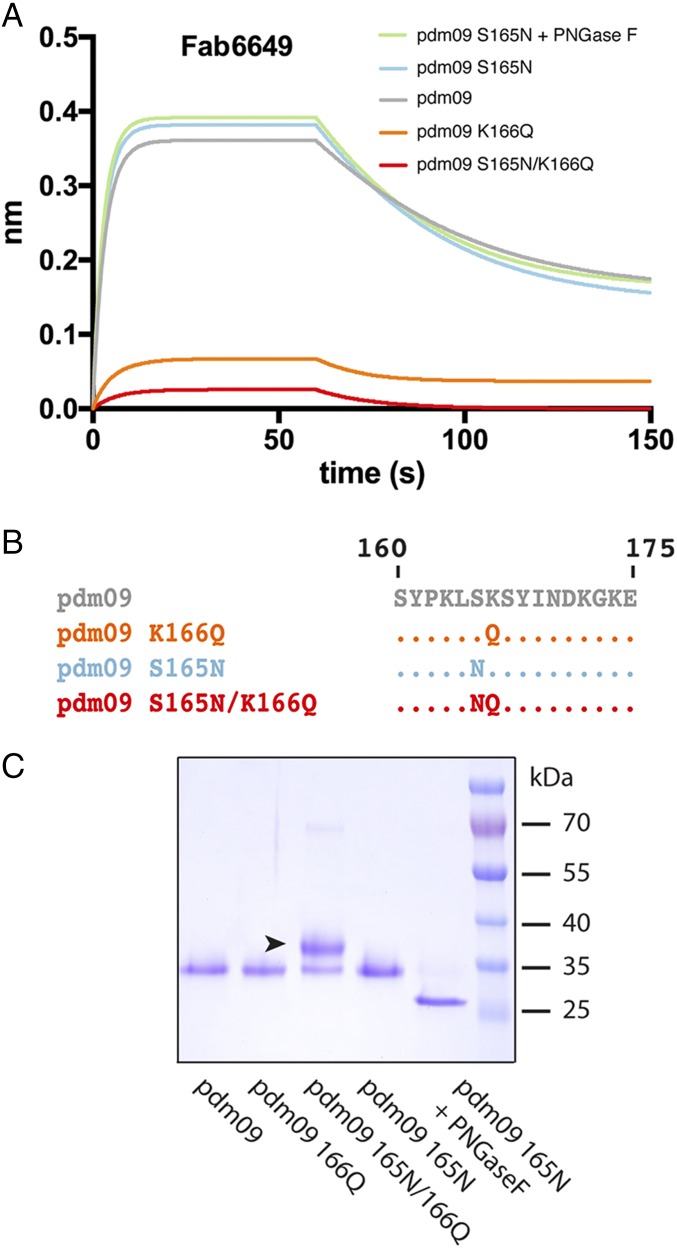
Circulating influenza viruses evade neutralization in their human hosts by acquiring escape mutations at epitopes of prevalent antibodies. A goal for next-generation influenza vaccines is to reduce escape likelihood by selectively eliciting antibodies recognizing conserved surfaces on the viral hemagglutinin (HA). The receptor-binding site (RBS) on the HA "head" and a region near the fusion peptide on the HA "stem" are two such sites. We describe here a human antibody clonal lineage, designated CL6649, members of which bind a third conserved site ("lateral patch") on the side of the H1-subtype, HA head. A crystal structure of HA with bound Fab6649 shows the conserved antibody footprint. The site was invariant in isolates from 1977 (seasonal) to 2012 (pdm2009); antibodies in CL6649 recognize HAs from the entire period. In 2013, human H1 viruses acquired mutations in this epitope that were retained in subsequent seasons, prompting modification of the H1 vaccine component in 2017. The mutations inhibit Fab6649 binding. We infer from the rapid spread of these mutations in circulating H1 influenza viruses that the previously subdominant, conserved lateral patch had become immunodominant for individuals with B-cell memory imprinted by earlier H1 exposure. We suggest that introduction of the pdm2009 H1 virus, to which most of the broadly prevalent, neutralizing antibodies did not bind, conferred a selective advantage in the immune systems of infected hosts to recall of memory B cells that recognized the lateral patch, the principal exposed epitope that did not change when pdm2009 displaced previous seasonal H1 viruses.
循环流感病毒通过在流行抗体的表位上获得逃逸突变来逃避人类宿主的中和作用。下一代流感疫苗的目标是通过选择性地诱导识别病毒血凝素 (HA) 表面保守区域的抗体来降低逃逸的可能性。HA“头部”上的受体结合位点 (RBS) 和 HA“茎”上靠近融合肽的区域就是这样的两个位点。我们在这里描述了一个人类抗体克隆谱系,称为 CL6649,其成员结合 H1 亚型 HA 头部侧面的第三个保守位点(“侧斑”)。与 Fab6649 结合的 HA 的晶体结构显示了保守的抗体足迹。该位点在 1977 年(季节性)到 2012 年(pdm2009)的分离株中是不变的;CL6649 中的抗体识别整个时期的 HA。2013 年,人类 H1 病毒在该表位获得了突变,这些突变在随后的季节中保留下来,促使 2017 年对 H1 疫苗成分进行了修改。这些突变抑制了 Fab6649 的结合。我们从循环 H1 流感病毒中这些突变的快速传播推断出,以前亚显性的保守侧斑已经成为了具有 B 细胞记忆的个体的免疫显性,这些记忆是由早期 H1 暴露所决定的。我们认为,pdm2009 H1 病毒的引入,使大多数广泛流行的、中和性的抗体无法结合,赋予了感染宿主免疫系统的选择性优势,以召回识别侧斑的记忆 B 细胞,当 pdm2009 取代以前的季节性 H1 病毒时,侧斑是主要暴露的表位,没有发生变化。