Chen Zhao-Shan, Huang Hsiang-Chi, Wang Xiangkun, Schön Karin, Jia Yane, Lebens Michael, Besavilla Danica F, Murti Janarthan R, Ji Yanhong, Sarshad Aishe A, Deng Guohua, Zhu Qiyun, Angeletti Davide
State Key Laboratory for Animal Disease Control and Prevention, College of Veterinary Medicine, Lanzhou University, Lanzhou Veterinary Research Institute, Chinese Academy of Agricultural Sciences, Lanzhou, China.
Department of Microbiology and Immunology, Institute of Biomedicine, University of Gothenburg, Gothenburg, Sweden.
Nat Commun. 2025 Jan 9;16(1):432. doi: 10.1038/s41467-024-55193-y.
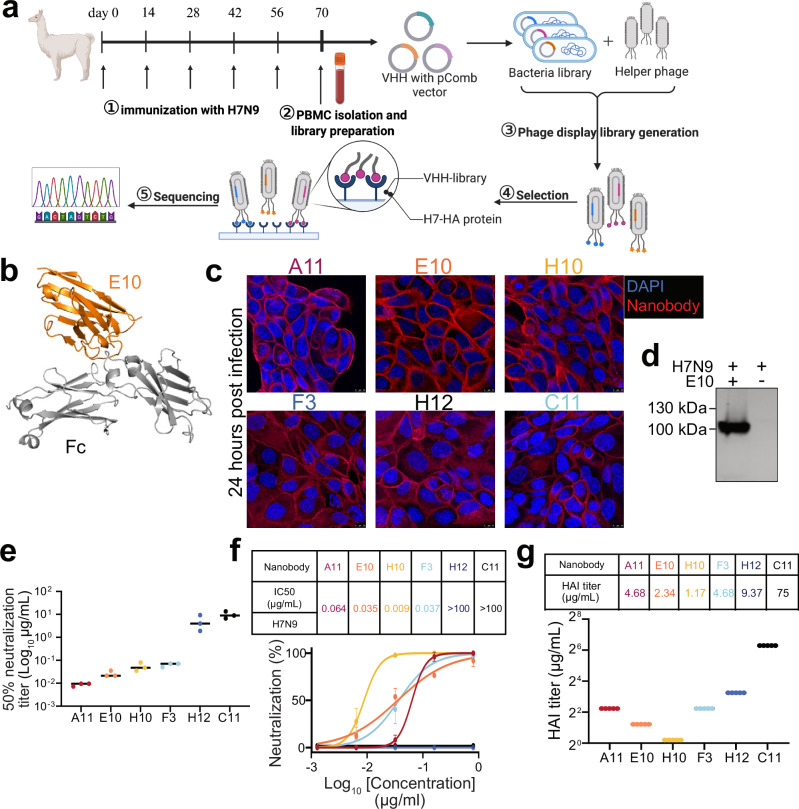
Influenza remains a persistent global health challenge, largely due to the virus' continuous antigenic drift and occasional shift, which impede the development of a universal vaccine. To address this, the identification of broadly neutralizing antibodies and their epitopes is crucial. Nanobodies, with their unique characteristics and binding capacity, offer a promising avenue to identify such epitopes. Here, we isolate and purify a hemagglutinin (HA)-specific nanobody that recognizes an H7 subtype of influenza A virus. The nanobody, named E10, exhibits broad-spectrum binding, cross-group neutralization and in vivo protection across various influenza A subtypes. Through phage display and in vitro characterization, we demonstrate that E10 specifically targets an epitope on HA head which is part of the conserved lateral patch and is highly immunodominant upon H7 infection. Importantly, immunization with a peptide including the E10 epitope elicits cross-reactive antibodies and mediates partial protection from lethal viral challenge. Our data highlights the potential of E10 and its associated epitope as a candidate for future influenza prevention strategies.
流感仍然是一个持续存在的全球健康挑战,这主要是由于该病毒不断的抗原漂移和偶尔的抗原转变,这阻碍了通用疫苗的研发。为了解决这一问题,识别广泛中和抗体及其表位至关重要。纳米抗体凭借其独特的特性和结合能力,为识别此类表位提供了一条有前景的途径。在此,我们分离并纯化了一种识别甲型流感病毒H7亚型的血凝素(HA)特异性纳米抗体。该纳米抗体名为E10,对各种甲型流感病毒亚型表现出广谱结合、跨组中和及体内保护作用。通过噬菌体展示和体外表征,我们证明E10特异性靶向HA头部的一个表位,该表位是保守侧向区域的一部分,在H7感染时具有高度免疫显性。重要的是,用包含E10表位的肽进行免疫可引发交叉反应抗体,并介导对致死性病毒攻击的部分保护作用。我们的数据突出了E10及其相关表位作为未来流感预防策略候选物的潜力。