Wang Hui, Rehman Kashif Ur, Liu Xiu, Yang Qinqin, Zheng Longyu, Li Wu, Cai Minmin, Li Qing, Zhang Jibin, Yu Ziniu
State Key Laboratory of Agricultural Microbiology, National Engineering Research Center of Microbial Pesticides, College of Life Science and Technology, Huazhong Agricultural University, Wuhan, People's Republic of China.
Livestock and Dairy Development Department, Punjab, Pakistan.
Biotechnol Biofuels. 2017 Dec 14;10:304. doi: 10.1186/s13068-017-0986-7. eCollection 2017.
As a major lignocellulosic biomass, which represented more than half of the world's agricultural phytomass, crop residues have been considered as feedstock for biofuel production. However, large-scale application of this conventional biofuel process has been facing obstacles from cost efficiency, pretreatment procedure, and secondary pollution. To meet the growing demands for food, feed, and energy as the global population continues to grow, certain kinds of insects, many of which are voracious feeders of organic wastes that may help address environmental, economic, and health issues, have been highlighted as a source of protein and fat.
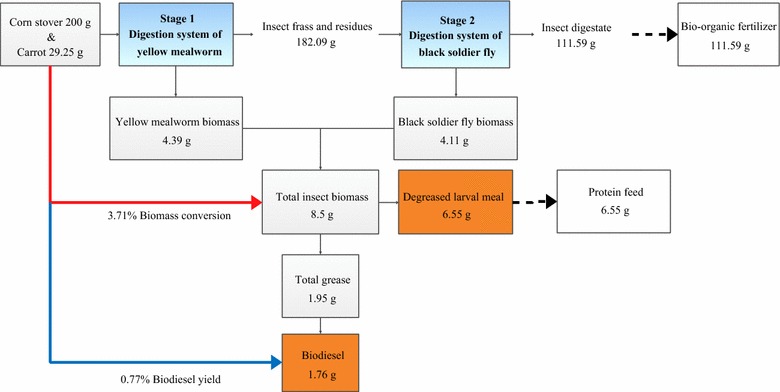
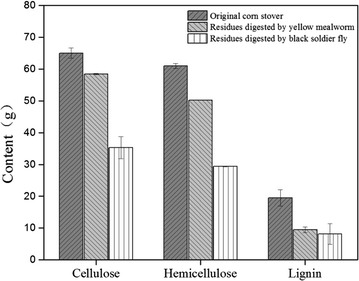
The biorefinery studied includes initial corn stover degradation by yellow mealworm ( L.), followed by a second stage that employs black soldier fly ( L.), to utilize the residues produced during the first stage. These two insect-based biorefinery yielded 8.50 g of insect biomass with a waste dry mass reduction rate of 51.32%, which resulted in 1.95 g crude grease from larval biomass that produced 1.76 g biodiesel, 6.55 g protein, and 111.59 g biofertilizer. The conversion rate of free fatty acids of crude grease into biodiesel reached 90%. The components of cellulose, hemicellulose, and lignin contained in corn stover hydrolyzed harmoniously, resulting in declines of 45.69, 51.85, and 58.35%, respectively. Moreover, fluctuations in lipid, protein, and reducing sugar were also analyzed.
The investigation findings demonstrated that successive co-conversion of corn stover by insects possessing different feeding habits could be an attractive option for efficient utilization of lignocellulosic resources, and represents a potentially valuable solution to crop residues management, rise of global liquid energy, and animal feed demand.
作为一种主要的木质纤维素生物质,作物秸秆占全球农业植物生物质的一半以上,一直被视为生物燃料生产的原料。然而,这种传统生物燃料工艺的大规模应用面临着成本效益、预处理程序和二次污染等障碍。随着全球人口持续增长,为满足对食物、饲料和能源日益增长的需求,某些种类的昆虫,其中许多是有机废物的贪婪食客,可能有助于解决环境、经济和健康问题,已被视为蛋白质和脂肪的来源。
所研究的生物精炼工艺包括先用黄粉虫(鞘翅目拟步甲科粉甲属)对玉米秸秆进行初步降解,然后进入第二阶段,利用黑腹果蝇(双翅目果蝇科果蝇属)处理第一阶段产生的残余物。这两种基于昆虫的生物精炼工艺产生了8.50克昆虫生物质,废物干重减少率为51.32%,从幼虫生物质中得到1.95克粗油脂,这些粗油脂生产出1.76克生物柴油、6.55克蛋白质和111.59克生物肥料。粗油脂中游离脂肪酸转化为生物柴油的转化率达到90%。玉米秸秆中所含的纤维素、半纤维素和木质素成分得到了和谐水解,含量分别下降了45.69%、51.85%和58.35%。此外,还分析了脂质、蛋白质和还原糖的波动情况。
研究结果表明,利用具有不同食性的昆虫对玉米秸秆进行连续共转化,可能是高效利用木质纤维素资源的一个有吸引力的选择,是作物秸秆管理、全球液体能源增加和动物饲料需求的一个潜在有价值的解决方案。