Department of Psychiatry, Yale University School of Medicine, New Haven, CT, USA.
Department of Psychiatry, Yale University School of Medicine, New Haven, CT, USA.
Drug Alcohol Depend. 2018 Feb 1;183:162-168. doi: 10.1016/j.drugalcdep.2017.10.022. Epub 2017 Dec 7.
Poor performance on Drug Stroop tasks, which could indicate attentional bias to drug-related cues, craving, poor cognitive control (including poor response inhibition), has been associated with substance use severity, treatment retention and substance use treatment outcomes. Cognitive Behavioral Therapy (CBT) focuses on training in appraisal and coping strategies, including strategies to minimize the negative impact of triggers and coping with drug-cue-induced craving. One mechanism of action of CBT may be the strengthening of cognitive control processes and reduction of attentional bias to drug-related stimuli.
Methadone-maintained individuals with cocaine-use disorders, participating in a randomized controlled trial of treatment as usual (TAU) versus TAU plus access to computer-based CBT (CBT4CBT), completed a computerized Drug Stroop task at pre- and post-treatment. Analyses determined whether attentional bias toward drug-related stimuli changed differentially by treatment group or cocaine use outcomes across the treatment period and whether engagement in components of CBT4CBT or TAU treatment related to changes in attentional bias toward drug-related stimuli at post- versus pre-treatment.
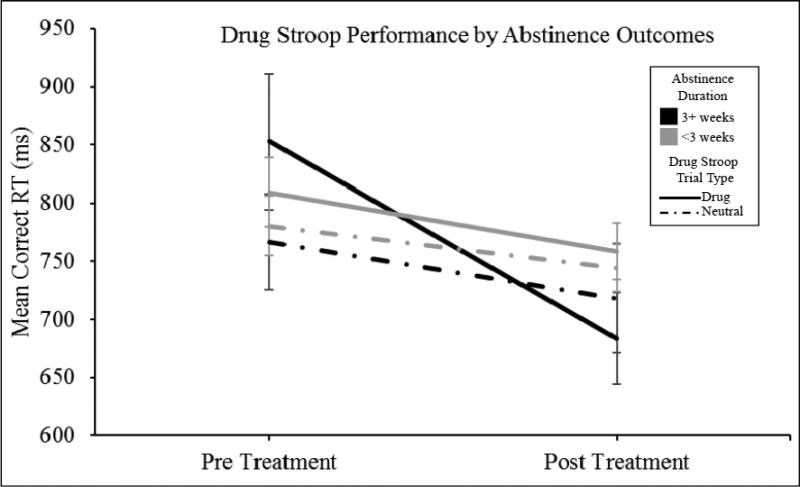
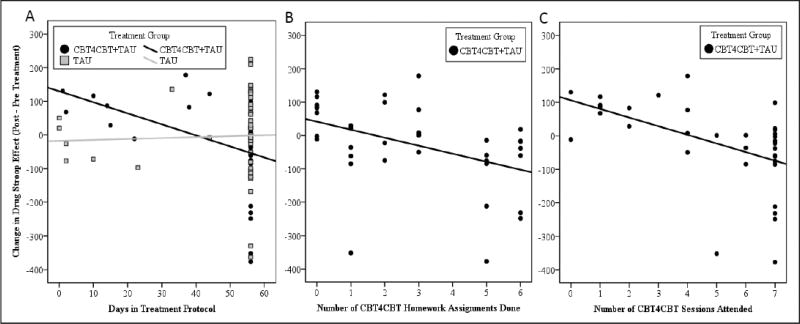
Participants achieving a longer duration of cocaine abstinence during treatment (3+ weeks) showed greater reductions in Drug Stroop Effect than those with shorter maximum continuous abstinence. Reductions in Drug Stroop Effect across treatment were associated with greater engagement with CBT4CBT-specific treatment components, but not TAU-specific treatment components.
Reduction in attentional bias to drug-related cues and craving and/or improved executive cognitive control and response inhibition may contribute to the mechanism of action of CBT4CBT.
在药物斯特鲁普任务中的表现不佳,可能表明对与药物相关的线索存在注意力偏向、渴求、认知控制能力差(包括反应抑制能力差),这与物质使用严重程度、治疗保留和物质使用治疗结果有关。认知行为疗法(CBT)专注于评估和应对策略的培训,包括最小化触发因素负面影响和应对药物线索诱发的渴求的策略。CBT 的一种作用机制可能是增强认知控制过程和减少对与药物相关刺激的注意力偏向。
参加了一项关于常规治疗(TAU)与 TAU 加获得基于计算机的 CBT(CBT4CBT)的随机对照试验的美沙酮维持个体,患有可卡因使用障碍,在治疗前和治疗后完成了计算机化的药物斯特鲁普任务。分析确定了注意力偏向是否因治疗组或可卡因使用结果而在治疗期间发生差异变化,以及 CBT4CBT 或 TAU 治疗的参与是否与治疗后与治疗前相比药物相关刺激的注意力偏向变化相关。
在治疗期间(3 周以上)实现可卡因禁欲时间更长的参与者,药物斯特鲁普效应的减少幅度大于最长连续禁欲时间较短的参与者。治疗过程中药物斯特鲁普效应的减少与对 CBT4CBT 特定治疗成分的更大参与相关,而与 TAU 特定治疗成分无关。
对与药物相关线索和渴求的注意力偏向的减少和/或执行认知控制和反应抑制能力的提高可能有助于 CBT4CBT 的作用机制。