Yale University School of Medicine, 40 Temple St, Ste 6C, New Haven, CT 06510.
Department of Psychiatry, Yale University School of Medicine, New Haven, Connecticut, USA.
J Clin Psychiatry. 2018 Jan/Feb;79(1). doi: 10.4088/JCP.17m11669.
To examine whether galantamine, a cognitive-enhancing medication that is both acetylcholinesterase inhibitor and agonist at nicotinic acetylcholine receptors, is effective at improving cocaine use outcomes and cognitive functioning, alone and in combination with computerized cognitive behavioral therapy (CBT).
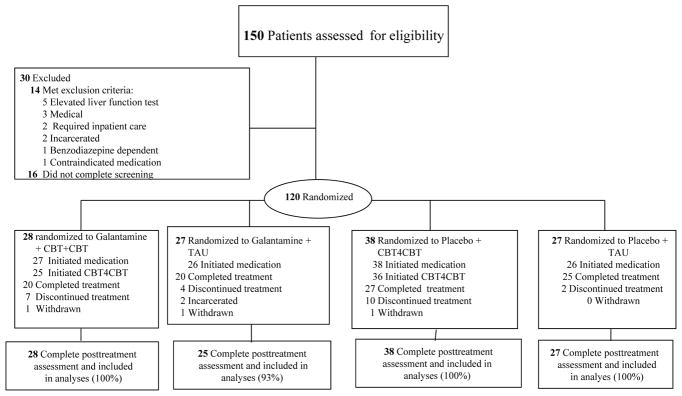
A 12-week, randomized 2 × 2, factorial trial was conducted to evaluate galantamine versus placebo (double-blind) and computerized CBT plus standard methadone treatment versus standard methadone treatment alone in a community-based methadone maintenance program (September 2009-April 2015). One hundred twenty individuals diagnosed with DSM-IV cocaine use disorder were randomly assigned to the following conditions: (1) galantamine (8 mg/d) plus standard methadone maintenance treatment (treatment as usual [TAU]), (2) placebo plus TAU, (3) galantamine plus computerized CBT plus TAU, or (4) placebo plus computerized CBT plus TAU; medication administration was supervised at the time of daily methadone dosing. The primary cocaine use outcome was change in percent days of abstinence over time. Number of cocaine-negative urine toxicology screens submitted and cognitive function were secondary outcomes.
Random effect regression analysis indicated significant reductions in frequency of cocaine use over time, with significant treatment-by-time effects for both galantamine over placebo (F = 5.3, P = .02, d = 0.34) and computerized CBT over standard methadone treatment (F = 4.2, P = .04, d = 0.30) but no evidence of significant benefit of the combination over either treatment alone. Pretreatment to posttreatment comparisons of multiple indices of cognitive functioning, including sustained attention, indicated no benefit of galantamine over placebo.
Findings suggest benefits of galantamine and computerized CBT for reducing cocaine use in this sample. Although galantamine did not improve measures of cognitive function in this sample, multiple measures of cognitive function were associated with cocaine use outcomes, underlining the significance of cognitive function in cocaine treatment outcomes.
ClinicalTrials.gov identifier: NCT00809835.
研究加兰他敏作为一种认知增强药物,同时作为乙酰胆碱酯酶抑制剂和烟碱型乙酰胆碱受体激动剂,是否单独或与计算机化认知行为疗法(CBT)联合使用,能改善可卡因使用结果和认知功能。
这是一项为期 12 周的随机 2×2 析因试验,在一个基于社区的美沙酮维持治疗项目中(2009 年 9 月至 2015 年 4 月),评估加兰他敏与安慰剂(双盲)以及计算机化 CBT 加标准美沙酮治疗与单独标准美沙酮治疗相比的效果。120 名被诊断为 DSM-IV 可卡因使用障碍的个体被随机分配到以下条件:(1)加兰他敏(8mg/d)加标准美沙酮维持治疗(常规治疗);(2)安慰剂加常规治疗;(3)加兰他敏加计算机化 CBT 加常规治疗;(4)安慰剂加计算机化 CBT 加常规治疗;药物管理在每日美沙酮给药时进行监督。主要可卡因使用结果是随时间变化的禁欲天数百分比的变化。提交的可卡因阴性尿液毒理学筛查次数和认知功能是次要结果。
随机效应回归分析表明,可卡因使用频率随时间显著降低,加兰他敏优于安慰剂(F=5.3,P=0.02,d=0.34)和计算机化 CBT 优于标准美沙酮治疗(F=4.2,P=0.04,d=0.30)的治疗时间效应均有统计学意义,但联合治疗并未优于单独治疗。认知功能的多个指标的预处理到后处理比较,包括持续注意力,加兰他敏并不优于安慰剂。
研究结果表明,加兰他敏和计算机化 CBT 对减少该样本中的可卡因使用有好处。尽管加兰他敏在该样本中并未改善认知功能的测量,但多项认知功能测量与可卡因使用结果相关,这强调了认知功能在可卡因治疗结果中的重要性。
ClinicalTrials.gov 标识符:NCT00809835。