Perdrix Anne, Najem Ahmad, Saussez Sven, Awada Ahmad, Journe Fabrice, Ghanem Ghanem, Krayem Mohammad
Laboratory of Oncology and Experimental Surgery, Institut Jules Bordet, Université Libre de Bruxelles, 1 rue Heger-Bordet, 1000 Brussels, Belgium.
Clinical Laboratory, Department of Biopathology, Henri Becquerel Centre, 76038 Rouen, France.
Cancers (Basel). 2017 Dec 16;9(12):172. doi: 10.3390/cancers9120172.
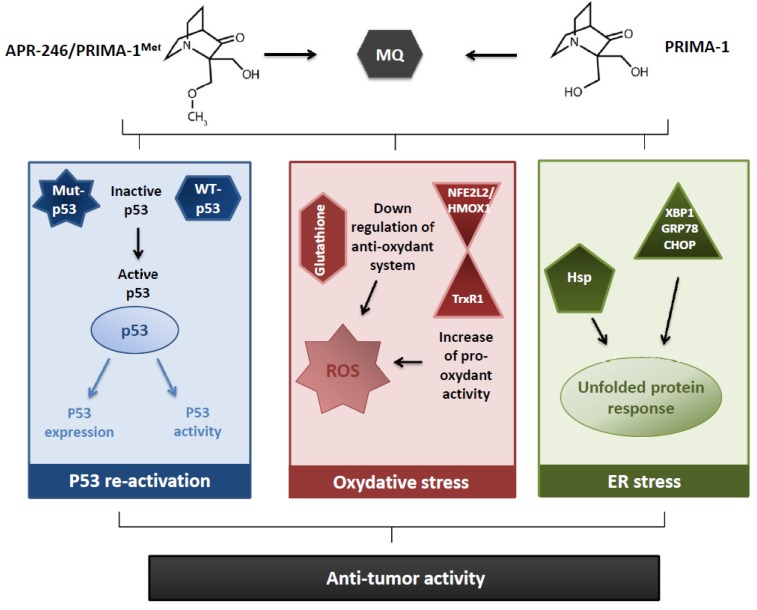
p53 protects cells from genetic assaults by triggering cell-cycle arrest and apoptosis. Inactivation of p53 pathway is found in the vast majority of human cancers often due to somatic missense mutations in TP53 or to an excessive degradation of the protein. Accordingly, reactivation of p53 appears as a quite promising pharmacological approach and, effectively, several attempts have been made in that sense. The most widely investigated compounds for this purpose are PRIMA-1 (p53 reactivation and induction of massive apoptosis )and PRIMA-1 (APR-246), that are at an advanced stage of development, with several clinical trials in progress. Based on publications referenced in PubMed since 2002, here we review the reported effects of these compounds on cancer cells, with a specific focus on their ability of p53 reactivation, an overview of their unexpected anti-cancer effects, and a presentation of the investigated drug combinations.
p53通过触发细胞周期停滞和凋亡来保护细胞免受基因攻击。在绝大多数人类癌症中都发现p53通路失活,这通常是由于TP53中的体细胞错义突变或该蛋白的过度降解所致。因此,重新激活p53似乎是一种非常有前景的药理学方法,实际上已经在这方面进行了多次尝试。为此目的研究最广泛的化合物是PRIMA-1(p53重新激活和诱导大量凋亡)和PRIMA-1(APR-246),它们正处于开发的后期阶段,有多项临床试验正在进行。基于自2002年以来PubMed中引用的出版物,我们在此回顾这些化合物对癌细胞的报道作用,特别关注它们重新激活p53的能力、对其意外抗癌作用的概述以及对所研究药物组合的介绍。