School of Health Studies, University of Memphis, Memphis, TN 38152, USA.
BENEO-Institute, c/o BENEO GmbH, Wormser Str. 11, 67283 Obrigheim, Germany.
Nutrients. 2017 Dec 18;9(12):1372. doi: 10.3390/nu9121372.
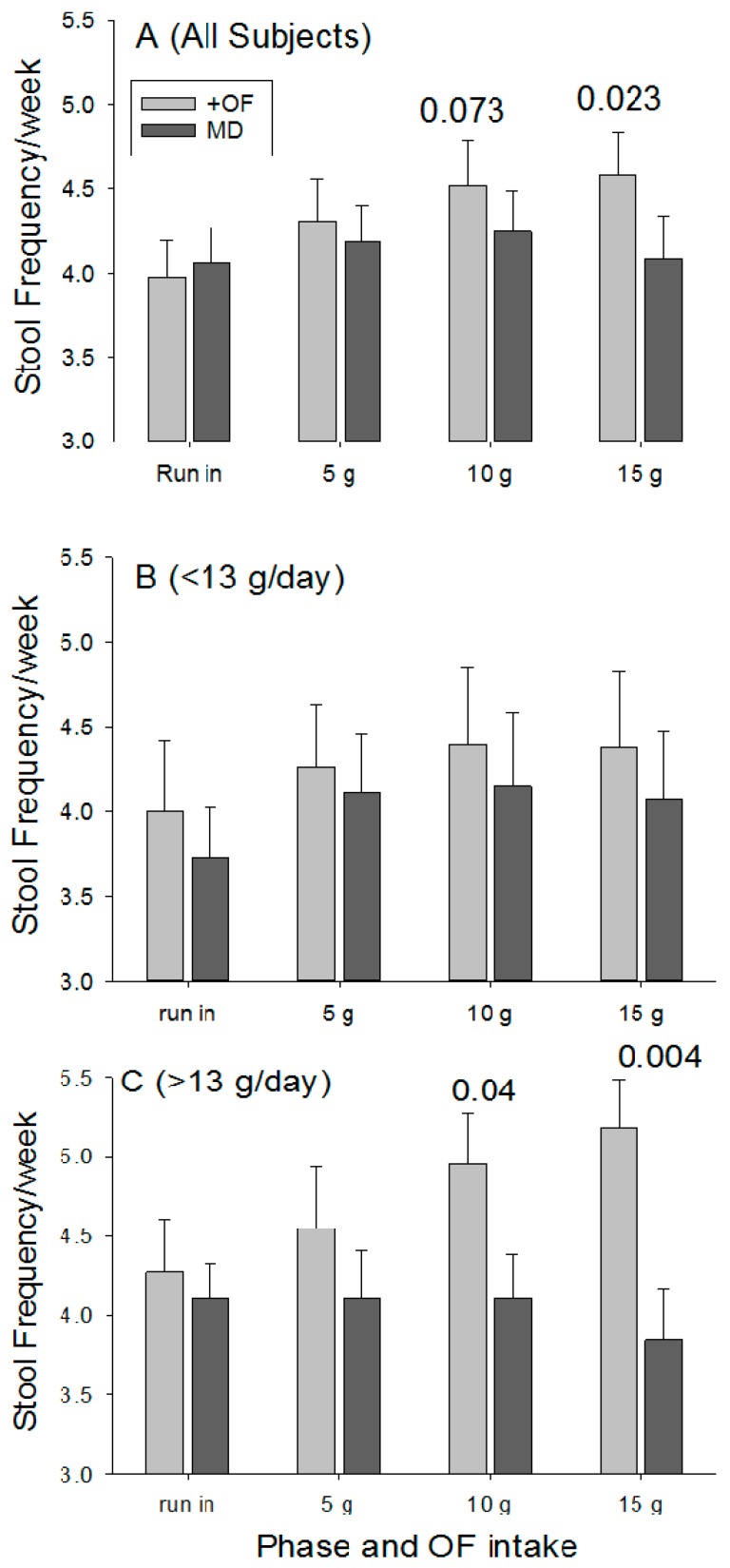
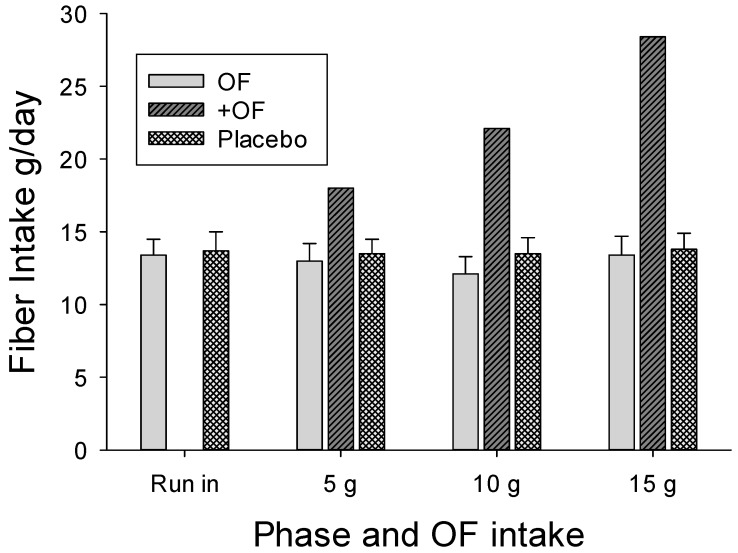
Inadequate dietary fiber intake contributes to the prevalent irregularity and constipation in Western countries. Although eating adequate amounts of fibers from fiber-rich foods, foods with added fibers and dietary fiber supplements is considered the first option for improving laxation, the efficacy can vary among types of fibers. The present study is a randomized control trial that included healthy adult participants with ≤3 bowel movements/week and a habitual low dietary fiber intake in a parallel design to evaluate the benefits for laxation by supplementing the daily diet with oligofructose (Orafti P95; OF), a fermentable source of fiber and established prebiotic ( = 49); maltodextrin was the placebo ( = 48). After a run-in phase, OF was initially provided at 5 g/day, then increased to 10 and 15 g/day with four weeks for each phase. Stool frequency (bowel movements per week) for the OF and maltodextrin (MD) groups were initially similar (3.98 ± 1.49 vs. 4.06 ± 1.48), did not change for the placebo group, but increased for the OF group with the difference significant at 15 g/day ( = 0.023). Stool consistency was similar and remained unchanged at all doses for both groups. Gastrointestinal sensations were low for both groups. Laxation benefits were especially pronounced for participants with >13 g/day habitual dietary fiber intake, with significant laxation at 10 g and 15 g OF/day ( = 0.04 and = 0.004, respectively) A daily supplement with a short-chain inulin-type fructan derived from chicory roots, i.e., oligofructose (Orafti P95) provided a laxation effect without causing gastrointestinal (GI) distress for healthy participants with irregularity associated with low dietary fiber intake.
膳食纤维摄入不足导致西方国家普遍存在的不规则排便和便秘。尽管从富含纤维的食物、添加纤维的食物和膳食纤维补充剂中摄入足够量的纤维被认为是改善排便的首选方法,但不同类型的纤维的效果可能有所不同。本研究是一项随机对照试验,纳入了每周排便次数≤3 次且习惯性膳食纤维摄入量低的健康成年参与者,采用平行设计,评估通过补充低聚果糖(Orafti P95;O)来改善排便的益处,O 是一种可发酵的纤维来源和已被证实的益生元(=49);麦芽糊精为安慰剂(=48)。在导入期后,O 最初以 5 g/天的剂量提供,然后在每个阶段增加到 10 g/天和 15 g/天,持续四周。O 组和麦芽糊精(MD)组的排便频率(每周排便次数)最初相似(3.98±1.49 比 4.06±1.48),安慰剂组没有变化,但 O 组随着剂量的增加而增加,差异在 15 g/天时有统计学意义(=0.023)。两组的粪便稠度相似且在所有剂量下均保持不变。两组的胃肠道感觉均较低。对于习惯性膳食纤维摄入量>13 g/天的参与者,O 的通便益处尤为明显,10 g 和 15 g O/天均有显著的通便作用(=0.04 和=0.004,分别)。每日补充菊苣根来源的短链菊粉型果聚糖,即低聚果糖(Orafti P95),可在不引起胃肠道(GI)不适的情况下为膳食纤维摄入不足导致排便不规则的健康参与者提供通便作用。