Krepkova Lubov V, Babenko Aleksandra N, Saybel' Olga L, Lupanova Irina A, Kuzina Olga S, Job Kathleen M, Sherwin Catherine M, Enioutina Elena Y
Center of Medicine, All-Russian Research Institute of Medicinal and Aromatic Plants (VILAR), Moscow, Russia.
Division of Clinical Pharmacology, Department of Pediatrics, University of Utah School of Medicine, Salt Lake City, UT, United States.
Front Pharmacol. 2021 Nov 18;12:738504. doi: 10.3389/fphar.2021.738504. eCollection 2021.
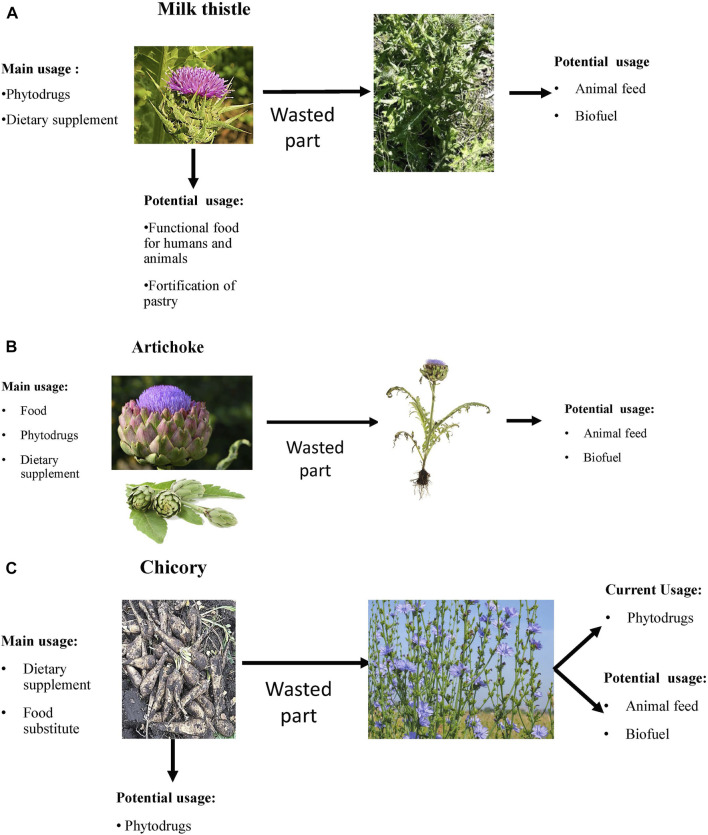
Humans used plants for thousand of years as food, drugs, or fuel to keep homes warm. People commonly used fruits and roots, and other parts of the plant were often wasted. This review aims to discuss the potential of rational stem-to-stern use of three highly versatile and valuable plants with hepatoprotective properties. Milk thistle ( L. Gaertn.), artichoke (), and chicory ( L.) have well-characterized hepatoprotective properties. These plants have been chosen since liver diseases are significant diseases of concern worldwide, and all parts of plants can be potentially utilized. Artichoke and chicory are commonly used as food or dietary supplements and less often as phytodrugs. Various dietary supplements and phytodrugs prepared from milk thistle (MT) fruits/seeds are well-known to consumers as remedies supporting liver functions. However, using these plants as functional food, farm animal feed, is not well-described in the literature. We also discuss bioactive constituents present in various parts of these plants, their pharmacological properties. Distinct parts of MT, artichoke, and chicory can be used to prepare remedies and food for humans and animals. Unused plant parts are potentially wasted. To achieve waste-free use of these and many other plants, the scientific community needs to analyze the complex use of plants and propose strategies for waste-free technologies. The government must stimulate companies to utilize by-products. Another problem associated with plant use as a food or source of phytodrug is the overharvesting of wild plants. Consequently, there is a need to use more active cultivation techniques for plants.
人类使用植物作为食物、药物或燃料来保持家庭温暖已有数千年历史。人们通常使用果实和根茎,而植物的其他部分往往被浪费。本综述旨在探讨合理地从头到尾利用三种具有高度通用性和价值且具有保肝特性的植物的潜力。水飞蓟(L. Gaertn.)、洋蓟()和菊苣(L.)具有明确的保肝特性。选择这些植物是因为肝脏疾病是全球关注的重大疾病,并且植物的各个部分都有可能得到利用。洋蓟和菊苣通常用作食物或膳食补充剂,较少用作植物药。消费者熟知各种由水飞蓟(MT)果实/种子制成的膳食补充剂和植物药是支持肝功能的药物。然而,将这些植物用作功能性食品、农场动物饲料在文献中描述较少。我们还讨论了这些植物不同部位存在的生物活性成分及其药理特性。水飞蓟、洋蓟和菊苣的不同部位可用于为人类和动物制备药物和食物。未使用的植物部分可能被浪费。为了实现这些以及许多其他植物的无废利用,科学界需要分析植物的综合利用并提出无废技术策略。政府必须激励企业利用副产品。与将植物用作食物或植物药来源相关的另一个问题是野生植物的过度采收。因此,需要对植物采用更积极的种植技术。