Abaza Haitham, Marschollek Michael
Peter L. Reichertz Institute for Medical Informatics, Hannover Medical School, Carl-Neuberg-Str. 1, 30625, Hannover, Germany.
BMC Public Health. 2017 Dec 19;17(1):962. doi: 10.1186/s12889-017-4973-5.
Due to the ubiquity of mobile phones in low and middle income countries, we aimed to examine the feasibility of SMS education among diabetic patients in Egypt, and assess the impact of educational text messages, compared to traditional paper-based methods, on glycemic control and self-management behaviors.
We conducted a 12-week randomized controlled trial at Misr University for Science & Technology hospital in Cairo-Egypt. Known as MUST diabetes awareness program, patients were included if they had diabetes, owned a mobile phone, and could read SMS messages or lived with someone that could read for them. Intervention patients received daily messages and weekly reminders addressing various diabetes care categories. We expected greater improvement in their glycemic control compared to controls who only received paper-based educational material. The primary outcome was the change in HbA1c, measured by the difference between endpoint and baseline values and by the number of patients who experienced at least 1% reduction from baseline to endpoint. Key secondary outcomes included blood glucose levels, body weight, treatment and medication adherence, self-efficacy, and diabetes knowledge. Data were analyzed using ANCOVA, chi-square, and t-tests.
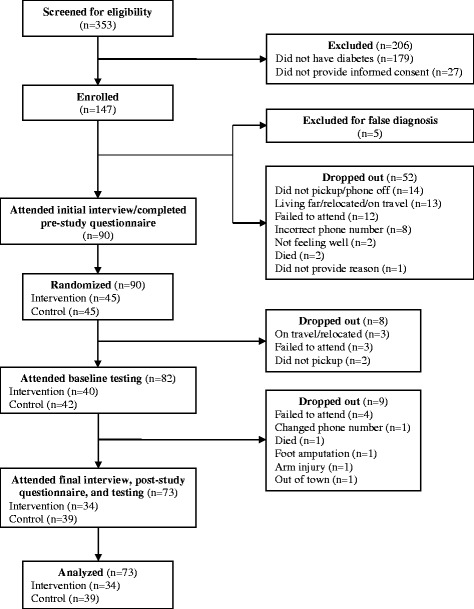
Thirty four intervention and 39 control patients completed the study. Over 12 weeks, 3880 messages were sent. Each intervention patient received 84 educational and 12 reminder messages plus one welcome message. Our primary outcome did not differ significantly (Δ 0.290; 95% CI -0.402 to 0.983; p = 0.406) between groups after 3 months, demonstrating a mean drop of -0.69% and -1.05% in the control and intervention group respectively. However, 16 intervention patients achieved the targeted 1% drop versus only 6 controls, suggesting clear association between study group and 1% HbA1c reductions (chi-square = 8.655; df = 1; p = 0.003). Secondary outcomes seemed in favor of intervention patients at endpoint, with considerable improvements in treatment and medication adherence, self-efficacy, and knowledge scores. Participants also indicated full satisfaction with the program.
SMS education is a feasible and acceptable method for improving glycemic control and self-management behaviors among Egyptian diabetics. However, whether it is more effective than traditional paper-based methods needs further investigation.
ClinicalTrials.gov NCT02868320 . Registered 9 August 2016. Retrospectively registered.
由于中低收入国家手机的普及,我们旨在研究在埃及糖尿病患者中开展短信教育的可行性,并评估与传统纸质方法相比,教育短信对血糖控制和自我管理行为的影响。
我们在埃及开罗的米斯尔科技大学医院进行了一项为期12周的随机对照试验。该试验称为MUST糖尿病认知项目,纳入的患者需患有糖尿病、拥有手机且能阅读短信,或者与能为其阅读的人同住。干预组患者每天接收短信,并每周收到针对各类糖尿病护理内容的提醒。我们预计与仅接受纸质教育材料的对照组相比,干预组患者的血糖控制会有更大改善。主要结局指标是糖化血红蛋白(HbA1c)的变化,通过终点值与基线值的差值以及从基线到终点至少降低1%的患者数量来衡量。关键次要结局指标包括血糖水平、体重、治疗和用药依从性、自我效能感以及糖尿病知识。数据采用协方差分析、卡方检验和t检验进行分析。
34名干预组患者和39名对照组患者完成了研究。在12周内,共发送了3880条短信。每位干预组患者收到84条教育短信、12条提醒短信以及1条欢迎短信。3个月后,两组间的主要结局指标无显著差异(差值为0.290;95%置信区间为-0.402至0.983;p = 0.406),对照组和干预组的糖化血红蛋白平均降幅分别为-0.69%和-1.05%;然而,16名干预组患者实现了目标降幅1%,而对照组仅有6名患者达到,这表明研究组与糖化血红蛋白降低1%之间存在明显关联(卡方值 = 8.655;自由度 = 1;p = 0.003)。次要结局指标在终点时似乎有利于干预组患者,治疗和用药依从性、自我效能感以及知识得分均有显著改善。参与者对该项目也表示完全满意。
短信教育是改善埃及糖尿病患者血糖控制和自我管理行为的一种可行且可接受的方法。然而,它是否比传统纸质方法更有效还需要进一步研究。
ClinicalTrials.gov NCT02868320。于2016年8月9日注册。回顾性注册。