Department of Neurology, University Hospital Zurich, , University of Zurich, Frauenklinikstrasse 26, 8091, Zurich, Switzerland.
Institute of Clinical Chemistry, University Hospital Bern, Bern, Switzerland.
Orphanet J Rare Dis. 2017 Dec 19;12(1):184. doi: 10.1186/s13023-017-0740-z.
Mitochondrial dysfunction may represent a pathogenic factor in Huntington disease (HD). Physical exercise leads to enhanced mitochondrial function in healthy participants. However, data on effects of physical exercise on HD skeletal muscle remains scarce. We aimed at investigating adaptations of the skeletal muscle mitochondria to endurance training in HD patients.
Thirteen HD patients and 11 healthy controls completed 26 weeks of endurance training. Before and after the training phase muscle biopsies were obtained from M. vastus lateralis. Mitochondrial respiratory chain complex activities, mitochondrial respiratory capacity, capillarization, and muscle fiber type distribution were determined from muscle samples.
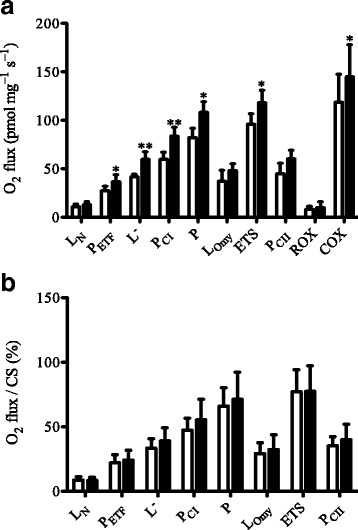
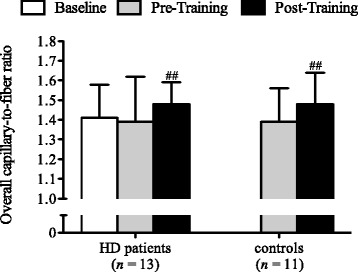
Citrate synthase activity increased during the training intervention in the whole cohort (P = 0.006). There was no group x time interaction for citrate synthase activity during the training intervention (P = 0.522). Complex III (P = 0.008), Complex V (P = 0.043), and succinate cytochrome c reductase (P = 0.008) activities increased in HD patients and controls by endurance training. An increase in mass-specific mitochondrial respiratory capacity was present in HD patients during the endurance training intervention. Overall capillary-to-fiber ratio increased in HD patients by 8.4% and in healthy controls by 6.4% during the endurance training intervention.
Skeletal muscle mitochondria of HD patients are equally responsive to an endurance-training stimulus as in healthy controls. Endurance training is a safe and feasible option to enhance indices of energy metabolism in skeletal muscle of HD patients and may represent a potential therapeutic approach to delay the onset and/or progression of muscular dysfunction.
ClinicalTrials.gov NCT01879267 . Registered May 24, 2012.
线粒体功能障碍可能是亨廷顿病(HD)的致病因素。体育锻炼可增强健康参与者的线粒体功能。然而,关于体育锻炼对 HD 骨骼肌的影响的数据仍然很少。我们旨在研究耐力训练对 HD 患者骨骼肌线粒体的适应性。
13 名 HD 患者和 11 名健康对照者完成了 26 周的耐力训练。在训练阶段前后,从股外侧肌获得肌肉活检。从肌肉样本中测定线粒体呼吸链复合物活性、线粒体呼吸能力、毛细血管化和肌纤维类型分布。
柠檬酸合酶活性在整个队列的训练干预过程中增加(P=0.006)。在训练干预过程中,柠檬酸合酶活性没有组 x 时间的相互作用(P=0.522)。HD 患者和对照组的复合物 III(P=0.008)、复合物 V(P=0.043)和琥珀酸细胞色素 c 还原酶(P=0.008)活性在耐力训练后增加。HD 患者的质量特异性线粒体呼吸能力在耐力训练干预期间增加。在耐力训练干预过程中,HD 患者的毛细血管与纤维比总体增加了 8.4%,健康对照组增加了 6.4%。
HD 患者的骨骼肌线粒体对耐力训练刺激的反应与健康对照组相同。耐力训练是增强 HD 患者骨骼肌能量代谢指标的安全可行选择,可能是延迟肌肉功能障碍发生和/或进展的潜在治疗方法。
ClinicalTrials.gov NCT01879267。注册于 2012 年 5 月 24 日。