Rodríguez-García Miguel Ángel, Gkoutos Georgios V, Schofield Paul N, Hoehndorf Robert
Computational Bioscience Research Center (CBRC), King Abdullah University of Science and Technology, 4700 KAUST, Thuwal, 23955-6900, Saudi Arabia.
Computer, Electrical and Mathematical Sciences & Engineering Division (CEMSE), King Abdullah University of Science and Technology, 4700 KAUST, PO Box 2882, Thuwal, 23955-6900, Saudi Arabia.
J Biomed Semantics. 2017 Dec 19;8(1):58. doi: 10.1186/s13326-017-0167-4.
Integration and analysis of phenotype data from humans and model organisms is a key challenge in building our understanding of normal biology and pathophysiology. However, the range of phenotypes and anatomical details being captured in clinical and model organism databases presents complex problems when attempting to match classes across species and across phenotypes as diverse as behaviour and neoplasia. We have previously developed PhenomeNET, a system for disease gene prioritization that includes as one of its components an ontology designed to integrate phenotype ontologies. While not applicable to matching arbitrary ontologies, PhenomeNET can be used to identify related phenotypes in different species, including human, mouse, zebrafish, nematode worm, fruit fly, and yeast.
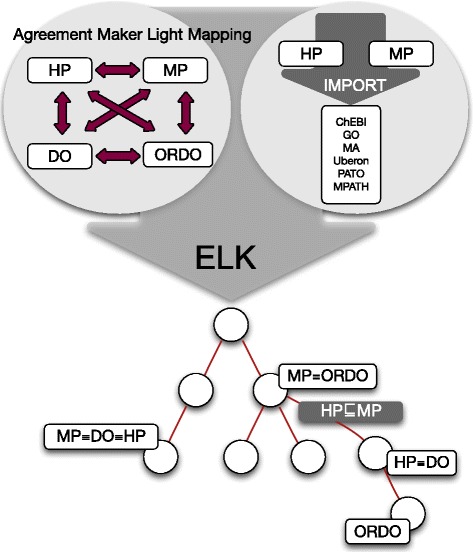
Here, we apply the PhenomeNET to identify related classes from two phenotype and two disease ontologies using automated reasoning. We demonstrate that we can identify a large number of mappings, some of which require automated reasoning and cannot easily be identified through lexical approaches alone. Combining automated reasoning with lexical matching further improves results in aligning ontologies.
PhenomeNET can be used to align and integrate phenotype ontologies. The results can be utilized for biomedical analyses in which phenomena observed in model organisms are used to identify causative genes and mutations underlying human disease.
整合和分析来自人类及模式生物的表型数据,是增进我们对正常生物学和病理生理学理解的一项关键挑战。然而,临床和模式生物数据库中所记录的表型范围及解剖学细节,在试图跨物种以及跨行为和肿瘤形成等多样的表型来匹配类别时,会带来复杂问题。我们之前开发了PhenomeNET,这是一个用于疾病基因优先级排序的系统,其组件之一是一个旨在整合表型本体的本体。虽然不适用于匹配任意本体,但PhenomeNET可用于识别不同物种(包括人类、小鼠、斑马鱼、线虫、果蝇和酵母)中的相关表型。
在此,我们应用PhenomeNET通过自动推理从两个表型本体和两个疾病本体中识别相关类别。我们证明,我们能够识别大量映射关系,其中一些需要自动推理,无法仅通过词汇方法轻易识别。将自动推理与词汇匹配相结合,能进一步提高本体对齐的结果。
PhenomeNET可用于对齐和整合表型本体。这些结果可用于生物医学分析,其中在模式生物中观察到的现象用于识别人类疾病背后的致病基因和突变。