Al Nimer Faiez, Jelcic Ivan, Kempf Christian, Pieper Tom, Budka Herbert, Sospedra Mireia, Martin Roland
Neuroimmunology and Multiple Sclerosis Research Section (F.A.N., I.J., C.K., M.S., R.M.), Department of Neurology, University Hospital Zurich, Switzerland; Neuropediatric Clinic and Clinic for Neurorehabilitation (T.P.), Epilepsy Center for Children and Adolescents, Schoen Klinik Vogtareuth, Germany; and Institute of Neuropathology (H.B.), University Hospital Zurich, Switzerland.
Neurol Neuroimmunol Neuroinflamm. 2017 Dec 8;5(1):e419. doi: 10.1212/NXI.0000000000000419. eCollection 2018 Jan.
To characterize the brain-infiltrating immune cell repertoire in Rasmussen encephalitis (RE) with special focus on the subsets, clonality, and their cytokine profile.
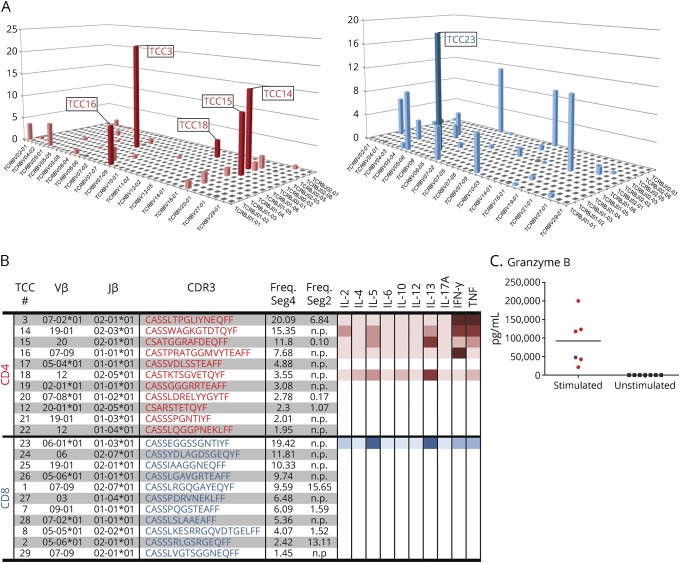
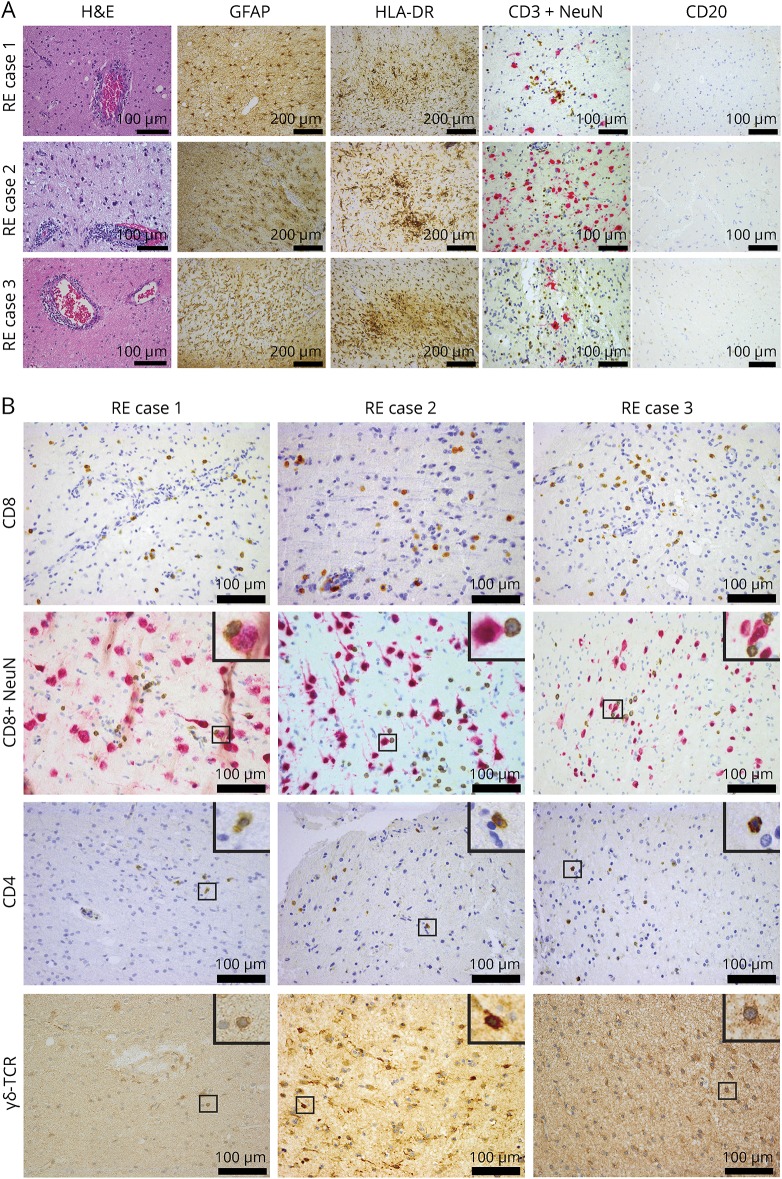
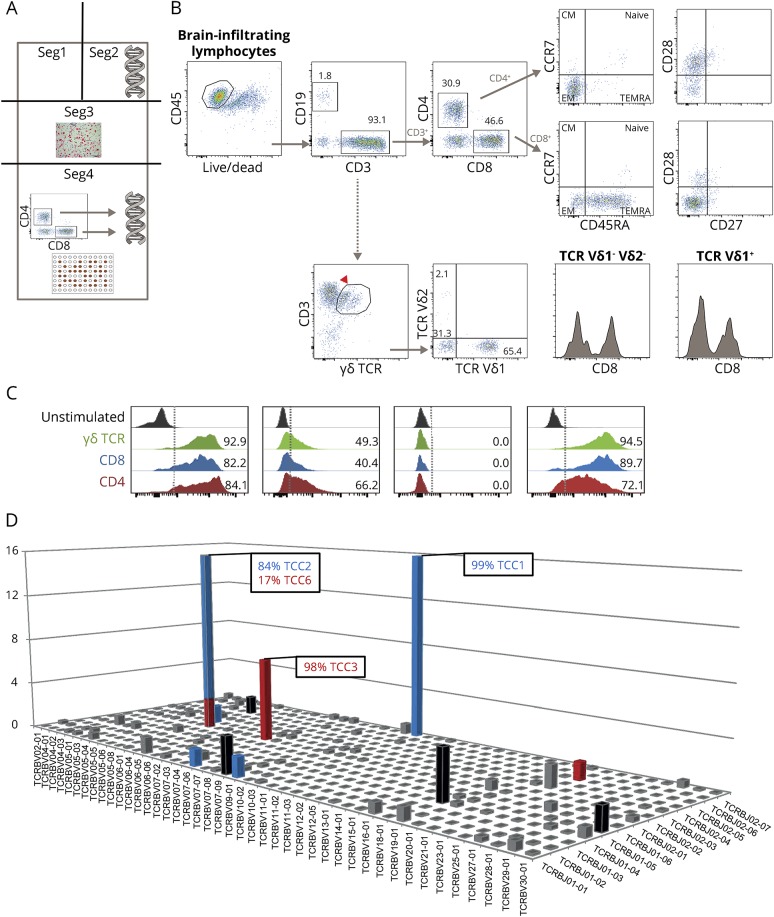
The immune cell infiltrate of freshly isolated brain tissue from RE was phenotypically and functionally characterized using immunohistology, flow cytometry, and T-cell receptor (TCR) deep sequencing. Identification of clonally expanded T-cell clones (TCCs) was achieved by combining flow cytometry sorting of CD4 and CD8 T cells and high-throughput TCR Vβ-chain sequencing. The most abundant brain-infiltrating TCCs were isolated and functionally characterized.
We found that CD4, CD8, and also γδ T cells infiltrate the brain tissue in RE. Further analysis surprisingly revealed that not only brain-infiltrating CD8 but also CD4 T cells are clonally expanded in RE. All 3 subsets exhibited a Tc1/Th1 phenotype characterized by the production of interferon (IFN)-γ and TNF. Broad cytokine profiling at the clonal level showed strong production of IFN-γ and TNF and also secretion of interleukin (IL)-5, IL-13, and granzyme B, both in CD4 and CD8 T cells.
CD8 T cells were until now considered the central players in the immunopathogenesis of RE. Our study adds to previous findings and highlights that CD4 TCCs and γδ T cells that secrete IFN-γ and TNF are also involved. These findings underline the complexity of T-cell immunity in RE and suggest a specific role for CD4 T cells in orchestrating the CD8 T-cell effector immune response.
明确拉斯穆森脑炎(RE)中浸润大脑的免疫细胞组成,特别关注其亚群、克隆性及其细胞因子谱。
运用免疫组织学、流式细胞术和T细胞受体(TCR)深度测序,对从RE新鲜分离的脑组织中的免疫细胞浸润进行表型和功能特征分析。通过结合CD4和CD8 T细胞的流式细胞术分选与高通量TCR Vβ链测序,鉴定克隆性扩增的T细胞克隆(TCCs)。分离出最丰富的浸润大脑的TCCs并进行功能特征分析。
我们发现CD4、CD8以及γδ T细胞浸润RE的脑组织。进一步分析令人惊讶地发现,不仅浸润大脑的CD8 T细胞,而且CD4 T细胞在RE中也发生克隆性扩增。所有3个亚群均表现出以产生干扰素(IFN)-γ和肿瘤坏死因子(TNF)为特征的Tc1/Th1表型。在克隆水平进行的广泛细胞因子分析显示,CD4和CD8 T细胞中均强烈产生IFN-γ和TNF,同时还分泌白细胞介素(IL)-5、IL-13和颗粒酶B。
迄今为止,CD8 T细胞被认为是RE免疫发病机制的核心参与者。我们的研究补充了先前的发现,并强调分泌IFN-γ和TNF的CD4 TCCs和γδ T细胞也参与其中。这些发现突显了RE中T细胞免疫的复杂性,并提示CD4 T细胞在协调CD8 T细胞效应免疫反应中具有特定作用。