Brenner Jacob S, Kiseleva Raisa Yu, Glassman Patrick M, Parhiz Hamideh, Greineder Colin F, Hood Elizabeth D, Shuvaev Vladimir V, Muzykantov Vladimir R
1 14640 Pulmonary, Allergy, & Critical Care Division, University of Pennsylvania, Philadelphia, PA, USA.
2 14640 Department of Pharmacology, The Perelman School of Medicine, University of Pennsylvania, Philadelphia, PA, USA.
Pulm Circ. 2018 Jan-Mar;8(1):2045893217752329. doi: 10.1177/2045893217752329. Epub 2017 Dec 20.
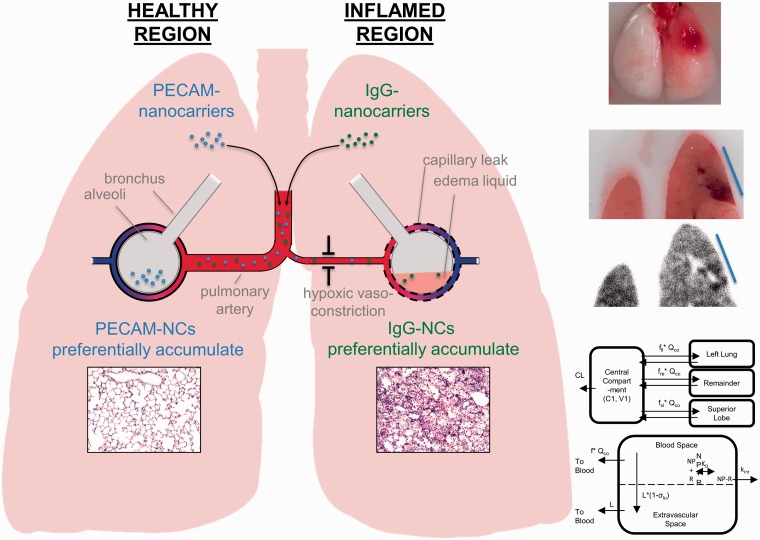
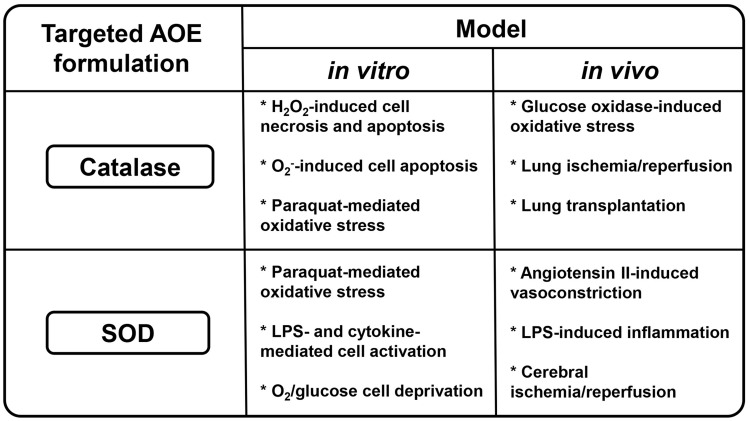
The pulmonary vasculature plays an important role in many lung pathologies, such as pulmonary arterial hypertension, primary graft dysfunction of lung transplant, and acute respiratory distress syndrome. Therapy for these diseases is quite limited, largely due to dose-limiting side effects of numerous drugs that have been trialed or approved. High doses of drugs targeting the pulmonary vasculature are needed due to the lack of specific affinity of therapeutic compounds to the vasculature. To overcome this problem, the field of targeted drug delivery aims to target drugs to the pulmonary endothelial cells, especially those in pathological regions. The field uses a variety of drug delivery systems (DDSs), ranging from nano-scale drug carriers, such as liposomes, to methods of conjugating drugs to affinity moieites, such as antibodies. These DDSs can deliver small molecule drugs, protein therapeutics, and imaging agents. Here we review targeted drug delivery to the pulmonary endothelium for the treatment of pulmonary diseases. Cautionary notes are made of the risk-benefit ratio and safety-parameters one should keep in mind when developing a translational therapeutic.
肺血管系统在许多肺部疾病中起着重要作用,如肺动脉高压、肺移植原发性移植物功能障碍和急性呼吸窘迫综合征。这些疾病的治疗方法非常有限,主要是因为许多已试验或批准的药物存在剂量限制副作用。由于治疗化合物对血管缺乏特异性亲和力,需要高剂量针对肺血管系统的药物。为了克服这个问题,靶向药物递送领域旨在将药物靶向肺内皮细胞,尤其是病理区域的细胞。该领域使用各种药物递送系统(DDS),从纳米级药物载体(如脂质体)到将药物与亲和部分(如抗体)偶联的方法。这些DDS可以递送小分子药物、蛋白质治疗剂和成像剂。在此,我们综述了靶向肺内皮细胞的药物递送用于治疗肺部疾病的情况。在开发转化治疗方法时,应注意风险效益比和安全参数。