Chen Rui, Xie Liping, Cai Xiaobing, Huang Yiran, Zhou Liqun, Ma Lulin, Gao Xu, Xu Chuanliang, Ren Shancheng, Shao Pengfei, Xu Danfeng, Xu Kexin, Ye Zhangqun, Liu Chunxiao, Ye Dingwei, Lu Li, Fu Qiang, Hou Jianquan, Yuan Jianlin, He Dalin, Zhou Tie, Wang Fubo, He Biming, Sun Yinghao
Department of Urology, Shanghai Changhai Hospital, Second Military Medical University, Shanghai, China.
Department of Urology, First Affiliated Hospital, School of Medicine, Zhejiang University, Hangzhou, China.
Asian J Urol. 2015 Apr;2(2):107-113. doi: 10.1016/j.ajur.2015.04.022. Epub 2015 Apr 16.
To test the diagnostic performance of percent free prostate-specific antigen (%fPSA) in predicting any prostate cancer (PCa) and high-grade prostate cancer (HGPCa) in a retrospective multi-center biopsy cohort with a PSA level of 4.0-10.0 ng/mL in China.
Consecutive patients with a PSA of 4.0-10.0 ng/mL who underwent transrectal ultrasound-guided biopsy were enrolled at 16 Chinese medical centers from January 1st, 2010 to December 31st, 2013. Total and free serum PSA determinations were performed using three types of electro-chemiluminescence immunoassays recalibrated to the World Health Organization (WHO) standard. The diagnostic accuracy of PSA, %fPSA, and %fPSA in combination with PSA (%fPSA + PSA) was determined using the area under the receiver operating characteristic (ROC) curve (AUC).
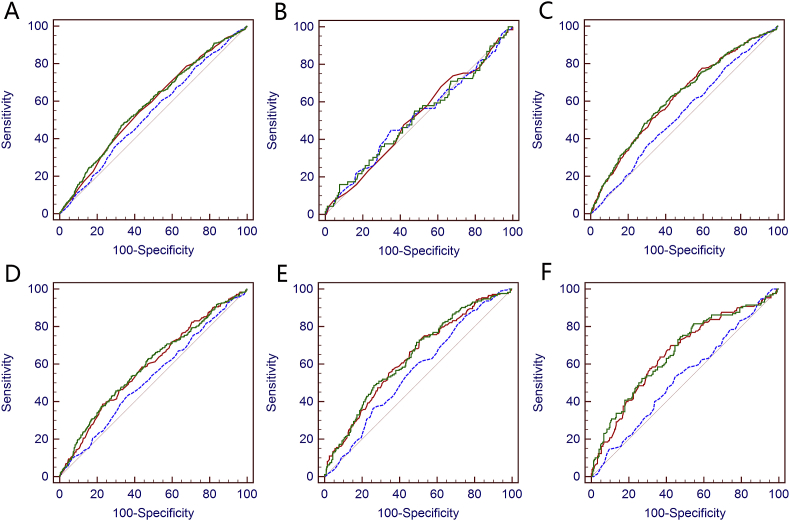
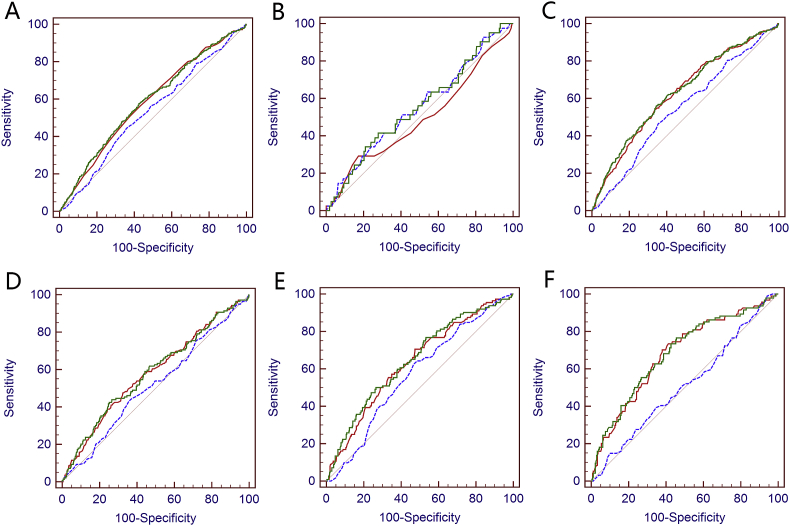
A total of 2310 consecutive men with PSA levels between 4.0 and 10.0 ng/mL were included, and the detection rate of PCa was 25.1%. The AUC of %fPSA and %fPSA + PSA in predicting any PCa was superior to PSA alone in men aged ≥60 years (0.623 0.534, < 0.0001) but not in men aged 40-59 years (0.517 0.518, = 0.939). Similar result was yield in predicting HGPCa.
In a clinical setting of Chinese men with 4.0-10.0 ng/mL PSA undergoing initial prostate biopsy, adding %fPSA to PSA can moderately improve the diagnostic accuracy for any PCa and HGPCa compared with PSA alone in patients ≥60 but not in patients aged 40-59 years.
在中国一个PSA水平为4.0 - 10.0 ng/mL的回顾性多中心活检队列中,检测游离前列腺特异性抗原百分比(%fPSA)预测任何前列腺癌(PCa)和高级别前列腺癌(HGPCa)的诊断性能。
2010年1月1日至2013年12月31日期间,在中国16个医学中心纳入连续的PSA为4.0 - 10.0 ng/mL且接受经直肠超声引导活检的患者。使用三种重新校准至世界卫生组织(WHO)标准的电化学发光免疫分析法进行总血清PSA和游离血清PSA测定。使用受试者操作特征(ROC)曲线下面积(AUC)确定PSA、%fPSA以及%fPSA联合PSA(%fPSA + PSA)的诊断准确性。
共纳入2310名连续的PSA水平在4.0至10.0 ng/mL之间的男性,PCa的检出率为25.1%。在≥60岁男性中,%fPSA和%fPSA + PSA预测任何PCa的AUC优于单独使用PSA(0.623对0.534,P < 0.0001),但在40 - 59岁男性中并非如此(0.517对0.518,P = 0.939)。在预测HGPCa方面也得出了类似结果。
在中国PSA水平为4.0 - 10.0 ng/mL且接受初次前列腺活检的男性临床环境中,与单独使用PSA相比,在PSA基础上增加%fPSA可适度提高≥60岁患者对任何PCa和HGPCa的诊断准确性,但对40 - 59岁患者则不然。