Wang Yan, Gao Xu, Yang Qingsong, Wang Haifeng, Shi Ting, Chang Yifan, Xu Chuanliang, Sun Yinghao
Department of Urology, Changhai Hospital, Second Military Medical University, Shanghai, China.
Department of Radiology, Changhai Hospital, Second Military Medical University, Shanghai, China.
Asian J Urol. 2015 Oct;2(4):214-219. doi: 10.1016/j.ajur.2015.09.002. Epub 2015 Sep 18.
To explore the effect of 3-dimensional (3D) printing-assisted cognitive fusion on improvement of the positive rate in prostate biopsy.
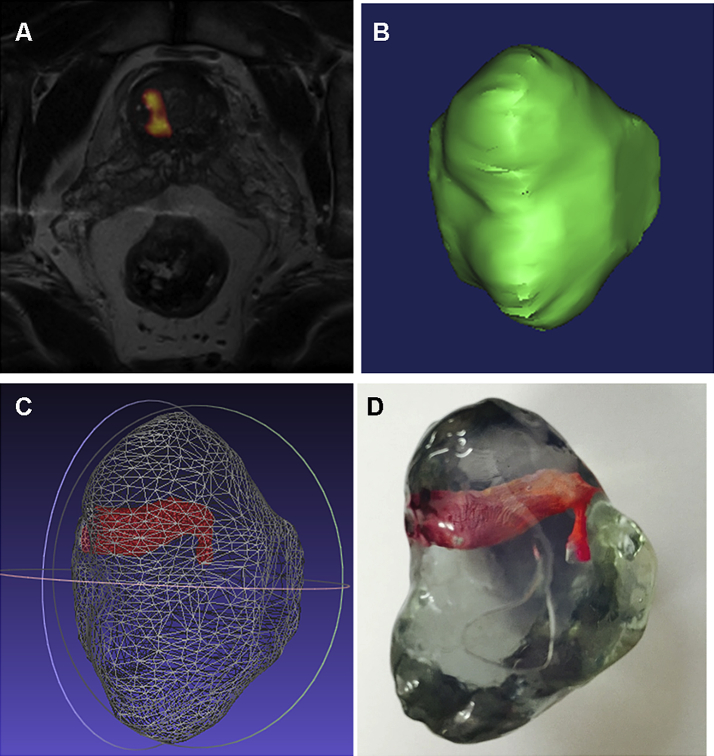
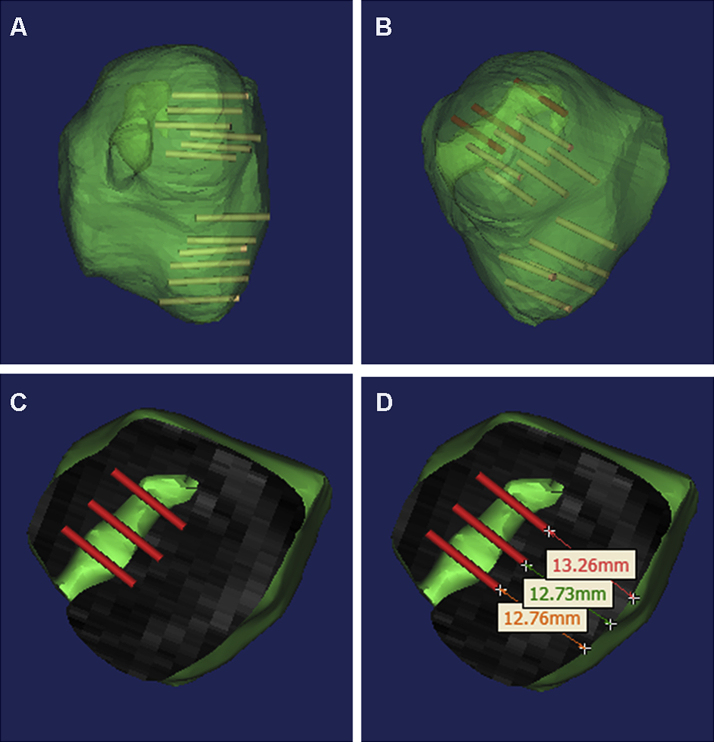
From August to December 2014, 16 patients with suspected prostatic lesions detected by multiparametric magnetic resonance imaging (MRI) were included. Targeted prostate biopsy was performed with the use of prostate 3D reconstruction modeling, computer-simulated biopsy, 3D printing, and cognitive fusion biopsy. All patients had received 3.0 T multiparametric MRI before biopsy. The DICOM MRI files were imported to medical imaging processing software for 3D reconstruction modeling to generate a printable .stl file for 3D printing with use of transparent resin as raw material. We further performed a targeted 2- to 3-core biopsy at suspected lesions spotted on MRI.
For the 16 patients in the present study, 3D modeling with cognitive fusion-based targeted biopsy was successfully performed. For a single patient, 1-2 lesions (average: 1.1 lesions) were discovered, followed by 2-6 cores (average: 2.4 cores) added as targeted biopsy. Systematic biopsies accounted for 192 cores in total, with a positive rate of 22.4%; targeted biopsies accounted for 39 cores in total, with a positive rate of 46.2%. Among these cases, 10 patients (62.5%) were diagnosed with prostate adenocarcinoma, in which seven were discovered by both systematic and targeted biopsy, one was diagnosed by systematic biopsy only, and two were diagnosed by targeted biopsy only. For systematic biopsy, Gleason score ranged from 6 to 8 (average: 7), while that for targeted biopsy ranged from 6 to 9 (average: 7.67). Among the seven patients that were diagnosed by both systematic and targeted biopsy, three (42.8%) were reported with a higher Gleason score in targeted therapy than in systematic biopsy.
3D printing-assisted cognitive fusion technique markedly promoted positive rate in prostate biopsy, and reduced missed detection in high-risk prostate cancer.
探讨三维(3D)打印辅助认知融合对提高前列腺穿刺活检阳性率的作用。
纳入2014年8月至12月间经多参数磁共振成像(MRI)检测出疑似前列腺病变的16例患者。采用前列腺三维重建建模、计算机模拟活检、3D打印及认知融合活检技术进行靶向前列腺穿刺活检。所有患者在穿刺活检前均接受了3.0T多参数MRI检查。将DICOM格式的MRI文件导入医学影像处理软件进行三维重建建模,生成可打印的.stl文件,以透明树脂为原材料进行3D打印。我们进一步对MRI上发现的可疑病变进行靶向2至3针穿刺活检。
本研究中的16例患者均成功进行了基于认知融合的靶向活检三维建模。单例患者发现1至2个病变(平均:1.1个病变),随后作为靶向活检增加2至6针(平均:2.4针)。系统活检共192针,阳性率为22.4%;靶向活检共39针,阳性率为46.2%。其中,10例患者(62.5%)被诊断为前列腺腺癌,其中7例通过系统活检和靶向活检均被发现,1例仅通过系统活检被诊断,2例仅通过靶向活检被诊断。系统活检的Gleason评分范围为6至8分(平均:7分),而靶向活检的Gleason评分范围为6至9分(平均:7.67分)。在通过系统活检和靶向活检均被诊断的7例患者中,3例(42.8%)报告靶向治疗中的Gleason评分高于系统活检。
3D打印辅助认知融合技术显著提高了前列腺穿刺活检的阳性率,并减少了高危前列腺癌的漏诊。