Sathyapalan Thozhukat, Javed Zeeshan, Rigby Alan S, Kilpatrick Eric S, Atkin Stephen L
Department of Academic Endocrinology, Diabetes, and Metabolism, Hull York Medical School, Hull HU3 2JZ, United Kingdom.
Department of Academic Cardiology, University of Hull, Hull HU3 2JZ, United Kingdom.
J Endocr Soc. 2017 Apr 3;1(5):423-430. doi: 10.1210/js.2016-1068. eCollection 2017 May 1.
Soy protein with isoflavones appears to have an adverse effect on thyroid function, but it is not known whether it is the protein or isoflavone component that is deleterious. The effect of isoflavone-free soy on thyroid function was determined in patients with subclinical hypothyroidism, with a secondary aim of assessing its effect on cardiovascular risk indices.
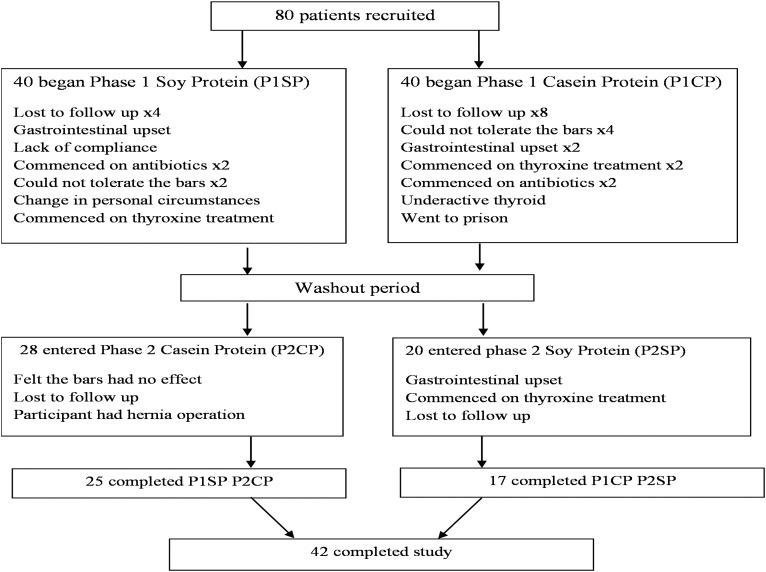
This was a randomized, double-blind, crossover study involving 80 patients with subclinical (compensated) hypothyroidism. Patients were randomly assigned to either isolated soy (isoflavone-free) protein (SP) or casein protein (CP) supplementation for 8 weeks, washed out for 8 weeks, and then crossed over for a further 8-week period.
Thyroid function was unaffected by either a SP or CP. There were significant decreases in fasting glucose (4.7 ± 0.6 vs 5.5 ± 1.4, < 0.01), insulin resistance (3.3 ± 3.0 vs 3.8 ± 3.4, = 0.05), total cholesterol (4.4 ± 0.9 vs 5.3 ± 1.2, < 0.01), triglycerides (0.9 ± 0.5 vs 1.7 ± 0.9, < 0.1), and highly sensitive C-reactive protein (hsCRP; 0.8 ± 0.7 vs 2.6 ± 2.8, < 0.01) in the SP group compared with the CP group. Blood pressure, low-density lipoprotein, and high-density lipoprotein remained unchanged in both groups.
SP alone had no effect on thyroid function in patients with subclinical hypothyroidism and resulted in a significant reduction in fasting glucose, insulin resistance, total cholesterol, triglycerides, and hsCRP compared with CP.
含异黄酮的大豆蛋白似乎对甲状腺功能有不良影响,但尚不清楚是蛋白质成分还是异黄酮成分有害。本研究测定了不含异黄酮的大豆对亚临床甲状腺功能减退患者甲状腺功能的影响,其次要目的是评估其对心血管风险指标的影响。
这是一项随机、双盲、交叉研究,纳入80例亚临床(代偿性)甲状腺功能减退患者。患者被随机分配接受分离大豆(不含异黄酮)蛋白(SP)或酪蛋白(CP)补充剂治疗8周,洗脱8周,然后交叉再进行8周治疗。
SP和CP对甲状腺功能均无影响。与CP组相比,SP组的空腹血糖(4.7±0.6对5.5±1.4,P<0.01)、胰岛素抵抗(3.3±3.0对3.8±3.4,P=0.05)、总胆固醇(4.4±0.9对5.3±1.2,P<0.01)、甘油三酯(0.9±0.5对1.7±0.9,P<0.1)和高敏C反应蛋白(hsCRP;0.8±0.7对2.6±2.8,P<0.01)显著降低。两组的血压、低密度脂蛋白和高密度脂蛋白均保持不变。
单独使用SP对亚临床甲状腺功能减退患者的甲状腺功能无影响,与CP相比,可显著降低空腹血糖、胰岛素抵抗、总胆固醇、甘油三酯和hsCRP。