
长链n-3和n-6多不饱和脂肪酸与心房颤动风险:一项丹麦队列研究的结果
Long-chain n-3 and n-6 polyunsaturated fatty acids and risk of atrial fibrillation: Results from a Danish cohort study.
作者信息
Mortensen Lotte Maxild, Lundbye-Christensen Søren, Schmidt Erik Berg, Calder Philip C, Schierup Mikkel Heide, Tjønneland Anne, Parner Erik T, Overvad Kim
机构信息
Department of Public Health, Section for Epidemiology, Aarhus University, Aarhus, Denmark.
Department of Cardiology, Aalborg AF Study Group, Aalborg University Hospital, Aalborg, Denmark.
出版信息
PLoS One. 2017 Dec 22;12(12):e0190262. doi: 10.1371/journal.pone.0190262. eCollection 2017.
BACKGROUND
Studies of the relation between polyunsaturated fatty acids and risk of atrial fibrillation have been inconclusive. The risk of atrial fibrillation may depend on the interaction between n-3 and n-6 polyunsaturated fatty acids as both types of fatty acids are involved in the regulation of systemic inflammation.
OBJECTIVE
We investigated the association between dietary intake of long chain polyunsaturated fatty acids (individually and in combination) and the risk of atrial fibrillation with focus on potential interaction between the two types of polyunsaturated fatty acids.
DESIGN
The risk of atrial fibrillation in the Diet, Cancer and Health Cohort was analyzed using the pseudo-observation method to explore cumulative risks on an additive scale providing risk differences. Dietary intake of long chain polyunsaturated fatty acids was assessed by food frequency questionnaires. The main analyses were adjusted for the dietary intake of n-3 α-linolenic acid and n-6 linoleic acid to account for endogenous synthesis of long chain polyunsaturated fatty acids. Interaction was assessed as deviation from additivity of absolute association measures (risk differences).
RESULTS
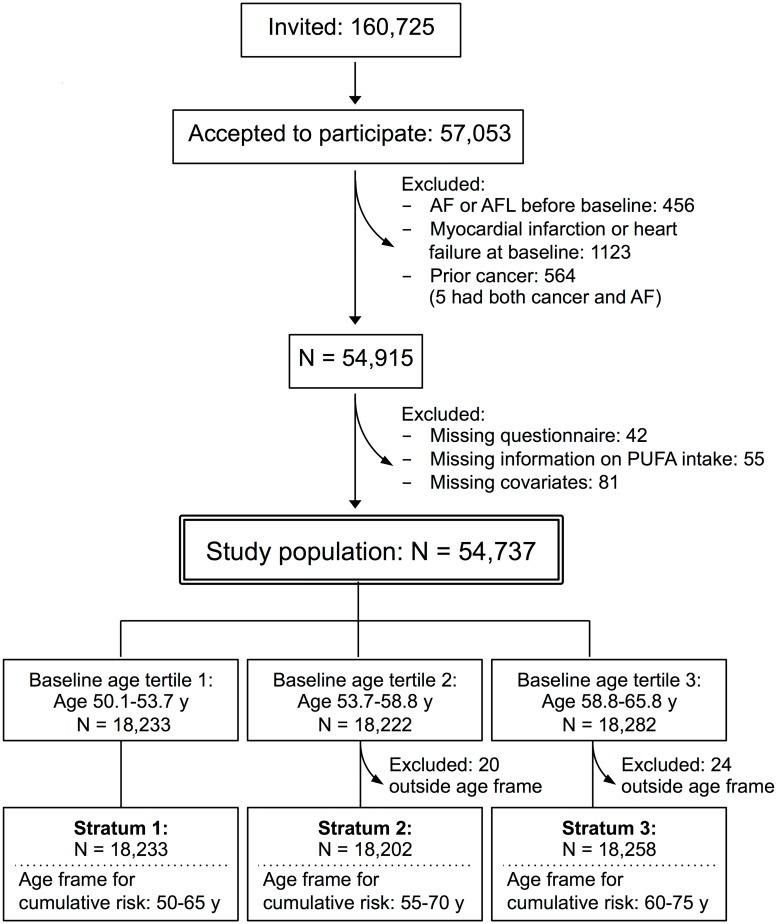
Cumulative risks in 15-year age periods were estimated in three strata of the cohort (N = 54,737). No associations between intake of n-3 or n-6 long chain polyunsaturated fatty acids and atrial fibrillation were found, neither when analyzed separately as primary exposures nor when interaction between n-3 and n-6 long chain polyunsaturated fatty acids was explored.
CONCLUSION
This study suggests no association between intake of long chain polyunsaturated fatty acids and risk of atrial fibrillation.
背景
关于多不饱和脂肪酸与心房颤动风险之间关系的研究尚无定论。心房颤动的风险可能取决于n-3和n-6多不饱和脂肪酸之间的相互作用,因为这两种脂肪酸都参与全身炎症的调节。
目的
我们研究了长链多不饱和脂肪酸的饮食摄入量(单独及联合)与心房颤动风险之间的关联,重点关注这两种多不饱和脂肪酸之间的潜在相互作用。
设计
采用伪观察法分析饮食、癌症和健康队列中心房颤动的风险,以探索累加尺度上的累积风险并提供风险差异。通过食物频率问卷评估长链多不饱和脂肪酸的饮食摄入量。主要分析对n-3α-亚麻酸和n-6亚油酸的饮食摄入量进行了调整,以考虑长链多不饱和脂肪酸的内源性合成。相互作用被评估为绝对关联测量值(风险差异)与可加性的偏差。
结果
在该队列的三个年龄层(N = 54,737)中估计了15年年龄期的累积风险。未发现n-3或n-6长链多不饱和脂肪酸的摄入量与心房颤动之间存在关联,无论是将其作为主要暴露因素单独分析,还是探索n-3和n-6长链多不饱和脂肪酸之间的相互作用时均未发现。
结论
本研究表明长链多不饱和脂肪酸的摄入量与心房颤动风险之间无关联。
 Zotero 插件