Institut d'Investigacions Biomèdiques August Pi i Sunyer (IDIBAPS), Barcelona, Spain; Department of Neurochemistry and Neuropharmacology, IIBB-CSIC (Consejo Superior de Investigaciones Científicas), Barcelona 08036, Spain.
Neurodegenerative Diseases Research Group, Vall d'Hebron Research Institute, Barcelona 08035, Spain; Centro de Investigación Biomédica en Red de Enfermedades Neurodegenerativas (CIBERNED), ISCIII, Madrid, Spain.
Mol Ther. 2018 Feb 7;26(2):550-567. doi: 10.1016/j.ymthe.2017.11.015. Epub 2017 Nov 29.
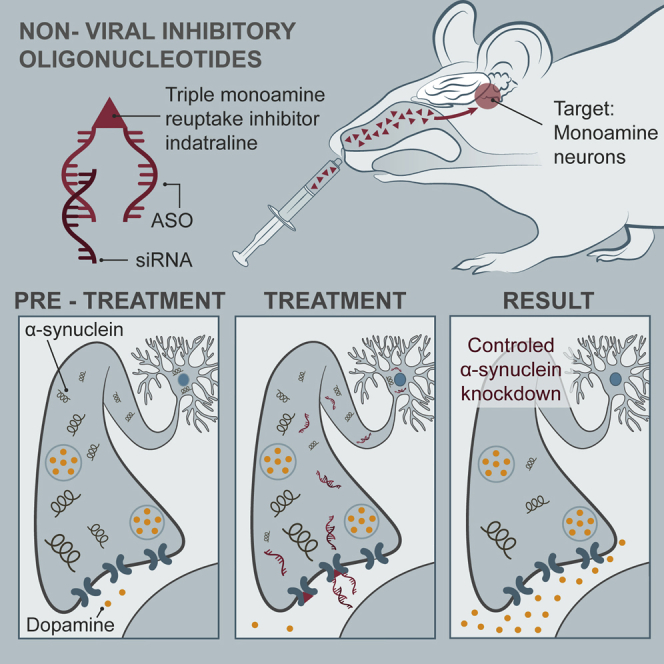
Progressive neuronal death in brainstem nuclei and widespread accumulation of α-synuclein are neuropathological hallmarks of Parkinson's disease (PD). Reduction of α-synuclein levels is therefore a potential therapy for PD. However, because α-synuclein is essential for neuronal development and function, α-synuclein elimination would dramatically impact brain function. We previously developed conjugated small interfering RNA (siRNA) sequences that selectively target serotonin (5-HT) or norepinephrine (NE) neurons after intranasal administration. Here, we used this strategy to conjugate inhibitory oligonucleotides, siRNA and antisense oligonucleotide (ASO), with the triple monoamine reuptake inhibitor indatraline (IND), to selectively reduce α-synuclein expression in the brainstem monoamine nuclei of mice after intranasal delivery. Following internalization of the conjugated oligonucleotides in monoamine neurons, reduced levels of endogenous α-synuclein mRNA and protein were found in substantia nigra pars compacta (SNc), ventral tegmental area (VTA), dorsal raphe nucleus (DR), and locus coeruleus (LC). α-Synuclein knockdown by ∼20%-40% did not cause monoaminergic neurodegeneration and enhanced forebrain dopamine (DA) and 5-HT release. Conversely, a modest human α-synuclein overexpression in DA neurons markedly reduced striatal DA release. These results indicate that α-synuclein negatively regulates monoamine neurotransmission and set the stage for the testing of non-viral inhibitory oligonucleotides as disease-modifying agents in α-synuclein models of PD.
脑干部位神经元渐进性死亡和广泛的α-突触核蛋白积累是帕金森病(PD)的神经病理学特征。因此,降低α-突触核蛋白水平是 PD 的一种潜在治疗方法。然而,由于α-突触核蛋白对神经元的发育和功能至关重要,α-突触核蛋白的消除将对大脑功能产生巨大影响。我们之前开发了共轭小分子干扰 RNA(siRNA)序列,这些序列在鼻腔内给药后可特异性靶向 5-羟色胺(5-HT)或去甲肾上腺素(NE)神经元。在这里,我们使用这种策略将抑制性寡核苷酸、siRNA 和反义寡核苷酸(ASO)与三重单胺再摄取抑制剂吲达曲林(IND)共轭,以在鼻腔内递送至小鼠后选择性降低脑干部位单胺核中的α-突触核蛋白表达。共轭寡核苷酸被单胺神经元内化后,在黑质致密部(SNc)、腹侧被盖区(VTA)、中缝背核(DR)和蓝斑核(LC)中发现内源性α-突触核蛋白 mRNA 和蛋白水平降低。α-突触核蛋白敲低约 20%-40%不会引起单胺能神经元退行性变,并增强前脑多巴胺(DA)和 5-HT 的释放。相反,DA 神经元中适度的人源α-突触核蛋白过表达显著降低纹状体 DA 的释放。这些结果表明,α-突触核蛋白负调节单胺能神经传递,并为在 PD 的α-突触核蛋白模型中测试非病毒抑制性寡核苷酸作为疾病修饰剂奠定了基础。