Department of Neurology, Charité Universitätsmedizin Berlin, Campus Mitte, Berlin, Germany.
Department of Neurology, Universitätsmedizin Greifswald, Greifswald, Germany.
J Neurol Neurosurg Psychiatry. 2018 Jun;89(6):586-592. doi: 10.1136/jnnp-2017-315962. Epub 2017 Dec 22.
Recent evidence has fuelled the debate on the role of massed practice in the rehabilitation of chronic post-stroke aphasia. Here, we further determined the optimal daily dosage and total duration of intensive speech-language therapy.
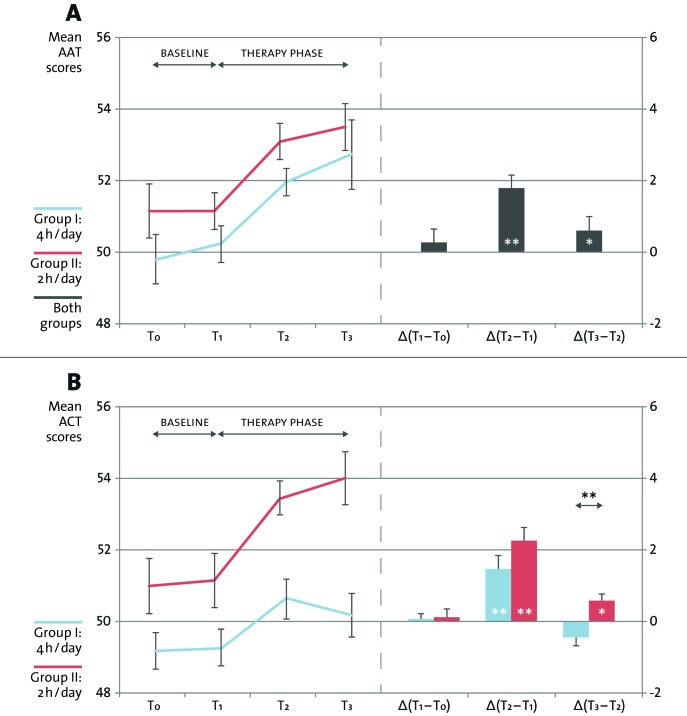
Individuals with chronic aphasia more than 1 year post-stroke received Intensive Language-Action Therapy in a randomised, parallel-group, blinded-assessment, controlled trial. Participants were randomly assigned to one of two outpatient groups who engaged in either highly-intensive practice (Group I: 4 hours daily) or moderately-intensive practice (Group II: 2 hours daily). Both groups went through an initial waiting period and two successive training intervals. Each phase lasted 2 weeks. Co-primary endpoints were defined after each training interval.
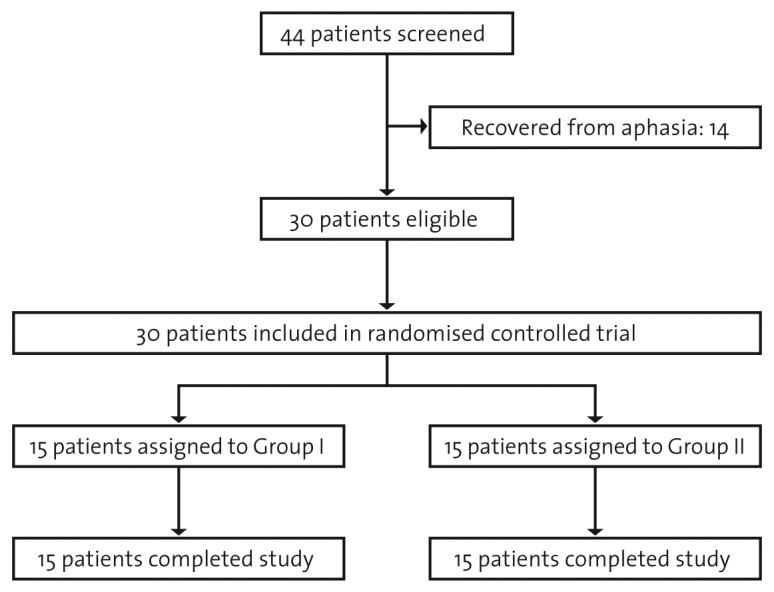
Thirty patients-15 per group-completed the study. A primary outcome measure (Aachen Aphasia Test) revealed no gains in language performance after the waiting period, but indicated significant progress after each training interval (gradual 2-week -score change [CI]: 1.7 [±0.4]; 0.6 [±0.5]), independent of the intensity level applied (4-week change in Group I: 2.4 [±1.2]; in Group II: 2.2 [±0.8]). A secondary outcome measure (Action Communication Test) confirmed these findings in the waiting period and in the first training interval. In the second training interval, however, only patients with moderately-intensive practice continued to make progress (Time-by-Group interaction: =0.009, =0.13).
Our results suggest no added value from more than 2 hours of daily speech-language therapy within 4 weeks. Instead, these results demonstrate that even a small 2-week increase in treatment duration contributes substantially to recovery from chronic post-stroke aphasia.
最近的证据加剧了关于密集练习在慢性卒中后失语症康复中的作用的争论。在这里,我们进一步确定了强化语言治疗的最佳每日剂量和总持续时间。
患有慢性失语症且发病时间超过 1 年的患者参加了一项随机、平行组、盲法评估、对照试验,接受强化语言-动作治疗。参与者被随机分配到两个门诊组中的一个,他们分别进行高度密集练习(组 I:每天 4 小时)或中度密集练习(组 II:每天 2 小时)。两组均经历初始等待期和两个连续的训练期。每个阶段持续 2 周。主要终点在每个训练期后定义。
30 名患者-每组 15 名-完成了研究。一项主要的结果测量(亚琛失语症测试)显示,在等待期后语言表现没有提高,但在每个训练期后都有显著的进展(渐进的 2 周-得分变化[CI]:1.7[±0.4];0.6[±0.5]),与应用的强度水平无关(第 1 组的 4 周变化:2.4[±1.2];在组 II:2.2[±0.8])。次要结果测量(行动沟通测试)证实了等待期和第一训练期的这些发现。然而,在第二训练期,只有接受中度密集练习的患者继续取得进展(时间与组之间的相互作用:=0.009,=0.13)。
我们的结果表明,在 4 周内每天进行超过 2 小时的语言治疗没有额外的价值。相反,这些结果表明,即使是治疗时间的微小 2 周增加,也会对慢性卒中后失语症的恢复有很大的贡献。