Mallorquí-Bagué Nuria, Fernández-Aranda Fernando, Lozano-Madrid María, Granero Roser, Mestre-Bach Gemma, Baño Marta, Pino-Gutiérrez Amparo Del, Gómez-Peña Mónica, Aymamí Neus, Menchón José M, Jiménez-Murcia Susana
1 Department of Psychiatry, University Hospital of Bellvitge-IDIBELL , Barcelona, Spain.
2 Ciber Fisiopatologia Obesidad y Nutrición (CIBERobn), Instituto Salud Carlos III , Madrid, Spain.
J Behav Addict. 2017 Dec 1;6(4):669-677. doi: 10.1556/2006.6.2017.078.
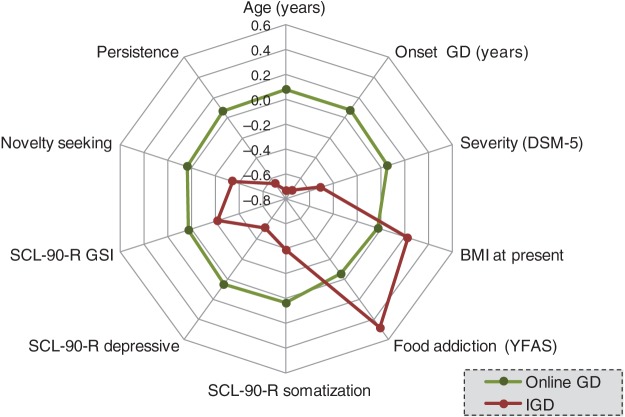
Background and aims The recent growth of Internet use has led to an increase of potentially problematic behaviors that can be engaged online, such as online gambling or Internet gaming. The aim of this study is to better conceptualize Internet gaming disorder (IGD) by comparing it with gambling disorder (GD) patients who only gamble online (online GD). Methods A total of 288 adult patients (261 online GD and 27 IGD) completed self-reported questionnaires for exploring psychopathological symptoms, food addiction (FA), and personality traits. Results Both clinical groups presented higher psychopathological scores and less functional personality traits when compared with a normative Spanish population. However, when comparing IGD to online GD, some singularities emerged. First, patients with IGD were younger, more likely single and unemployed, and they also presented lower age of disorder onset. In addition, they displayed lower somatization and depressive scores together with lower prevalence of tobacco use but higher FA scores and higher mean body mass index. Finally, they presented lower novelty seeking and persistence traits. Discussion GD is fully recognized as a behavioral addiction, but IGD has been included in the Appendix of DSM-5 as a behavioral addiction that needs further study. Our findings suggest that IGD and online GD patients share some emotional distress and personality traits, but patients with IGD also display some differential characteristics, namely younger age, lower novelty seeking scores and higher BMI, and FA scores. Conclusions IGD presents some characteristics that are not extensive to online GD. These specificities have potential clinical implications and they need to be further studied.
背景与目的 近期互联网使用的增长导致了一些可能在网上出现的问题行为的增加,如网络赌博或网络游戏。本研究的目的是通过将网络游戏障碍(IGD)与仅进行在线赌博的赌博障碍(GD)患者(在线GD)进行比较,来更好地界定IGD。方法 共有288名成年患者(261名在线GD患者和27名IGD患者)完成了自我报告问卷,以探究心理病理症状、食物成瘾(FA)和人格特质。结果 与西班牙正常人群相比,两个临床组均表现出更高的心理病理得分和更不良的人格特质。然而,在将IGD与在线GD进行比较时,出现了一些独特之处。首先,IGD患者更年轻,更可能单身且失业,并且他们的疾病发病年龄也更低。此外,他们的躯体化和抑郁得分较低,吸烟率也较低,但FA得分较高,平均体重指数也较高。最后,他们的寻求新奇和坚持特质较低。讨论 GD已被完全确认为一种行为成瘾,但IGD已被列入《精神疾病诊断与统计手册》第5版附录中作为一种需要进一步研究的行为成瘾。我们的研究结果表明,IGD和在线GD患者有一些共同的情绪困扰和人格特质,但IGD患者也表现出一些不同的特征,即年龄较小、寻求新奇得分较低、BMI和FA得分较高。结论 IGD呈现出一些在线GD中不存在的特征。这些特异性具有潜在的临床意义,需要进一步研究。