HIV Unit, Department of Internal Medicine and Infectious Diseases, Hospital Universitari Joan XXIII, IISPV, Universitat Rovira i Virgili.
Department of Electronic Engineering, Metabolomics Platform, Rovira i Virgili University, IISPV, Tarragona.
AIDS. 2018 Mar 13;32(5):565-573. doi: 10.1097/QAD.0000000000001730.
Poor immunological recovery in treated HIV-infected patients is associated with greater morbidity and mortality. To date, predictive biomarkers of this incomplete immune reconstitution have not been established. We aimed to identify a baseline metabolomic signature associated with a poor immunological recovery after antiretroviral therapy (ART) to envisage the underlying mechanistic pathways that influence the treatment response.
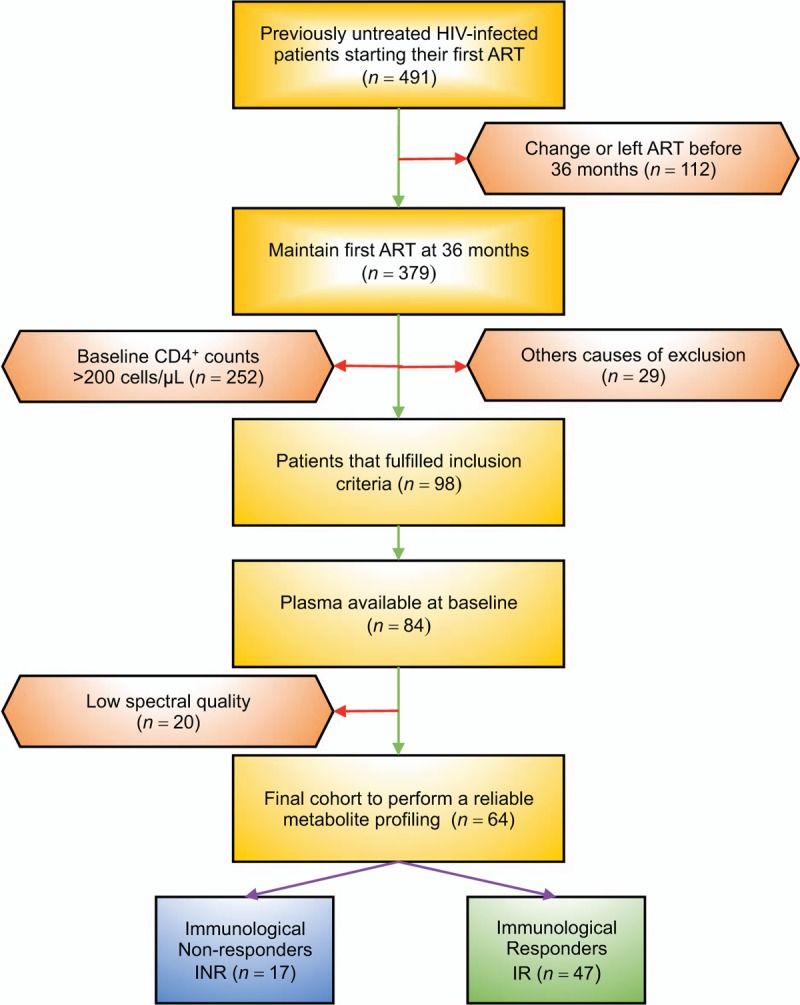
This was a multicentre, prospective cohort study in ART-naive and a pre-ART low nadir (<200 cells/μl) HIV-infected patients (n = 64).
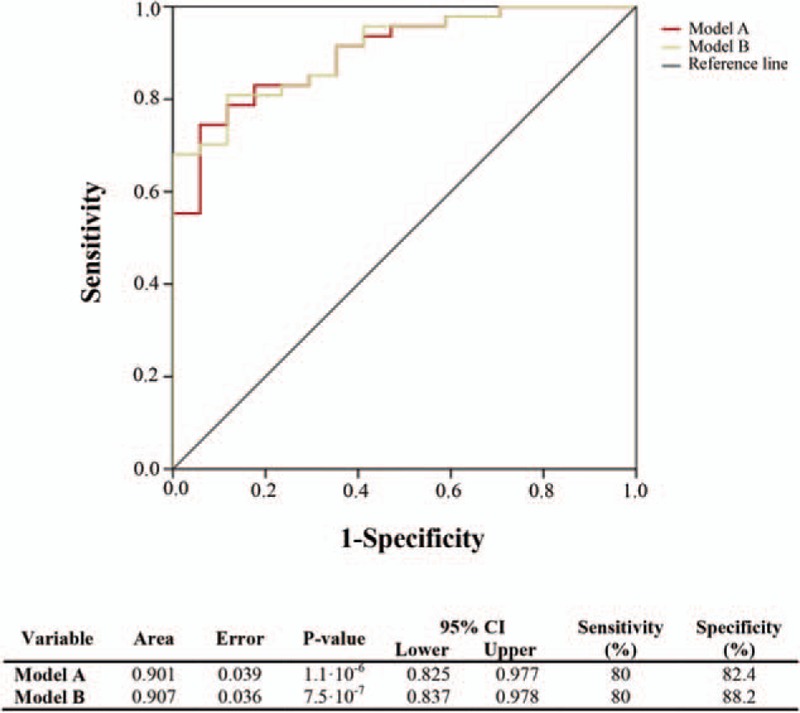
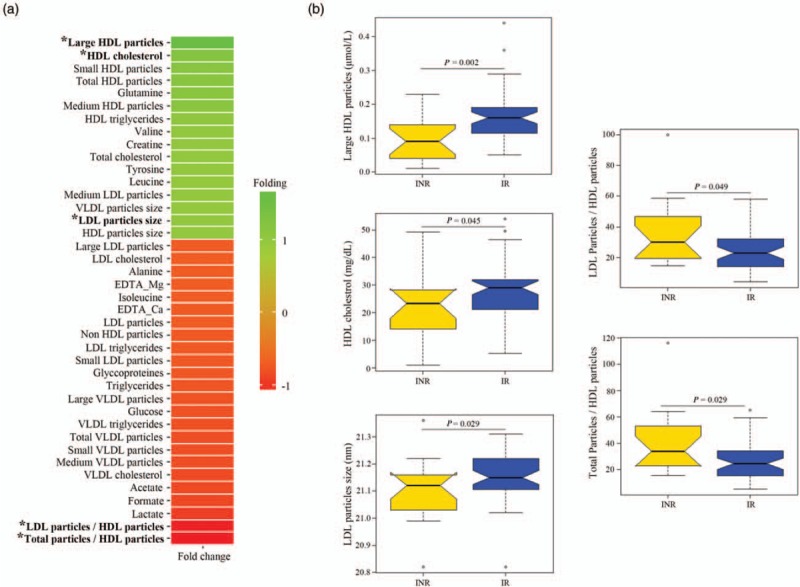
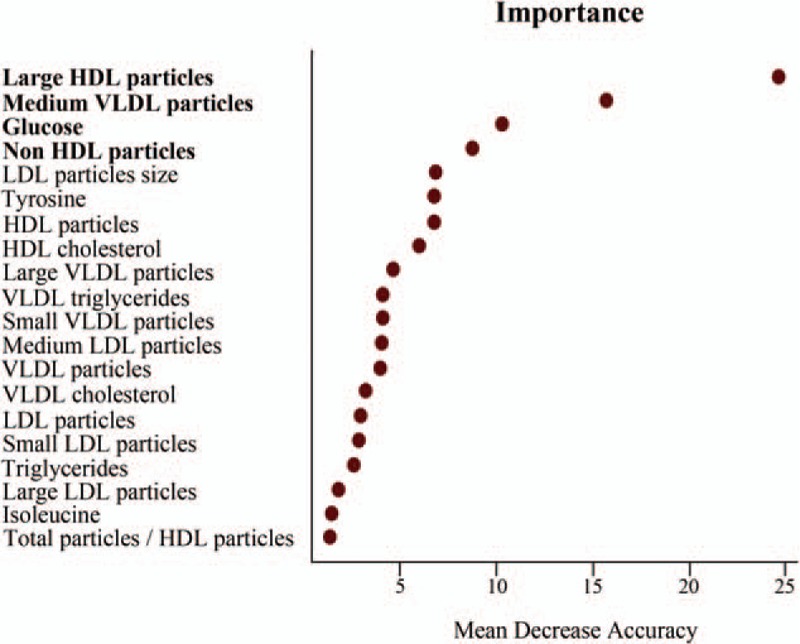
We obtained clinical data and metabolomic profiles for each individual, in which low molecular weight metabolites, lipids and lipoproteins (including particle concentrations and sizes) were measured by NMR spectroscopy. Immunological recovery was defined as reaching CD4 T-cell count at least 250 cells/μl after 36 months of virologically successful ART. We used univariate comparisons, Random Forest test and receiver-operating characteristic curves to identify and evaluate the predictive factors of immunological recovery after treatment.
HIV-infected patients with a baseline metabolic pattern characterized by high levels of large high density lipoprotein (HDL) particles, HDL cholesterol and larger sizes of low density lipoprotein particles had a better immunological recovery after treatment. Conversely, patients with high ratios of non-HDL lipoprotein particles did not experience this full recovery. Medium very-low-density lipoprotein particles and glucose increased the classification power of the multivariate model despite not showing any significant differences between the two groups.
In HIV-infected patients, a baseline healthier metabolomic profile is related to a better response to ART where the lipoprotein profile, mainly large HDL particles, may play a key role.
治疗后 HIV 感染患者免疫恢复不良与更高的发病率和死亡率相关。迄今为止,尚未确定这种不完全免疫重建的预测性生物标志物。我们旨在确定与抗逆转录病毒治疗 (ART) 后免疫恢复不良相关的基线代谢组学特征,以设想影响治疗反应的潜在机制途径。
这是一项针对初治和 ART 前低 nadir(<200 个细胞/μl)HIV 感染患者(n=64)的多中心前瞻性队列研究。
我们获得了每个个体的临床数据和代谢组学特征,其中通过 NMR 光谱法测量了低分子量代谢物、脂质和脂蛋白(包括颗粒浓度和大小)。免疫恢复定义为在病毒学上成功的 ART 后 36 个月达到 CD4 T 细胞计数至少 250 个细胞/μl。我们使用单变量比较、随机森林检验和接收者操作特征曲线来识别和评估治疗后免疫恢复的预测因素。
基线代谢模式特征为高水平大高密度脂蛋白 (HDL) 颗粒、HDL 胆固醇和低密度脂蛋白颗粒较大的 HIV 感染患者在治疗后具有更好的免疫恢复。相反,非 HDL 脂蛋白颗粒比值较高的患者则没有完全恢复。中等极低密度脂蛋白颗粒和葡萄糖增加了多变量模型的分类能力,尽管两组之间没有显示出任何显著差异。
在 HIV 感染患者中,基线更健康的代谢组学特征与更好的 ART 反应相关,其中脂蛋白谱,主要是大 HDL 颗粒,可能发挥关键作用。